
Key takeaways
THE SILENT LEAK
## What is the Due-Diligence Gap? The Due-Diligence Gap is Vista's framework for the unmeasured space between outreach engagement and a reply. A recipient becomes interested enough to investigate, but the business fails the legitimacy check. The recipient quietly closes the site, returns to the inbox, and never answers. The outreach dashboard records silence, even though the offer cleared its first test. This gap matters because it reverses the usual diagnosis. Weak replies are commonly treated as evidence that the list, subject line, or offer is wrong. Those may be wrong. But when the message creates curiosity and the trust surface cannot carry it, changing the message only sends more people into the same leak.The Due-Diligence Gap. A Vista framework for the silent conversion loss that occurs when an engaged outreach recipient investigates your site, social presence, and legitimacy before replying, finds insufficient trust, and leaves without creating a trackable outbound event.
THE BLIND SPOT
## Why does your outbound dashboard miss the failure? Because the trust check happens outside the reporting path. The dashboard can show delivery, an open, a click, or a reply when those events are available. It cannot reliably show that someone searched your name, opened a profile, scanned the homepage, noticed an old page, and decided not to continue. The most important negative event never fires. That absence creates a seductive story: people opened but did not reply, so the copy must need another rewrite. The team adjusts the subject line, sharpens the call to action, and sends again. Better copy may increase curiosity, but it also increases the number of prospects reaching a trust surface that still cannot support the promise. > A missing reply is an outcome, not a diagnosis. Operators we work with often discover the blind spot by reenacting the buyer's path. They read the message on a phone, search the sender, open the site, and ask what they would believe without inside knowledge. That short walk reveals gaps no campaign report can name.THE PROSPECT VIEW
## What does a prospect actually check before replying? A prospect checks for continuity. Does the business they find look like the business that contacted them? Is there a real person attached to the claim? Does the activity look current? Can they understand what happens next without decoding a vague page? The review is quick, but it is not careless. They are not usually conducting a formal audit. They are reducing uncertainty. A strong trust surface makes the outreach claim easier to believe. A weak one adds small contradictions: a precise message linked to a generic homepage, an expert claim with no visible expert, or an active pitch attached to an abandoned presence. | What prospects check | What kills the reply | The minimum fix | |---|---|---| | Whether the site matches the outreach claim | The homepage describes a different or vague business | Align the headline, offer, and language with the promise in the message | | Whether a real person stands behind the message | No credible name, face, role, or point of view is visible | Publish a clear person page with an honest role and relevant perspective | | Whether the business appears active | Broken pages, stale copy, or an obviously neglected presence | Repair dead ends and show current, substantive activity | | Whether the offer has substance | Assertions appear without a process, example, or clear boundary | Explain how the work proceeds and what the offer does and does not cover | | Whether the next step feels safe | Contact details are unclear or the commitment feels too large | Offer a clear, low-friction next step with accurate expectations | The minimum fix is not a giant brand project. It is continuity across the places a reasonable prospect will inspect. Polish helps only after the claim, person, activity, substance, and next step agree with one another.THE MINIMUM SURFACE
## What trust surface must exist before you scale sends? Build enough evidence to answer the prospect's immediate questions without requiring faith. The minimum surface is compact, but it must be real. It should make the business legible, the sender identifiable, the offer plausible, and the next step safe. - **A claim that matches the outreach.** The homepage should complete the sentence started in the message. If the pitch names a specific operating problem, the site cannot retreat into broad language about helping businesses grow. - **A visible, credible person.** Show who is writing, what role that person holds, and the perspective behind the offer. A prospect should not have to investigate whether the sender exists. - **A substantive explanation of the work.** Describe the problem, the method, the boundary, and what participation requires. Specific process language is more useful than stacks of adjectives. - **A sign of active stewardship.** Remove broken paths, unfinished pages, and stale promises. The surface should feel owned by someone who is paying attention now. - **A low-friction next step.** Make the response path obvious and proportionate. A cold prospect should not have to commit deeply merely to learn whether a conversation fits. This is where restraint matters. Do not invent testimonials, inflate experience, or manufacture activity to fill the page. Thin truth is more durable than rich fiction. If proof is still limited, state the offer precisely, show the real operator, and explain the process clearly. Legitimacy comes from coherence, not decoration.The minimum trust surface. A claim that matches the message, a real person, a substantive explanation, signs of active stewardship, and a safe next step. Build these elements before volume, then deepen the surface as the outreach teaches you which questions prospects carry.
ONE SYSTEM
## Why are outbound and brand trust the same system? They are one system because the prospect does not experience them as separate stages. The inbox creates interest. The site and social presence answer whether that interest is safe to act on. The reply occurs only after both parts have done their jobs. Treating brand as a later project ignores the order in which the buyer encounters the evidence. Outbound creates a promise under pressure. It asks for attention from someone who did not request the conversation. That makes the trust surface more important, not less. Warm referrals arrive carrying borrowed credibility. Cold messages arrive carrying a question: who are you, and why should I believe this? Across the advisory work we do, the strongest correction is often alignment rather than expansion. The operator does not need more channels. The existing message, site, and person need to tell one coherent story. Once they do, outbound feedback becomes more useful because silence is less likely to be caused by a basic legitimacy failure.THE REAL CONSTRAINT
## Where is the real constraint when replies stay low? The constraint may sit upstream of the send button. Under Vista's [real-constraint lens](https://www.vistaadvisinggroup.com/insights/how-to-find-the-real-constraint-in-your-business), the useful question is what would have to change for the result to improve. If a better-qualified prospect would still investigate and hesitate, list quality is not the whole answer. If a clearer message would still land on a contradictory site, copy is not the whole answer either. Run the diagnosis by holding the message constant and walking the evidence path. Does the homepage support the exact claim? Can the recipient verify the sender without detective work? Does the business appear alive? Is the next step clear? A failure at any of these points sits before reply conversion, even if the campaign tool cannot display it. The [Vista matchmaking thesis](https://www.vistaadvisinggroup.com/matchmaking) applies here too: fit becomes easier to judge when both the need and the operator are legible. Outreach should not try to manufacture certainty in a short message. Its job is to earn investigation. The trust surface must then make the right next conversation feel reasonable.THE DIAGNOSIS
## How can you tell whether trust is the leak? Start with a manual review before adding more tracking. Ask someone unfamiliar with the business to follow the recipient's likely path from message to search to site. Have that person narrate where confidence rises, where it drops, and what remains unverified. You are looking for contradictions and missing evidence, not a design critique. Then compare the promise with the proof. If the message claims a focused capability but the site only offers generalities, fix the site. If the person is invisible, make the person legible. If the business appears unattended, repair the signs of neglect. Do not use this review to excuse a weak list or offer. It isolates one possible leak so the next outbound test means something. The diagnostic is strongest when the reviewer can say what killed the reply in plain language. “I could not tell who was behind this” is actionable. “It did not feel premium” is not. Specific hesitation points can be repaired and tested without turning the work into an endless rebrand.QUESTIONS
## Frequently asked questions ### What is a trust check in cold outreach? A trust check is the informal investigation an interested recipient performs before replying. The person may review your site, sender identity, social presence, activity, offer, and contact path. The goal is not exhaustive verification. It is deciding whether the outreach claim is coherent enough and the next interaction is safe enough to continue. ### Why do good open rates still produce weak replies? An open only shows that the message received attention. The offer may still be wrong, the list may still be weak, or an interested prospect may fail to verify the sender after reading. When investigation ends in doubt, no reply appears. Reenact the full prospect path before assuming the copy is the only problem. ### Does a business need a complete brand before outbound? No. It needs a minimum trust surface, not a complete brand system. The site should match the outreach claim, identify a real person, explain the work, appear actively maintained, and offer a clear next step. Those elements create coherence. Deeper proof and richer content can grow as real conversations reveal what prospects need. ### Can social presence replace a business website? Usually it should not carry the whole trust burden. A social profile can make the sender visible and show current thinking, while a business site can explain the claim, process, boundaries, and next step in one owned place. The important standard is continuity: every surface should support the same honest story rather than create contradictions. ### How should a team fix the Due-Diligence Gap? Map the path from message to investigation, then repair the first point where belief breaks. Align the homepage with the pitch, make the sender visible, remove signs of neglect, explain the offer, and lower the friction of the next step. Resume volume only when an unfamiliar reviewer can follow that path without unresolved legitimacy questions.THE SEQUENCE
## What is the sequencing rule for trust and outbound? Build the minimum trust surface first or build it simultaneously with a small outreach test. Never plan to add trust after volume. Scaling sends before the evidence path works does not merely waste attention. It teaches the market to associate your name with a claim that cannot yet survive inspection.The sequencing rule. If an engaged prospect cannot verify the claim, the person, the activity, the substance, and the next step, do not increase outbound volume. Repair the trust surface first. If those elements are coherent, scale carefully and use real objections to decide what the surface needs next.
Key takeaways
THE REAL PROBLEM
## Why do most AI-written SOPs get ignored? Most AI-written SOPs fail because they describe a clean, imagined version of the work that nobody actually does. The model produces a tidy numbered list, it reads well, and it skips the messy real steps, the exceptions, and the "obvious" knowledge that lives only in the doer's head. So the document looks finished and stays useless. In the engagements we run, the pattern is almost always the same. Someone asks a general AI assistant to "write an SOP for onboarding a client." The output is fluent and generic. It misses the field on the form everyone fudges, the two-day wait nobody documents, and the one approval that actually gates the whole thing. The team reads it once and goes back to doing the work the way they always have. > A generic SOP describes a process you wish you had, not the one you run. That gap is the whole problem. The value of an SOP is that it captures reality precisely enough that a new person can repeat it. Fluency is not the same as accuracy, and an SOP built from the model's imagination is fluent and wrong in exactly the places that matter.The core mistake. Teams ask AI to invent the process from a one-line prompt. The fix is to capture how the work is really done first, then ask AI to structure that capture, not to imagine the steps for you.
THE METHOD
## What actually makes AI good at this? What makes AI fast and reliable for SOPs is feeding it a real capture of the work plus your context, not a one-line request. This is Vista's Agent-Does-the-Work principle. The AI does the heavy lifting of structuring and writing, while you supply the reality and keep the judgment. The model is the drafter. You are still the author. Two of our other frameworks do the load-bearing work here. Context-as-Moat says the AI's output is only as good as the context you give it, so a recording of an actual run beats any prompt you could type. Good-Enough-For-You says the target is an SOP that works for your team and your tools, not a polished template that would impress a stranger. A document that gets followed beats a document that gets praised. Put together, the method is simple. Capture the truth, hand it to the AI with your specifics, let it draft, then verify and have the doer sign off. The steps below turn that into a repeatable run you can do in an afternoon.BEFORE YOU START
## What you will need A short setup makes the rest fast. Gather these before you write a single step.What you will need
THE STEPS
## How do you write the SOP, step by step? Follow these six steps in order. Each one is a small action plus the reason it matters, so you can adapt it without losing the point. 1. Capture the real process. Record a screen-share of an actual run, transcribe a session where the doer narrates each click, or have them walk through it out loud while you capture the words. Why it matters: this capture is the single thing that separates a useful SOP from a generic one. Everything downstream inherits its truth or its fiction. 2. Feed the capture to the AI with your context. Paste the recording transcript or your notes into the assistant, then add the specifics it cannot know: the exact tool names, the field that always trips people up, who owns each handoff, and where approvals gate the flow. Why it matters: the model has general knowledge of your category and zero knowledge of your reality. Context is what closes that gap. 3. Ask it to draft the SOP in your format. Tell it the structure you want, a title, a purpose line, prerequisites, numbered steps, owners, and an exceptions section, and have it write the SOP from the capture. Why it matters: a consistent format means people can scan any SOP the same way, and asking for your format up front saves a full reformatting pass later. 4. Verify the draft against reality and cut the invented steps. Read it next to the actual process, not for fluency. Delete any step the AI added that does not happen, fix any it got subtly wrong, and add the unspoken steps the capture missed. Why it matters: this is where you catch the confident hallucinations. A wrong step in an SOP is worse than a missing one, because people trust it and act on it. 5. Have the doer bless and refine it. Hand the corrected draft to the person who actually does the job and ask them to run it as written. Whatever they trip on gets fixed. Why it matters: the bless step is what turns a document about the work into a document the team owns. People follow the SOP they helped confirm, and they quietly ignore the one dropped on them. 6. Store it where the work already happens. Put the SOP in the tool the team already opens to do the task, linked from the workflow, not buried in a drive nobody visits. Why it matters: an SOP that lives where the work happens gets used and updated. One that lives in a forgotten folder is dead on arrival, no matter how good it is.THE PAYOFF
## Where does the time actually get saved? The time savings land in the drafting and formatting, which is real, but the quality comes entirely from the human steps around it. The AI collapses an hour of writing and structuring into a few minutes. The capture and the bless are what make those minutes worth keeping. Skip them and you have just generated a useless document faster. This is the honest version of the AI promise for operators. The model is genuinely good at turning a messy transcript into a clean, structured document in your format. It is genuinely bad at knowing which steps are real. So you let it do the part it is good at and you keep the part it cannot do, which is knowing your reality and carrying the accountability. In the engagements we run, the operators who get durable value from AI on documentation are not the ones with the cleverest prompts. They are the ones who built the habit of capturing the real process first and routing every draft through the person who does the work. That habit is the asset. The tool underneath it can change next quarter and the method still holds.SCALING IT
## How do you turn one good SOP into a system? Turn one good SOP into a system by reusing the capture-draft-verify-bless loop for every recurring process and keeping the documents close to the work. Once the loop is a habit, each new SOP gets faster, because the team already knows how to capture and the AI already knows your format and context. The compounding part is the context you build along the way. Every SOP you produce this way teaches you what to capture and gives the AI a richer picture of how your business runs. That accumulated context is the moat. A competitor can copy your template in an afternoon. They cannot copy the captured reality of how your specific team actually does the work. If you want to build this loop with other operators and get live help applying it to your own processes, the [Vista AI Collective](/collective) is where we work through exactly this kind of operator-grade AI use, hands on, every week. You can also sit in on a session first at the free [Vista AI Lab](/workshops/ai-lab) to see the method before you commit to anything.COMMON QUESTIONS
## Frequently asked questions **How is this faster than just writing the SOP myself?** You skip the slowest parts, the blank page and the formatting, while keeping the parts that matter. The AI turns your captured run into a clean structured draft in minutes. You spend your time verifying and refining instead of typing from scratch. The net is a better document in less time, because creation is slower than review. **What if I cannot record the process live?** Narration works almost as well as a recording. Have the person who does the job talk through every step out loud while you capture the words with voice-to-text, or write the steps down in plain language as they describe them. The point is a faithful account of the real process. A recording is convenient, but an honest narration is what actually matters. **Why does the doer have to bless it if I already verified it?** Because you verify against your understanding, and they verify against the reality of doing it. You will catch invented steps and obvious errors. They will catch the small thing you both assumed and the exception that only shows up on a real run. The bless step also creates ownership, and people follow the SOP they helped confirm. **Will the AI just hallucinate steps that are not real?** Yes, sometimes, which is exactly why step four exists. Models add plausible-sounding steps that do not happen in your process, especially when your capture is thin. Reading the draft against the real process, not for how well it reads, is how you catch them. Treat every step as a claim to confirm, not a fact to trust. **Do I need a special SOP tool or app for this?** No. A general AI assistant you already use is enough to draft and format. The advantage is in the method, the real capture and the human bless, not in any dedicated software. Add a documentation tool only when you have enough SOPs that storage and search become the bottleneck, and store them where the work already happens. **How do I keep the SOP from going stale?** Store it where the work happens and update it the next time the process changes, not on a calendar. When someone hits a step that no longer matches reality, they fix it on the spot or flag it. An SOP that lives next to the workflow gets corrected as a byproduct of use. One in a forgotten folder rots quietly until it misleads someone. ### Why You Should Record Every Business Call: Four Payoffs URL: https://www.vistaadvisinggroup.com/insights/why-record-every-business-call Published: 2026-07-22 Updated: 2026-07-17 Author: Logan Henderson Topic: Using AI Summary: A searchable call archive can protect the business, improve handoffs, sharpen sales coaching, and train new hires from proven examples. Markdown: # Why You Should Record Every Business Call: Four Payoffs Record every field and sales call you can properly disclose and capture. Once an AI transcriber makes those conversations searchable, each recording can protect the business, improve the handoff, sharpen coaching, and train new people. The file stops being dead storage and becomes a working knowledge asset.Key takeaways
THE CORE IDEA
## What changes when business calls become searchable? Searchability changes a recording from a file you might replay into a source you can query. A manager no longer has to remember which call contained the unusual scope condition or scrub through audio to find it. The transcript can surface commitments, objections, names, dates expressed in words, site details, and next actions in seconds. That distinction matters because most recordings once had a single practical use: settle a disagreement after something went wrong. AI adds extraction. The same conversation can now produce a fulfillment brief, a coaching note, and a training example without asking a person to listen from beginning to end each time.Four-Purpose Recording. Vista's framework for treating each properly disclosed field or sales call as four assets at once: dispute protection, a sales-to-fulfillment handoff, coaching on real objections, and a library of best-call examples for onboarding. AI performs the first extraction; a person approves anything that changes customer commitments or operating instructions.
PAYOFF ONE
## How does recording protect you when memories differ? The first payoff is a clean record of what the customer and representative actually said. It does not prevent every dispute, but it replaces competing recollections with a reviewable source and helps the business respond calmly. ### Operator scenario A project is underway when a customer says a particular repair was included. The salesperson remembers describing it as a possible add-on, while the production lead received only the signed scope. Instead of turning the disagreement into a contest of confidence, the manager finds the call and checks the relevant passage. ### What the AI layer extracts The transcriber can surface the mentions of the repair, pull the nearby context, and summarize whether it was promised, excluded, or left unresolved. It can also flag language that sounds like a commitment for human review. The manager still listens to the source passage before making a customer-facing decision. ### The habit that makes it work Attach recordings and transcripts to the customer record, then use a consistent naming convention that includes the account and conversation stage. When a scope dispute appears, search the transcript before asking people to reconstruct the call. Keep the original audio so the transcript never becomes the only evidence.PAYOFF TWO
## How does a transcript improve the sales-to-fulfillment handoff? The second payoff is a more complete handoff built from the customer's own specifics. Sales notes usually capture the headline. The call contains the conditions, preferences, constraints, and expectations that determine whether fulfillment feels seamless. ### Operator scenario A salesperson closes a complex job after discussing access, sequencing, decision makers, finish preferences, and one condition that could change the schedule. The operations team receives a short note and a signed scope. The missing details surface only when a crew arrives and asks questions the customer believes were already answered. ### What the AI layer extracts AI can draft a structured handoff with scope details, access instructions, stated preferences, unresolved questions, risks, and promised follow-ups. It can separate confirmed facts from possible interpretations and link each important item to the underlying transcript. That turns the handoff into a review task instead of a blank-page writing task. ### The habit that makes it work Use the same handoff template for every qualified sale, and require the salesperson to approve it before fulfillment receives it. This is Vista's **agent-does-the-work model** in a practical form: the agent extracts and organizes; the accountable person checks nuance and blesses the output. > The transcript should shorten the handoff, not remove ownership of it.PAYOFF THREE
## How does recording make sales coaching more honest? The third payoff is coaching based on what prospects actually ask and how representatives actually respond. Role-play has value, but it often rehearses tidy objections. Real calls reveal the hesitation, confusion, and mixed signals that make selling difficult. ### Operator scenario A sales leader hears that the team keeps losing deals because prospects are price sensitive. A review of calls shows a different pattern. Representatives explain the service well, but they rush past questions about timing, disruption, or who will be on site. The stated diagnosis was price; the observed coaching need is confidence around delivery. ### What the AI layer extracts The system can cluster recurring objections, retrieve representative responses, and compare strong and weak moments across calls. It can draft a coaching brief with the objection, the response used, what happened next, and a better question to test. No invented role-play is required. ### The habit that makes it work Review a small, consistent call set in each coaching cycle. Choose examples by sales stage and objection type, then have the manager verify context before giving feedback. Operators we work with get more value when review is routine and developmental, not a surprise investigation triggered by a missed target.PAYOFF FOUR
## How do recordings become an onboarding library? The fourth payoff is a library that shows new hires what good sounds like in your business. A script teaches approved language. A strong call demonstrates pacing, discovery, judgment, and how an experienced person adapts without losing the process. ### Operator scenario A new representative reads the playbook and can repeat the service explanation, but struggles when a prospect gives an incomplete answer. The manager assigns a few approved call excerpts that show skilled follow-up across different situations. The new hire can hear the difference between interrogating a prospect and helping one think. ### What the AI layer extracts AI can tag calls by stage, objection, service line, and teaching point. It can suggest excerpts where a behavior appears clearly, then draft a short note explaining what the learner should notice. A manager selects the examples because a successful outcome alone does not make every moment exemplary. ### The habit that makes it work Promote recordings into the library deliberately. Add a short reason for inclusion, remove stale examples, and pair each excerpt with a reflection question. The library should teach principles through evidence, not become a folder of long calls labeled good.THE OPERATING SYSTEM
## What workflow turns four possible payoffs into routine value? Use one capture process and four downstream views. The recording is the source, the transcript is the searchable layer, and each output has a named owner. This keeps the archive from becoming another tool that collects data without changing work. | Purpose | AI drafts | Human gate | Operating habit | |---|---|---|---| | Dispute protection | Relevant passages and commitment language | Manager verifies audio and decides the response | Store source audio with the customer record | | Fulfillment handoff | Scope, preferences, risks, open questions, follow-ups | Salesperson confirms the handoff | Approve before operations accepts the job | | Sales coaching | Objection clusters and response examples | Leader checks context and coaches the behavior | Review a consistent call set | | Onboarding library | Tags, excerpts, and suggested teaching notes | Manager approves exemplary calls | Curate and retire examples deliberately | Start with one conversation type that already affects several teams. Define the disclosure language, storage location, retention practice, and access rules. Then create the four views above before adding more call sources. A searchable mess is still a mess. Across the AI implementation work we do, the strongest designs put a **human-in-the-loop gate** at the point where an extraction becomes a commitment, instruction, evaluation, or training standard. People should not retype what the agent can extract. They should spend their attention on meaning, exceptions, and approval. If you want to build this kind of operating habit with peers, the [Vista AI Cohort](https://www.vistaadvisinggroup.com/collective) is designed around applied operator work. You can also bring a workflow to the [free AI Lab](https://www.vistaadvisinggroup.com/workshops/ai-lab), or use Vista's [advisor matchmaking process](https://www.vistaadvisinggroup.com/matchmaking) when implementation needs an experienced operator beside the team.THE BOUNDARY
## What should you settle before recording calls? Settle disclosure, consent, access, retention, and customer sensitivity before making recording automatic. Consent and notification norms vary by region, channel, and context. This article is not legal advice, and it does not replace guidance for the places and situations in which your business operates. Plain disclosure is the sound default. Tell participants that the call is being recorded, explain the practical purpose in ordinary language, and provide another path when recording is inappropriate. Do not hide the practice inside a long script or treat a transcript as permission to circulate a conversation widely. Limit access by purpose. A fulfillment lead may need the approved handoff without needing every sales call. A coach may need selected excerpts without broad customer records. Capture should create useful knowledge with clear stewardship, not an internal surveillance habit.QUESTIONS
## Frequently asked questions ### Should every business call literally be recorded? Record calls that your business can properly disclose, capture, secure, and use. Some conversations are too sensitive or context dependent for routine recording. The principle is not blind collection. It is consistent capture where appropriate, paired with clear notice, limited access, purposeful retention, and a usable downstream workflow. ### Is an AI transcript reliable enough to settle a dispute? Treat the transcript as a search layer, not the final authority. It can find the likely passage and organize surrounding context quickly, but names, technical terms, and overlapping speech can be wrong. A responsible manager checks the original audio before deciding what was promised or communicating a resolution. ### What should the sales-to-fulfillment handoff include? A useful handoff includes confirmed scope, customer priorities, access details, timing conditions, decision makers, stated preferences, risks, unresolved questions, and promised follow-ups. It should distinguish facts from interpretations and link important points to the transcript, so the salesperson can verify the draft before operations relies on it. ### How many calls belong in an onboarding library? Quality and coverage matter more than volume. Keep enough approved excerpts to demonstrate the main stages, recurring objections, and judgment calls a new hire will face. Give every example a teaching purpose, review the set as the offer changes, and retire calls that no longer represent the process. ### Does recording remove the need for managers to review calls? No. AI reduces search, transcription, tagging, and first-draft work. Managers still decide what a commitment means, what behavior deserves coaching, and which examples represent the standard. The useful division is simple: let the agent prepare the evidence, then let an accountable person approve the consequential interpretation.NEXT STEP
## Make one conversation pay off four times Choose one repeatable call type and map its four outputs. Decide who reviews disputes, who approves handoffs, who coaches from excerpts, and who curates onboarding examples. Then make the transcript arrive where those people already work. The point is not to build a larger archive. It is to stop throwing away the operational value already present in your conversations. With disclosure, sensible controls, and human approval at the right moments, one call can keep helping long after everyone hangs up. ### Operator Advisor vs Traditional Consultant: What Is the Real Difference? URL: https://www.vistaadvisinggroup.com/insights/operator-advisor-vs-traditional-consultant Published: 2026-07-22 Updated: 2026-06-26 Author: Logan Henderson Topic: Choosing an Advisor Summary: An operator advisor runs the function and stays until the metric moves. A consultant diagnoses and exits. How SMB founders decide which one they actually need. Markdown: # Operator Advisor vs Traditional Consultant: What Is the Real Difference? An operator advisor is someone who has personally run the function they now advise on, so they work inside your constraints and stay until a metric moves. A traditional consultant studies the problem from outside, then delivers a recommendation and exits. The difference is accountability for the result, not the quality of the slides.Key takeaways
DEFINITIONS
## What is an operator advisor, and how is it different? An operator advisor carries scar tissue. They have hired and fired for the role, missed a target, fixed the system, and lived with the consequences. That history changes the advice. They tend to share these traits: - They have held real P&L or functional ownership, not just a client roster. - They prescribe the smallest change that moves the metric, because they have paid for the big ones. - They stay through implementation instead of leaving at the recommendation. - They speak in tradeoffs and sequencing, not frameworks for their own sake. - They are comfortable being wrong in public and correcting fast. A traditional consultant is valuable for a different reason. They bring breadth, benchmark data, and an outside read when you are too close to the problem. The work is analysis, and the deliverable is a documented recommendation you then have to execute yourself.The real-constraint lens. Before prescribing anything, name the one constraint actually limiting the business right now. Most advice fails because it improves something that was never the bottleneck.
THE MARKET
## Why does this distinction matter more now? It matters because founders are buying more outside help than ever, and a lot of it never converts into a result. Consulting is a large and growing category, which means more options and more noise for a small team trying to pick well.estimated size of the global management consulting market, a signal of how crowded the advice market has become for buyers. sourceIBISWorld · 2024
SIDE BY SIDE
## Operator advisor vs traditional consultant: the decision table The short verdict: hire the operator when execution is the bottleneck and the consultant when a clean outside diagnosis is. The two are not better or worse in the abstract. They are built for different jobs, and the decision dimensions below make that concrete. | Decision dimension | Traditional consultant | Operator advisor | |---|---|---| | Primary work | Outside analysis and a diagnosis | Hands-on execution and ownership | | What you keep | A documented recommendation | A moved metric and the system behind it | | Stays through execution | No, exits at the recommendation | Yes, until the number moves | | Best when | You need a neutral one-time read | Execution is the actual bottleneck | | Accountable for the result | You and your team | The advisor, by design | A traditional consultant sits between these lanes. They give you more than a tool and less ongoing ownership than an operator. For a one-time audit, that is exactly right. For a problem you have to actually fix, it usually is not. > The deck tells you what is wrong. The operator stays until it is right.ACCOUNTABILITY
## Who actually owns the outcome? The single clearest test is ownership. Ask each candidate what happens if the metric does not move. A consultant typically points to the recommendation and the implementation you ran. An operator advisor treats a flat metric as their problem to diagnose and re-solve. This is the build-not-watch principle in practice. The right advisor does not narrate your dashboard from the sidelines. They get into the work, change one thing, watch the result, and adjust. In the engagements we run, the advisors who add the most value are the ones who are slightly uncomfortable being paid before anything has shipped.
THE TRADEOFF
## What does each option really cost you? The honest answer: every option has a real price, and the cheapest sticker is rarely the cheapest outcome. A subscription tool costs little and asks everything of your attention. A consultant costs a defined fee and leaves you holding execution. An operator advisor costs more upfront and absorbs the execution risk. Here is how the three common paths compare, set against a generic consultant and a fractional-only hire, with the matched approach as the contrast.Generalist consultant
outside diagnosis
Fractional-only hire
borrowed seniority
Vista Advising Group
matched operator dose
YOUR CALL
## How do you decide which one you need? Decide by naming your actual bottleneck first, then matching the help to it. If you are missing information or a neutral read, a consultant or an audit is the efficient buy. If you know the goal but execution keeps stalling, you need an operator in the work with you. **Choose an operator advisor if:** the goal is clear but the result is not moving, you need someone accountable through implementation, and the constraint is execution rather than insight. **Choose a traditional consultant if:** you need a one-time diagnosis, an outside benchmark, or a documented recommendation you and your team will execute internally. In the engagements we run, the most common mistake is buying the wrong category for the right problem. Founders hire a consultant for an execution problem, get a good deck, and stay stuck. Naming the constraint before choosing the helper prevents almost all of it. ## Frequently asked questions ### Is an operator advisor the same as a fractional executive? Not quite. A fractional executive sells you a slice of senior time on an ongoing basis. An operator advisor is scoped to a specific outcome and stays until that metric moves, then steps back. There is overlap, but the operator advisor is defined by accountability for a result, not by a recurring seat on your team. ### When is a traditional consultant the better choice? When the problem is genuinely informational. If you need a market read, a neutral audit, a benchmark against peers, or a documented strategy your own team will execute, a consultant is efficient and appropriate. The trouble starts when you hire that diagnostic model for an execution problem, because execution is exactly what the model is not built to own. ### How do I tell if someone is a real operator or just rebranded? Ask what they personally owned and what broke on their watch. Real operators answer with specifics, including failures and the fixes. Then ask what happens if your metric does not move. If the answer points back at you, you are likely buying analysis. If they treat it as their problem to re-solve, that is the operator signal. ### Does an operator advisor cost more than a consultant? Usually more per hour and often less per result. A consultant bills a defined project and leaves execution to you, so a flat outcome still costs you the full fee plus your team's time. An operator engagement is priced against the result, which means the spend is tied to the thing you actually wanted to change in the first place. ### What if I am not sure which one I need? Start by naming the single constraint limiting the business right now, in one sentence. If that sentence is about not knowing something, lean consultant. If it is about something stalling that you already understand, lean operator. When the constraint is genuinely unclear, a short matched conversation is cheaper than guessing and buying the wrong category. ### How to Cut AI Costs With Model Routing URL: https://www.vistaadvisinggroup.com/insights/how-to-cut-ai-costs-with-model-routing Published: 2026-07-21 Updated: 2026-07-17 Author: Logan Henderson Topic: Using AI Summary: Route routine AI work to small models and reserve frontier capability for building and reasoning with Vista's Tiered-Model Cost Discipline. Markdown: # How to Cut AI Costs With Model Routing Cut AI costs by routing work according to the capability it actually needs. Let a small, cheap model handle wake-ups, glue, status checks, and orchestration. Reserve frontier models for building and difficult reasoning. The durable fix is a written routing protocol, not asking operators to make a fresh cost decision every time they send a prompt.Key takeaways
THE CORE IDEA
## What is Tiered-Model Cost Discipline? Tiered-Model Cost Discipline is Vista's framework for assigning each AI task to the least expensive model tier that can complete it reliably. Small models own coordination work. Frontier models own the building and reasoning work where capability changes the quality of the result. The point is not to minimize the cost of every prompt. It is to stop paying for capability a task cannot use. The distinction fades when a workflow moves quickly. An operator opens the strongest model for a hard problem, gets a good result, and leaves every later prompt in the same thread. Convenience quietly becomes the routing policy.Tiered-Model Cost Discipline. A Vista framework that routes wake-ups, glue, status prompts, and orchestration to a small, cheap model while reserving frontier models for building and complex reasoning. The objective is reliable work at the right capability tier, not cheap output at any cost.
THE HIDDEN LEAK
## Why does AI spend become invisible? AI spend becomes invisible when prompt habit substitutes for task classification. The operator has a model open, so every request goes there. Nothing breaks loudly. The system simply buys frontier capability for tasks that needed memory, formatting, or a handoff. Status prompts are the cleanest example. “Keep going,” “check whether the file exists,” and “summarize the last action” do not become better because a frontier model handles them. Neither does moving structured output between tools or waking a paused process. Yet these prompts often inherit the model selected for the hardest step nearby. > The expensive habit is not using a frontier model. It is using one without a reason. Operators we work with usually see the pattern once they draw the workflow rather than inspect isolated prompts. The large reasoning step is visible and defensible. The chain of small coordination steps around it is diffuse. Tiered routing makes those edges explicit, where they can be assigned deliberately.THE SETUP
## What will you need before you route model work? You need a task inventory, a plain-language definition of each model tier, an owner for exceptions, and a small set of quality checks. Do not begin with a complicated scoring system. Begin with enough shared language that two operators would route the same task the same way.What you'll need. A list of recurring AI tasks, access to a small model and a frontier model, a place to record routing defaults, representative test inputs, an acceptance check for important outputs, and a named human who can approve exceptions.
THE PROTOCOL
## How do you build a model-routing protocol? Build the protocol in the order below. Each step turns a judgment that currently lives in an operator's head into an operating default that the whole team can inspect. 1. **Inventory recurring AI tasks in plain language.** Capture the jobs that repeat across a normal workflow, including the tiny prompts between visible deliverables. Name the input, the expected output, and what happens next. Include wake-ups, file checks, formatting, summaries, tool handoffs, drafting, synthesis, and decision support. **Why it matters:** You cannot route work you have not named. The small prompts are easy to omit because no one considers them deliverables, but they are exactly where frontier usage spreads without a capability reason. 1. **Classify each task by the capability it requires.** Ask whether the job needs retrieval, transformation, coordination, generation, or complex reasoning. Then note the consequence of a weak answer. A task with a simple output and an easy retry belongs in a different class from one that shapes a customer decision or a system design. **Why it matters:** Task labels prevent importance from being confused with difficulty. A message can be important but mechanically simple. A short prompt can require deep judgment. Routing improves when capability and consequence are assessed separately. 1. **Set the small model as the default coordination lane.** Send wake-ups, keep-going prompts, status checks, structured extraction, formatting, routing decisions, and tool orchestration to the cheap tier. Give it clear schemas and narrow instructions. Escalate only when it encounters an exception the protocol already names. **Why it matters:** Defaults beat willpower. If every operator must remember to downgrade a routine prompt, convenience will eventually win. A structural small-model lane makes cost discipline the normal path through the system. 1. **Reserve frontier models for building and difficult reasoning.** Route architecture, nuanced synthesis, ambiguous diagnosis, high-stakes drafting, and work that must integrate competing constraints to the stronger tier. State why the frontier tier is required in the task definition, so the exception is legible rather than habitual. **Why it matters:** The goal is not universal cheapness. Frontier capability is valuable when the work can absorb it. Protecting that lane gives demanding tasks the attention they need without letting nearby coordination inherit the same cost. 1. **Install acceptance checks and escalation triggers.** Define what a passing output looks like for each class. Let simple tasks use deterministic checks such as required fields or a successful handoff. Give complex work a human-in-the-loop gate that reviews reasoning, assumptions, and the decision before it moves forward. **Why it matters:** Routing without evaluation is guesswork. Clear acceptance checks let the small model own routine work confidently, while escalation triggers catch the cases where apparent simplicity hides ambiguity or risk. 1. **Review exceptions and update the routing map.** Record where the small tier failed, where the frontier tier added no meaningful value, and where operators bypassed the default. Change the task class or instruction when a pattern repeats. Keep one-off surprises as exceptions until they become a real category. **Why it matters:** A routing protocol is an operating system, not a poster. Actual failures show where the classification or guardrail is weak. Review turns those failures into better defaults instead of permanent fear about using the cheaper tier. This sequence reflects Vista's agent-does-the-work model: the system handles the repeatable operating work, while a person blesses the judgments that deserve human accountability. Model routing is the same division applied inside the AI stack.THE ROUTING MAP
## Which tasks belong in each model tier? Route by cognitive demand and cost of failure, not by how polished the request sounds. The table is a starting map. Your acceptance checks and escalation rules should decide the boundary in your own workflow. | Task pattern | Default tier | Minimum control | |---|---|---| | Wake-up, keep-going, or status prompt | Small model | Confirm the next action or current state | | Formatting, extraction, or schema conversion | Small model | Validate required fields and output shape | | Tool handoff or workflow orchestration | Small model | Confirm the handoff completed and preserve context | | Routine summary with clear source material | Small model | Check coverage against the supplied material | | New build with interacting requirements | Frontier model | Review the design and test the result | | Ambiguous diagnosis or competing evidence | Frontier model | Inspect assumptions and reasoning with a human gate | | Decision support with meaningful consequences | Frontier model | Keep the accountable person at the approval point | This map also exposes false economy. A task can appear routine but contain unresolved ambiguity. If a summary must reconcile conflicting evidence, it is no longer simple compression. If orchestration must decide which business rule applies, it may have crossed into reasoning. Route the actual job, not the familiar verb in its prompt.THE QUALITY CLIFF
## When should you refuse the cheaper tier? Refuse it when the work depends on deep context, multi-step reasoning, novel construction, or a judgment whose error will propagate. The quality cliff on hard work is real. Sending demanding work to a small model can create confident gaps, brittle builds, and a review burden larger than the token savings. This is the honest counterweight to cost discipline. Cheap models are not a moral preference, and frontier models are not an indulgence. They are different tools. The wrong cheap route produces rework, repeated prompts, and delayed decisions. It can cost more while delivering less. Across the AI operating work we do, the best signal is not output length. It is how many constraints the task must hold at once. A short architecture choice can demand more capability than a long formatting job. The [real-constraint lens](https://www.vistaadvisinggroup.com/insights/how-to-find-the-real-constraint-in-your-business) keeps the question honest: is model cost actually blocking the workflow, or is weak task definition creating waste at every tier?THE OPERATING RHYTHM
## How do you keep routing discipline from fading? Put routing ownership into the workflow. Name who can change a default, where exceptions are recorded, and when the map gets reviewed. A protocol that no one owns will decay into personal preference, especially when a deadline makes the strongest model feel like the safest shortcut. Treat the map as a learning asset. When a small model fails, diagnose the task class, instruction, and acceptance check. When a frontier model handles routine work, ask why the default was bypassed. The answer may reveal a broken handoff. Teams that want to practice this operating rhythm can use Vista's [free AI Lab](https://www.vistaadvisinggroup.com/workshops/ai-lab) to work through a real workflow, or go deeper on the full operating pattern inside the [AI Cohort](https://www.vistaadvisinggroup.com/collective). If the harder question is which operator should help design the system, [matchmaking for an operator advisor](https://www.vistaadvisinggroup.com/matchmaking) connects the work to someone who can own the implementation with you.QUESTIONS
## Frequently asked questions ### What is model routing for AI work? Model routing is the practice of assigning each AI task to a capability tier before execution. Routine coordination, formatting, and status work defaults to a small model. Building and complex reasoning default to a frontier model. A useful routing system also defines acceptance checks, escalation triggers, and an owner for exceptions. ### Should every routine prompt use a small model? No. Routine appearance is not the same as low cognitive demand. A familiar summary can still require reconciling conflicting evidence, and a tool handoff can contain a meaningful business decision. Use the small tier when the output is bounded, testable, and easy to retry. Escalate when ambiguity or consequence rises. ### How do I know when a frontier model is worth using? Use a frontier model when the work must hold many interacting constraints, reason through ambiguity, construct something novel, or support a consequential decision. The tier earns its place when stronger capability materially changes the result. Record that reason in the routing map so frontier use remains intentional rather than automatic. ### Can model routing reduce quality? Yes, if hard work is mis-routed to a cheaper tier. The likely result is missing reasoning, brittle output, and expensive rework. Quality stays protected when routing includes acceptance checks and escalation triggers. Cost discipline means using the least expensive tier that is reliable, not simply choosing the cheapest available model. ### Where should a team start with model routing? Start with one recurring workflow and inventory every AI task inside it, especially status prompts and handoffs. Classify each task by required capability and consequence of failure. Set a small-model default for coordination, reserve the frontier tier for hard work, then review exceptions after the workflow has run in practice.NEXT MOVE
## Make the routing decision before the prompt The durable savings come from removing the repeated choice. This week, map one workflow and mark every task as coordination or building and reasoning. Set the small tier as the coordination default, name the escalation trigger, and protect the frontier lane for work that can use it. That is Tiered-Model Cost Discipline in operation. ### What Are the Red Flags When Hiring a Business Advisor? URL: https://www.vistaadvisinggroup.com/insights/red-flags-hiring-a-business-advisor Published: 2026-07-21 Updated: 2026-06-26 Author: Logan Henderson Topic: Choosing an Advisor Summary: The biggest red flags hiring a business advisor are patterns, not firms: selling before diagnosing, no operating experience, hourly billing, and dependence. Markdown: # What Are the Red Flags When Hiring a Business Advisor? The clearest red flags are patterns, not firms. Watch for an advisor who sells before diagnosing your constraint, one who has never operated the thing they advise on, and one who will not tell you when you do not need them. The throughline is simple: good advisory builds your capability and ends, while bad advisory manufactures dependence.Key takeaways
HOW TO READ THIS
## How should you use this list? Treat each item as a question to ask, not a verdict to fear. A single yellow flag is normal. Two or three stacked together, especially the first two, is your signal to slow down. Score the advisor against the pattern, not against how the meeting felt. Each red flag below follows the same shape. First the flag itself. Then why it matters for your money and your time. Then what good looks like instead, so you know what you are actually steering toward.THE RED FLAGS
## 1. They sell before they diagnose your constraint This is the biggest one. If the pitch arrives before anyone has understood what is actually slowing your business down, you are buying a product the advisor already wanted to sell. The diagnosis was skipped because it might have pointed somewhere else. **Why it matters.** Most stalled businesses are bottlenecked by one thing at a time. Pricing, a broken sales motion, a hiring gap, an owner doing work only the owner can do. An advisor who sells a fixed package before finding that one thing is optimizing for their catalog, not your result. **What good looks like instead.** A real advisor spends the first conversation finding the constraint before naming a solution. At Vista we call this the Real-Constraint Lens: identify the single binding limit first, then decide whether advisory is even the right tool for it. You can see how this shapes engagements on our [advisory matchmaking page](/matchmaking). ## 2. They have never actually operated the thing they advise on Beware the advisor whose entire career is advising. Frameworks are easy to recite. Knowing which one breaks under real pressure, with a real payroll and a real angry customer on the line, only comes from having been on the hook for the outcome. **Why it matters.** Operators can tell within minutes whether someone has done the work. Advice that never survived contact with reality tends to be clean, generic, and wrong in the specifics that matter to you. > Theory is cheap. Scar tissue is the credential. **What good looks like instead.** Ask what they personally built or ran, what broke, and what they would do differently. A strong advisor answers with specifics and owns their mistakes. The matchmaking thesis we work from is that fit beats brand: the right operator-advisor for your exact problem matters more than a famous logo. ## 3. They will not tell you when you do NOT need them A trustworthy advisor will sometimes talk you out of the engagement. If you ask "do I even need this right now" and the answer is always an enthusiastic yes, the incentive is pointing the wrong way. **Why it matters.** The advisor who never says no is selling their availability, not your progress. Sometimes the honest answer is "fix your pricing first and call me in a quarter." An advisor who cannot say that is one you cannot fully trust on the harder calls either. **What good looks like instead.** Watch for the person who scopes you out of work, defers an engagement, or hands you a free fix and walks away. That restraint is the strongest buy signal there is. If your problem is not an advisory problem at all, our [team can point you to the right next step](/work-with-us) rather than sell you a retainer. ## 4. They price by billable time instead of outcome or dose When the invoice tracks hours rather than results, the advisor is paid more the longer your problem takes. That is a misaligned incentive baked directly into the contract. **Why it matters.** Billable-hour pricing quietly rewards slow work, scope creep, and meetings that exist to be billed. You wanted a result. You are paying for time. Those are not the same purchase, and the gap between them is where budgets disappear.The test. Ask the advisor to tie their fee to a defined outcome or a fixed dose of work with a clear end. If they can only price by the hour, ask why the result cannot be named.
THE DECISION RULE
## How do you weigh all of this? Use one rule. Good advisory builds your capability and ends. Bad advisory manufactures dependence. Almost every red flag above is a different expression of that single split, and you can score most advisors against it inside two conversations. The table below maps each flag to the dependence-versus-capability test, so you can run it quickly.| Red flag | What it really signals | The capability test |
|---|---|---|
| Sells before diagnosing | Selling a catalog, not your result | Did they find your constraint first? |
| Never operated it | Reciting theory, not experience | Were they personally on the hook? |
| Never says you can skip them | Selling availability, not progress | Will they scope themselves out? |
| Prices by the hour | Paid more the longer it takes | Is the fee tied to an outcome? |
| Keeps you dependent | Building reliance, not muscle | Does your team get more capable? |
| References are logos | Proxy proof, not owned results | What did they personally move? |
| Promises certainty | Sales tactic, not a forecast | Do they name the assumptions? |
| Vague about the ending | Optimized to renew | Is the exit defined on day one? |
FREQUENTLY ASKED QUESTIONS
## Frequently asked questions ### What is the single biggest red flag when hiring a business advisor? Selling before diagnosing your constraint. If the advisor pitches a package before anyone has identified what is actually slowing your business down, they are optimizing for their catalog, not your result. A real advisor finds the binding limit first, then decides whether advisory is even the right tool for it. ### Should I avoid advisors who price by the hour? Hourly billing is a yellow flag, not an automatic no. The concern is incentive: hourly pricing pays the advisor more the longer your problem persists. Prefer outcome-based or fixed-dose pricing where you know what done looks like before you start. If they can only bill by the hour, ask why the result cannot be named. ### How do I tell if an advisor has real operating experience? Ask what they personally built or ran, what broke, and what they would do differently now. Operators answer with specifics and own their mistakes. Career advisors tend to answer in clean, generic frameworks. The advice that has never survived contact with a real payroll usually fails in exactly the details that matter to you. ### Are client logos and credentials a good way to vet an advisor? They are weak proof. Logos tell you who hired the firm, not what changed for those clients, and not whether this specific advisor drove that change. Credentials are proxies, and proxies get gamed. Ask instead for outcomes the advisor was personally on the hook for, described in plain before-and-after terms. ### Is it a bad sign if an advisor talks me out of hiring them? It is one of the best signs. An advisor who will scope you out of work, defer an engagement, or hand you a free fix is showing you their incentive points at your progress, not their invoice. The advisor who always says you need them is selling availability, and that bias colors their harder judgments too. ### How should the end of an advisory engagement be defined? On day one. A trustworthy advisor names what success looks like, how you will both know it is solved, and how the engagement winds down. Open-ended retainers with no exit criteria tend to continue by default rather than by need. A clear ending signals the advisor is selling progress, not permanence. ### The Two-Clock Problem: What to Build While You Wait for Approval URL: https://www.vistaadvisinggroup.com/insights/the-two-clock-problem Published: 2026-07-20 Updated: 2026-07-17 Author: Logan Henderson Topic: What's Stuck Summary: You cannot rush regulators, but waiting forfeits your window. The Two-Clock Problem: build a fast-clock wedge that pays now and feeds the approval endgame. Markdown: # The Two-Clock Problem: What to Build While You Wait for Approval The stalled default in approval-paced ventures is waiting: heads down on the application while revenue, audience, and proof all wait for the slow clock to strike. It is the wrong move. You cannot compress a regulator, and waiting forfeits a window that moves at technology speed. The answer is a wedge product built on the fast clock.Key takeaways
THE PATTERN
## What is the two-clock problem? The two-clock problem is a speed mismatch inside one venture. Your main play runs on an approval-paced clock: regulators, licensing boards, certification bodies, an acquisition working toward close, an enterprise procurement committee. Your opportunity runs on a technology-paced clock, where the capability that makes the play valuable gets cheaper and more crowded every quarter. We named this pattern the Two-Clock Problem because the two clocks fail differently, and most founders plan for only one of them. It shows up anywhere a gatekeeper sits between a venture and its market. A diagnostic waiting on clinical clearance. A lending product waiting on a state-by-state licensing run. A data platform waiting on a government security certification. A rollup thesis waiting on its first close. Different arenas, same shape: the thing that makes the venture big cannot ship until a slow external process finishes, and the thing that makes it timely will not wait for that process.The Two-Clock Problem. A Vista framework for ventures whose main play is approval-paced while their opportunity is technology-paced. The slow clock cannot be compressed, and waiting on it forfeits the window. The resolution is a wedge product on the fast clock: near-term tooling or services that monetize the window and feed the endgame instead of competing with it.
THE STALLED DEFAULT
## Why is waiting out the slow clock the wrong move? Because waiting spends the clock you control on the clock you do not. The slow clock is genuinely incompressible. Review queues, licensing boards, and procurement committees run at their own pace, and pushing them rarely helps and often costs credibility you will want later. That half of the founder's diagnosis is correct. The mistake is the conclusion drawn from it: that since the main play cannot ship yet, the company should hold its breath. While you hold your breath, three things keep moving. The capability behind your opportunity commoditizes, because technology-paced advantages always do. Adjacent players who need no approval occupy the ground floor of the market and set buyer expectations. And your runway converts into nothing but elapsed time: no revenue, no customer contact, no data, a team rehearsing a launch instead of learning from one. > The slow clock cannot be compressed. The fast clock will not wait for it. In the engagements we run in approval-paced spaces, the waiting team is rarely idle. It is busy with the filing, busy with investors, busy polishing a launch plan. Busy is what makes this default so comfortable. But none of that motion compounds, because all of it is aimed at a date someone else controls.THE REAL CONSTRAINT
## Is the approval really what is stuck? Usually not, and this is where the diagnosis earns its keep. Slow is not the same as stuck. Under [the real-constraint lens](https://www.vistaadvisinggroup.com/insights/how-to-find-the-real-constraint-in-your-business), the question is never what hurts. It is what would have to change for the pain to stop. Run that question here and the approval falls away quickly: if the clearance, the license, or the signed contract landed tomorrow, would you be ready to win with it? For most two-clocked ventures the honest answer is no. There is no audience to announce to. There is no revenue engine to pour the approval into, and no operating history that makes the newly permitted thing credible. The approval would land on an empty stage. That is the real constraint, and it has nothing to do with the queue: the venture has no fast-clock asset. Three signs you have misnamed the constraint: - **Every plan starts the day the approval lands.** Nothing in the company compounds before that date. - **The approval is the whole moat.** Take it away and nothing about the venture would be hard to copy. - **Progress updates describe the queue.** Reporting covers where the file sits, not what the business built. Across the advisory work we do in these spaces, this rename is often the entire first conversation. A founder arrives blocked on a regulator and leaves owning a different problem: what to build while the regulator does its job. That version has the useful property of being solvable this quarter.THE WEDGE
## What should you build on the fast clock? A wedge product: a near-term offer that sells now and builds exactly the assets the slow-clock endgame will need. Not a pivot, and not a side hustle. A deliberate first product whose job is to monetize the window and stock the shelves for the approved play. The shape varies by arena. Tooling for the workflow your endgame will eventually own. A productized service built on the expertise the approval will later let you apply at scale. Readiness and preparation offers for others stuck behind the same slow clock. A lighter tier of the product that stays outside the regulated perimeter. The form matters less than the tests it must pass. - **It monetizes now.** Real customers paying real money on a sales cycle measured in weeks, not on the approval's timeline. If it cannot produce revenue before the slow clock strikes, it is a second bet, not a wedge. - **It feeds the endgame.** Every customer, proof point, and dataset the wedge produces should be one the approved play inherits. You are building the audience, credibility, and data the endgame needs, and getting paid to do it. - **It never trains the market against the endgame.** If the wedge teaches buyers they do not need the approved product, or anchors your pricing so low the main play cannot recover, you are competing with your own future. Kill that wedge and pick another. One boundary is non-negotiable: the wedge stays outside the regulated perimeter. You are monetizing the window around the approval, never the activity that requires it. Held to that line, the wedge also strengthens the eventual application, because the file now describes a real company with real customers rather than a bet in a holding pattern.THE MAP
## Which wedge fits your situation? Match the wedge to the clock you are stuck behind. The table maps the common approval-paced situations to a wedge shape that fits and the asset it hands the endgame. | While the slow clock runs on | A wedge that fits | What it feeds the endgame | |---|---|---| | Regulatory clearance for a product | Tooling, education, or readiness services for the same buyer the cleared product will serve | A warm buyer list and trust in the exact channel the cleared product ships into | | A license or charter | Operate as a vendor or partner to incumbents who already hold one | Operating history and relationships the license will multiply | | A government or enterprise certification | Sell the uncertified tier to buyers the certification does not gate | Reference customers and usage the certified tier can cite | | An acquisition or deal working toward close | Stand-alone services built from the capability the deal is meant to buy | Cash flow now and proof the combined entity inherits | | A long enterprise procurement cycle | A self-serve or team tier that lands inside the account early | Internal champions and usage evidence procurement cannot ignore | Two notes on using the map honestly. First, a wedge earns real resourcing; run as an afterthought, it produces afterthought revenue and feeds nothing. Second, sometimes the wedge outgrows the endgame. That is not failure, it is information. A venture that discovers its fast-clock business is the better business has learned something the waiting version never would have.THE DECISION RULE
## How do you decide what to build while you wait? Run one test and obey the result.The two-clock decision rule. If the approval landed tomorrow and you would not be ready to win with it, the approval is not your constraint. Name the missing fast-clock asset, whether that is revenue, audience, credibility, or data, and build the wedge that produces it while feeding the endgame. If you would be ready, protect your focus and let the file sit.
QUESTIONS
## Frequently asked questions ### What is the two-clock problem in business? The two-clock problem is Vista's name for a venture whose main play is approval-paced, gated by regulators, licensing, certification, acquisitions, or procurement, while its opportunity is technology-paced. The slow clock cannot be compressed, and waiting on it forfeits the window. The resolution is a wedge product that monetizes the fast clock and feeds the endgame. ### Is it ever right to simply wait for the approval? Yes, in one narrow case: the endgame is fully staged, so the day the approval lands you can convert it, and the window is durable enough to still be there. If either half of that fails, waiting is drift. Run the tomorrow test honestly before you choose patience. ### What makes a good wedge product while you wait on approval? Three tests. It monetizes now, on a sales cycle measured in weeks rather than on the approval's timeline. It feeds the endgame by building the audience, credibility, or data the approved play will inherit. And it never trains the market against the endgame by teaching buyers they do not need it. ### Will a wedge product distract us from the main play? A bad one will. A good wedge is not a second company; it is the endgame's supply line, aimed at the same buyer and the same problem. If the wedge's customers, data, and proof do not transfer to the approved play, it is a distraction wearing a strategy's clothes. ### How do I know if I have misnamed my constraint? Ask what would have to change for the pain to stop. If the approval landed tomorrow and you would not be ready to win with it, the approval was never the constraint; the missing fast-clock asset is. Plans that all start on approval day are the clearest sign you are waiting on the wrong clock.NEXT STEP
## Stop watching the clock you cannot move Two-clocked ventures fail politely. Nobody makes a dramatic mistake; they wait, and the window closes while the file is still in the queue. This week, run the tomorrow test with your team and name what you would be missing on approval day. Then pick the wedge that builds it. The slow clock will keep its own time either way. The real choice is what you are building when it finally strikes. ### The Model-Deprecation Clock: Why Every AI Tool You Build Has an Expiration Date URL: https://www.vistaadvisinggroup.com/insights/model-deprecation-clock-ai-tools-obsolescence Published: 2026-07-20 Updated: 2026-06-25 Author: Logan Henderson Topic: Reading the AI Landscape Summary: Why every AI tool you build carries a built-in expiration date, and the two disciplines (a recurring upgrade budget and a relevance bar) that keep it valuable. Markdown: # The Model-Deprecation Clock: Why Every AI Tool You Build Has an Expiration Date Any software built on today's frontier models starts a hidden countdown the moment it ships, because frontier models get deprecated and replaced every year or two. The Model-Deprecation Clock is the Vista framework for that fact. It sets two rules: budget for a recurring upgrade cycle, and stay objectively better than raw, general-purpose AI or watch adoption collapse the day the base model catches up.Key takeaways
THE HIDDEN COUNTDOWN
## Why does an AI tool start aging the day you ship it? An AI tool ages because the ground under it moves. The frontier model you built on will be deprecated and replaced, usually within a year or two, and your tool does not automatically inherit the new model's gains. So the cleverness you hardcoded around last year's limits slowly turns into dead weight. In the engagements we run, a common pattern is the operator who ships an AI tool, celebrates, and treats it as finished. For a few months it feels like a real edge. Then the base model takes a leap, and the workarounds that made the tool smart become the very things holding it back. This is not a failure of engineering. It is the nature of building on a foundation that improves faster than almost any software layer sitting on top of it.THE TWO RULES IT SETS
## What does the Model-Deprecation Clock actually demand? It demands two things at once: a budget and a bar. The budget is for the upgrade cycle you cannot avoid. The bar is the relevance test your tool must keep passing against raw, general-purpose AI. The budget rule is simple to state and easy to skip. If frontier models turn over every year or two, then re-fitting your tool to the new model is not a one-time project. It is a standing line item, like rent, not a renovation you do once. The bar rule is sharper. A purpose-built AI tool exists to be better than what a user could do by typing into a general model themselves. The moment the base model can do the job just as well, your tool stops being a tool and becomes a detour. > The day the raw model matches your tool, your tool stops being an edge and becomes a habit.THE FRAMEWORK
## The Model-Deprecation Clock, defined The Model-Deprecation Clock is the built-in obsolescence timer that every AI tool inherits from the frontier model underneath it. Because that model will be deprecated and replaced, the tool carries a countdown from day one. The clock sets a recurring upgrade cost and a hard relevance bar against raw AI. This is the Vista framework we use to pressure-test whether an AI build is an asset or a slowly expiring one. It rests on a single uncomfortable truth.The Model-Deprecation Clock. The obsolescence countdown that every purpose-built AI tool inherits from the frontier model it runs on. Because frontier models are deprecated and replaced every year or two, the tool must be re-fitted to each new model (a recurring upgrade cost), and it must stay objectively better than what a user could now do with raw, general-purpose AI (a hard relevance bar). When either is ignored, the tool quietly becomes worse than the base model, and adoption collapses.
TWO POSTURES, TWO FATES
## How do the two ways of treating an AI tool compare? The difference is not how good the tool was on launch day. It is whether you treat it as a finished object or as a living thing on a clock. One posture quietly decays; the other compounds.| Dimension | Build it once and forget | Treat it as a tool on the clock |
|---|---|---|
| Relevance over time | Decays as the frontier moves past it | Re-fitted to each new model, stays sharp |
| Upgrade cost | Hidden until it is a painful rebuild | Budgeted as a recurring line item |
| The bar vs raw AI | Slowly slips below the base model | Held above the base model on purpose |
| Who wins | Whoever rides the next model, not you | You, because you keep riding the frontier |
| Failure mode | Adoption collapses, quietly and all at once | Periodic upgrade, no cliff |
THE PATTERN WE SEE
## Why does the "done" tool quietly become worse than the raw model? Because the tool is frozen and the frontier is not. The cleverness you wrote to compensate for last year's model is still there, still firing, still shaping outputs around limits that no longer exist. What was a workaround becomes a cage. Across the engagements we run, the same pattern repeats. An operator hardcodes prompts, guardrails, and scaffolding to squeeze good work out of a weaker base model. That investment is real, and for a while it pays. Then a stronger model arrives that needs less hand-holding, and the old scaffolding starts constraining a model that could have done more on its own. The operators who keep their edge do one thing differently. They keep asking a blunt question on every cycle: is this still better than just using the raw model? When the honest answer turns to no, they rebuild instead of defending the sunk cost. That habit, not the original tool, is the asset. It pairs with a related Vista idea, that the harness around a model can matter as much as the model itself, but only when you keep re-fitting the harness to the model you actually have now.LIVE WITH THE CLOCK
## How do you live with the Model-Deprecation Clock instead of fighting it? Stop trying to build something permanent. Build something you fully intend to revisit, and put the revisits on the calendar before you ship. Here is the sequence we walk operators through. 1. **Date the build, not just the launch.** Write down which model generation the tool assumes. The moment you name the assumption, the expiration becomes visible instead of ambient, and you can plan around it. 2. **Budget the upgrade as recurring.** Treat re-fitting to the next model as a standing cost, not a someday project. A tool with no upgrade budget is a tool with an unfunded expiration date. 3. **Re-run the raw-model test every cycle.** On a set cadence, ask whether a user with the current base model could now match your tool unaided. If they could, the tool needs to climb or it needs to die. 4. **Strip cleverness that the new model made obsolete.** Each upgrade, delete the workarounds the old model needed. Carrying them forward is how a tool ends up dumber than its own foundation. 5. **Decide rebuild versus retire honestly.** Not every tool deserves another lap. If raw AI has fully caught up and you cannot get back above the bar, retiring it cleanly beats defending a detour. The work here is a recurring discipline, not a heroic one-time push, and it is exactly the kind of habit worth building with people who watch the frontier for a living. A free starting point is the [Vista AI Lab](/workshops/ai-lab), a regular live session on where the models actually are right now. For the ongoing version, the [Vista AI Collective membership](/collective) is where operators learn to ride the frontier as a practice rather than a panic.THE BIGGER MOVE
## The tool was never the asset The Model-Deprecation Clock is not a reason to avoid building AI tools. It is a reason to stop expecting any single build to be the finish line. The tool is a snapshot of one model generation, and snapshots age. What does not age is the discipline. An operator who has internalized the clock treats every AI build as a temporary instrument and budgets, by default, for the next one. They are never blindsided when a base model leaps, because the leap was always the plan. That is the quiet inversion at the center of this. The durable advantage is not the clever thing you built once and protected. It is the habit of riding the moving frontier, re-checking the bar, and rebuilding without sentiment. The clock is going to run no matter what. The only choice is whether you are watching it. ## Frequently asked questions ### What is the Model-Deprecation Clock? The Model-Deprecation Clock is a Vista framework describing the obsolescence countdown every AI tool inherits from the frontier model beneath it. Because frontier models get deprecated and replaced every year or two, the tool carries a built-in expiration. It sets a recurring upgrade cost and a relevance bar against raw, general-purpose AI. ### Why does my AI tool get worse over time if nothing changed? Nothing in your tool changed, but the frontier did. The base model improved past the workarounds you hardcoded, so cleverness written for a weaker model now constrains a stronger one. The tool stays frozen while users gain a better raw option, and it quietly slips below the bar it once cleared. ### How often do frontier models actually get replaced? As a general industry rhythm, frontier models are deprecated and replaced roughly every year or two. The exact pace varies and is not something to hardcode a date against. The practical takeaway is that any tool built on a frontier model should assume a turnover cycle exists and plan its upgrades around that reality. ### How do I know if my tool is still better than raw AI? Run a blunt test on a regular cadence: could a user with today's base model get the same result by prompting it directly? If yes, your tool has slipped below the bar and needs to climb or retire. If your tool still saves real effort or quality over the raw model, it is earning its place. ### Should I just stop building custom AI tools then? No. The clock is a reason to build differently, not to stop. Build with the expiration named, budget the upgrade cycle as recurring, and keep re-checking the relevance bar. A tool that is maintained on the frontier stays valuable; the mistake is treating any single build as permanent and walking away. ### What does it cost to keep a tool on the right side of the clock? The honest answer is a recurring upgrade budget rather than a fixed figure, because it depends on the tool and how far each model jumps. The key shift is mental: treat re-fitting to new models as a standing line item, like a subscription, not a surprise rebuild. The cost of skipping it is silent, total adoption collapse. ### Should You Label Your Work as AI-Made? URL: https://www.vistaadvisinggroup.com/insights/should-you-label-your-work-ai-made Published: 2026-07-19 Updated: 2026-07-17 Author: Logan Henderson Topic: Reading the AI Landscape Summary: Mostly no. Buyers pay for outcomes, not mechanisms. When the AI-made label helps, when it hurts, and how to de-AI your positioning without hiding anything. Markdown: # Should You Label Your Work as AI-Made? Mostly no. Leading with an AI-made label suppresses reach and repels the buyers you most want, because buyers care about their outcome, not your mechanism. The exceptions are narrow and real: peers who are buying your method, and anywhere disclosure is genuinely required. This is a positioning decision, not permission to deceive anyone.Key takeaways
THE CALL
## The short answer: mostly no, with exceptions Put the outcome on the label and keep the mechanism in the workshop. If you sell websites, sell the site that converts. If you sell research, sell the decision it enables. The moment a headline says AI-made, the subject changes from what the buyer gets to how you got there, and that trade almost never favors you. Buyers do not purchase process. They purchase a changed state: the thing live, the problem gone, the pipeline moving again. A mechanism claim asks them to evaluate something they never wanted to evaluate. Worse, it hands them a discount reflex. If AI did it, why does it cost this much? Why through you? Those questions are unfair to the real work, but positioning happens in the reader's head, not in your defense of it.De-AI Positioning is Vista's name for stripping mechanism language out of how you present work and leading with the outcome the buyer is actually purchasing. It is not concealment. You answer honestly when asked, and you disclose wherever a contract or policy requires it. You simply stop volunteering the mechanism as the headline.
THE PATTERN
## Why the AI label is quietly costing you The pattern across the operator communities we sit in is consistent enough to act on. Content and offers that lead with the AI label travel less far, and the buyers they do reach arrive skeptical. Operators who strip AI language from their positioning report the same trade again and again: fewer inbound conversations, and noticeably better ones. Be clear about what kind of claim that is. It is an observed pattern from practitioners comparing notes, not a study with a percentage attached, and we will not dress it up as one. It does not need a decimal point to be actionable. When the same trade shows up across unrelated operators in unrelated markets, you reposition first and let the formal research catch up later. > Buyers are not buying your mechanism. They are buying their outcome. Why would one label do that much damage? Because it answers a question nobody asked, and an unprompted answer reads like a confession. AI-made lands as made with less care than you hoped. Feeds scroll past it. Prospects who would have judged the work on its merits now judge the method instead. Meanwhile, the operators getting the most from AI tend to mention it last, if at all, and let the work be the evidence.THE TENSION
## Isn't this just hiding how the work gets done? No, and the tension deserves daylight, because Vista lives on both sides of it. We teach AI in the open. The [AI Collective](https://www.vistaadvisinggroup.com/collective) exists to make operators genuinely capable with these tools, the free [AI Lab](https://www.vistaadvisinggroup.com/workshops/ai-lab) walks through what changed in a live room every two weeks, and [what Vista Advising Group does](https://www.vistaadvisinggroup.com/insights/what-is-vista-advising-group) is published for anyone to read. Nobody could accuse us of hiding the mechanism. Our standing advice to operators is still the same: sell the outcome, and keep the method out of the headline. Both positions hold because they serve different audiences. Practitioners buy the method; the how is the product they came for. Buyers buy the result. Same work, different question being asked of it. **Positioning is what you lead with. Honesty is what you say when asked.** Never trade the second to protect the first. If a client asks how the work gets done, tell them plainly. If a contract or platform requires disclosure, disclose. De-AI Positioning changes your headline, never your answers. This is the agent-does-the-work model applied to packaging. Inside the Collective, the agent produces the artifact and the human supplies judgment: the blessing, the cut, the call on what is right and why. Judgment is the part buyers are paying for. Lead with the part they are paying for.THE DECISION BAR
## When the AI label helps, and when it hurts Audience decides this, not ideology. The same label is a credential in one room and a confession in another, so run it as a decision bar rather than a vibe. | Decision dimension | The label helps | The label hurts | |---|---|---| | Who is buying | Peers and practitioners buying your method | Customers buying their outcome | | What you sell | AI skill itself: teaching, workflows, tooling | A deliverable: the site, the report, the campaign | | What it signals | Currency and credibility in a practitioner room | A shortcut that invites discounting | | Where it appears | Build-in-public channels that follow the process | Your homepage, proposal, or sales page | | Disclosure duty | A contract or platform rule requires it | Nobody asked and nothing requires it | ### Label it if - You sell the method itself: training, workflows, tooling, or the skill of working this way. - Your audience is practitioners who follow process for a living and read the label as currency. - A contract, platform policy, or regulator requires disclosure. That duty always wins. - The process is the product, as in a build-in-public experiment where the AI angle is the story. ### Drop the label if - Your buyer is purchasing an outcome and never asked about the mechanism. - The label would sit in the headline of a homepage, proposal, or sales page. - You are volunteering it to seem current rather than to inform a real decision. - The honest answer to "would this change the buyer's yes?" is that it would only invite doubt.THE SECOND TELL
## Minimalism is becoming the human signal Here is the part most operators miss: even without a label, AI-authored work tells on itself, because it is biased toward displaying everything it knows. Ask a model for a sales page and you get every feature, every caveat, every audience addressed at once. Exhaustive is the machine's safe default. Which is exactly why ruthless minimalism is becoming the recognizable mark of human judgment. A page where a stranger instantly knows what you do and what they get could not have happened by default. Somebody chose. Cutting is a decision, and decisions are the part a human still has to supply. > Exhaustive is the default. Restraint is a decision. When we rebuild positioning with operators, most of the work is subtraction. The right sentence is usually in the draft already, buried under a dozen defensible ones, and deleting the rest is the judgment buyers can feel even when they cannot name it. So the deeper answer to the question in the title is that your work is already labeled either way. Sprawl reads as machine. Restraint reads as human. Edit accordingly.THE PLAYBOOK
## How to de-AI your positioning this week You can run this as a working session on your own copy in an afternoon. The steps are deliberately small. 1. Strip mechanism language from every buyer-facing surface. Headlines, bios, proposals, package names. AI-powered comes out and the outcome goes in, because the headline is the frame the whole purchase gets judged in. 2. Apply the one-pass test. A stranger reads your homepage once and can say what you do and what they get. If they cannot, cut until they can. Restraint is now a trust signal, not just a style preference. 3. Move the AI story to the practitioner layer. Case notes, peer communities, live rooms full of builders. The story that discounts you with buyers builds authority with practitioners, so relocate it rather than delete it. 4. Script the honest answer for when you are asked. One plain sentence on how you work and why the client's result is better for it. Positioning without a ready answer collapses into evasion, and evasion is what actually damages trust. 5. Judge the reposition on inbound quality, not volume. Expect fewer conversations and better ones. Fewer-but-better is the intended result, not a side effect, and it is how you will know the change is working. The same outcome-first logic drives our [matchmaking thesis](https://www.vistaadvisinggroup.com/matchmaking). Operators do not need the most impressive mechanism. They need the right matched dose of help aimed at the constraint that is actually binding, and a mechanism either serves that outcome or it does not.QUESTIONS
## Frequently asked questions ### Is it dishonest to leave "AI-made" off your work? No. Positioning decides what you lead with; honesty decides what you say when asked. Sell the outcome the buyer is purchasing, and answer plainly if a client asks how the work gets done. Concealment only starts where a direct question, a contract, or a platform rule meets a false answer. ### Should I tell clients I use AI? Tell them when they ask, when a contract or policy requires disclosure, or when the method changes what they are agreeing to. Volunteering it in a proposal headline invites the discount reflex without informing any real decision. One plain, confident sentence about how you work beats a defensive paragraph. ### Does labeling content as AI-generated reduce its reach? In our observation across operator communities, yes. Labeled work travels less far and meets more skepticism, and operators who remove the label report fewer but better inbound conversations. Treat that as a practitioner pattern rather than a measured statistic, and test it against your own audience before relying on it. ### When does the AI-made label actually help? When your audience is buying the method rather than the outcome. Practitioners, peers, and build-in-public followers read the label as currency. If you sell AI training, workflows, or tooling, the mechanism is the product, so lead with it there and drop it everywhere buyers shop for results. ### How can people tell work is AI-made without a label? Sprawl is the tell. AI-authored writing tends to display everything it knows: every feature, every caveat, every section it could include. Human judgment shows up as restraint, a page where you instantly know what is on offer and what you get. Editing hard is the most visible way to mark work as human. ### What is De-AI Positioning? De-AI Positioning is Vista's framework for removing mechanism language from buyer-facing surfaces and leading with outcomes. Three rules: sell the changed state, keep the AI story for practitioner audiences, and answer method questions honestly whenever they are asked. The goal is a cleaner purchase decision, not a hidden process.NEXT STEP
## Sell the outcome, keep the method Nothing in this verdict asks you to use AI less. Use it on more of the work, and more aggressively. The label is the only thing under review. Lead with the outcome buyers are purchasing, keep the method story for rooms full of practitioners, and let restraint do the quiet work of marking your judgment as human. If you want to build the method side in the open with other operators, that is exactly what the Lab and the Collective are for. Your buyers never need to see the workshop for the work to be worth more because of it. ### What Is the Difference Between a Symptom and the Real Constraint? URL: https://www.vistaadvisinggroup.com/insights/symptom-vs-real-constraint Published: 2026-07-19 Updated: 2026-06-26 Author: Logan Henderson Topic: What's Stuck Summary: A symptom is the visible pain; the real constraint is the upstream bottleneck re-creating it. Learn the tell, the diagnostic, and where to spend first. Markdown: # What Is the Difference Between a Symptom and the Real Constraint? A symptom is the visible pain in a business: slow sales, churn, overwhelm, a target you keep missing. The real constraint is the single upstream bottleneck that re-creates those symptoms and that, if it moved, would change the most downstream at once. Symptoms are loud. The constraint usually sits quietly upstream, generating the noise you keep paying to silence.Key takeaways
DEFINITIONS
## What exactly is a symptom, and what is a constraint? A symptom is an observable result you do not like. It shows up in the numbers and in how the week feels. A constraint is the binding limit one layer upstream that produces that result. Clear the constraint and a cluster of symptoms eases at once. Treat the symptom and it returns, because the thing creating it is still in place. Here is the distinction in plain terms. The symptom is what you would describe to a friend over coffee. The constraint is what an outside operator finds when they ask "and why does that keep happening?" three times in a row. You can usually spot the difference by these characteristics: - **A symptom is visible and loud.** It draws attention and money toward itself. The constraint is quiet and upstream, which is exactly why it gets missed. - **A symptom recurs after you fix it.** If a problem returns every quarter, you have been treating a symptom, not its cause. - **A symptom is one of several.** A single constraint usually shows up as three or four separate complaints that feel unrelated until you trace them back. - **A constraint, when cleared, moves many things at once.** That leverage is the test. If fixing one thing only fixes that one thing, it was probably a symptom too. - **A constraint is often uncomfortable to name.** It frequently points at the owner, the operating model, or delivery capacity rather than at the market.The plain rule. If you have solved a problem before and it came back, you solved a symptom. The real constraint is one layer upstream, still doing its work.
THE VERDICT
## Why do most operators spend on the symptom instead? Most operators spend on symptoms because symptoms are visible, urgent, and easy to attach a purchase to. The binding constraint sits upstream where it is harder to see and harder to sell against. So the money flows toward the noise. A common pattern for the operators we work with looks like this. Sales feel slow, so the instinct is to buy more leads. Leads arrive. Close rate does not move, because the actual limit was never demand. It was the time the owner did not have to follow up, or a delivery team that could not have served the extra work anyway. The symptom got funded. The constraint kept generating it. This is where the **Real-Constraint Lens** earns its place. It is Vista's discipline of naming the one thing that, if it moved, would change the most across the business, before any money is committed. Not the loudest thing. The thing with the most downstream leverage. You name it first, then you spend. > Fund the constraint, not the noise it makes. The honest part is that the constraint is often the thing you least want it to be. It is rarely "the market." More often it is fulfillment capacity, owner-dependency, or a diagnosis problem where nobody can name the one number that would change everything. Those are harder conversations, which is precisely why they get skipped.SIDE BY SIDE
## How do symptom and constraint compare across the things that matter? The fastest way to tell them apart is to put them next to each other on the dimensions that decide where your money should go. The table below contrasts the two so you can hold any complaint up against it.| Dimension | Symptom | The real constraint |
|---|---|---|
| Visibility | Loud, obvious, shows up in the numbers | Quiet, upstream, easy to miss |
| Behavior over time | Returns after you "fix" it | When cleared, stays cleared |
| Spread | One of several related complaints | The single source of several symptoms |
| Leverage when addressed | Fixes one thing, briefly | Moves many things at once |
| Where it usually points | The market, the tools, "more leads" | Fulfillment, the owner, the operating model |
| How it feels to name | Comfortable, fundable | Uncomfortable, often personal |
THE DIAGNOSTIC
## How do you find your own real constraint? You find it by tracing a loud symptom upstream until you hit the thing that, if it moved, would change the most. Then you stop. That thing is your binding constraint, and it is where the first dollar belongs. The widget below turns that trace into a few honest yes-or-no reads. If the widget does not load for you, the table is the answer. Each row pairs a symptom you can feel with the constraint that most often sits behind it and the first move that actually clears it. The row that makes you wince is usually the true one. A few notes from doing this in real situations. When the answer points at fulfillment, more demand makes things worse, not better, because you cannot keep the promises you are already making. When it points at owner-dependency, no strategy deck fixes it, because the operating system lives in your head. And when nobody can name the one number that would change everything, the constraint is visibility itself, and the first job is an outside read.FROM DIAGNOSIS TO ACTION
## What should you do once you have named it? Once the constraint is named, the move is to apply the smallest amount of the right help that clears it, then re-check what is now binding. Constraints move. The bottleneck that limited you last quarter is rarely the one limiting you next quarter, so this is a loop, not a one-time fix. Two of Vista's working principles shape how that help gets applied. The first is the **matchmaking thesis**: the right operator at the right dose beats a bigger, generic engagement almost every time, because help matched to the actual constraint is cheaper and faster than help aimed at a symptom. If you want an outside read that names the binding constraint before you spend, that is exactly what a [constraint diagnosis on a working call](/book) is for. The second is **Agent-Does-the-Work**. Where the constraint is execution capacity, the modern answer is often to have an AI agent do the heavy lifting under your direction, so you bless the output rather than personally produce it. That can relieve a fulfillment or owner-dependency constraint without adding headcount. The pairing matters: name the constraint with the lens, then choose whether the right dose is an operator, an agent, or both. If you are not sure what dose you need, that is a fine place to start. Our [advisor matchmaking](/matchmaking) exists to put the right person against the specific thing that is binding, and you can see the broader shape of how we [work with operators](/work-with-us) when a single call is not enough.The sequence that saves money. Name the constraint, apply the smallest right dose, re-check what is now binding. Repeat. Spending before the diagnosis is how good businesses fund the wrong thing.
Key takeaways
THE PATTERN
## Why is detached advice so often the worst spend? Because nothing happens to the person giving it. We ask operators about their worst spend in almost every intake conversation we run at Vista, and the same category keeps coming back: the credentialed outsider. The mentor who dispenses wisdom and leaves. The consultant whose invoice clears before the results arrive. The observation has a mirror image, and it is just as consistent. When operators we work with describe advice that actually changed something, it almost never came from a stage or a slide deck. It came from someone inside the work: an operations lead who owned the number, a fractional executive with a seat and a target, an advisor whose fee moved with the outcome. Put the two categories side by side and the difference is structural. | Dimension | Detached advice | Embedded advice | | --- | --- | --- | | Where it comes from | Patterns observed across other companies | The inside of your actual operation | | Cost of being wrong | You absorb all of it | Shared: fee, role, reputation with you | | Default recommendation | The defensible option | The workable option | | What it produces | A plan and a framework | A decision, a build, a number to watch | | Where it ends | Before the consequences arrive | Still present when reality edits the plan | | Honest best use | Bounded, technical, verifiable questions | Decisions that change how you operate | Read the last row again, because it keeps this piece honest. This is a critique of a structure, not a profession. Excellent people do drop-in work, and for a bounded technical question, a specialist read on a contract, a one-time audit, detachment barely costs you. The damage concentrates in decisions that change how you operate, because that is exactly where the advisor's exposure ends and yours begins.THE FRAMEWORK
## What is the Skin-in-the-Game Filter? It is one sorting question applied to every piece of advice you receive: what happens to this person if I follow this and it fails?The Skin-in-the-Game Filter is Vista's test for weighting advice. Judge every recommendation by what the recommender personally loses if it fails. No exposure, no weight. It applies to mentors, consultants, your leadership team, and the AI assistant on your second monitor.
THE CHECKLIST
## How do you test for skin in the game? Six questions Put these six questions to anyone whose advice you are about to weight: a mentor, a consultant, a prospective fractional executive, and, with small adjustments, a model. Ask them out loud, in the live conversation. The pattern across all six matters more than any single reply. ### 1. What happens to you if this is wrong? **Why it matters:** This is the entire filter in one question. It separates people who share your downside from people renting you their confidence. **A good answer sounds like:** a named, personal cost. "The last third of my fee is tied to the number moving," or "I am the one unwinding this with you next quarter." Reputation talk you have no way to affect is a soft no. ### 2. Have you done this yourself, or advised on it? **Why it matters:** Doing produces advice with mechanics in it: what breaks first, what it really costs, which sequence matters. Watching produces patterns that sound right until they meet your payroll. **A good answer sounds like:** a scar. "I ran this rollout twice. The second time we sequenced billing first, because the first time burned us." ### 3. Who is in the room after the plan is approved? **Why it matters:** Implementation is where the risk lives, and detached advisory ends exactly there. **A good answer sounds like:** a named role in the messy middle. "I am in the Monday standup until this ships." A handoff deck is not a role. ### 4. Would you do this with your own money? **Why it matters:** It forces a second, personal recommendation, and the gap between the official answer and the personal one measures how much of the official answer was cover. **A good answer sounds like:** something smaller and more direct than the proposal. "Honestly, I would skip the platform and hire one contractor for six weeks." When the two answers match, trust rises. ### 5. What is the smallest test that would prove this? **Why it matters:** People with stakes think in experiments, because experiments cap their downside too. Programs get proposed when failure is scheduled to arrive after the proposer has left. **A good answer sounds like:** a scoped trial with a kill criterion and a date. "One product line, three weeks. If the number does not move, stop." ### 6. When would you tell me not to hire you? **Why it matters:** An advisor willing to argue against their own fee is showing you incentives pointed at your outcome, and that is hard to fake live. **A good answer sounds like:** a specific disqualifier, delivered without hedging. "If cash collection is your constraint, I am the wrong spend. Fix that first." A pivot back to the pitch is also an answer.THE AI LANE
## Does default AI advice pass the filter? No. Run the filter on your AI assistant and the default answer fails it for a structural reason: nothing happens to a model when its advice fails. You keep all of the downside, which is the same position the drop-in expert leaves you in. Ask a general-purpose model whether you should renegotiate a contract yourself, rebuild your pricing page, or run a data migration in-house, and the default output leans one institutional direction: hire the professional, consult the expert, do not attempt this alone. We are describing an output pattern, the thing operators show us on their screens, not anyone's intent. Whatever produces it, the effect on an operator is identical to detached human advice: a recommendation optimized to be defensible rather than to move your next quarter. > The default answer is the one nobody gets blamed for. Obey the defaults and you can end up paying twice. Once for the model's caution, and once for whichever professional it waved you toward. Both transactions bought the same thing: cover. The fix is to simulate the stakes a model does not have. In the AI Lab sessions we run, the working pattern is consistent: state [the real constraint](/insights/how-to-find-the-real-constraint-in-your-business) and the actual budget, ask the model what it would do with its own money, demand the smallest test with a kill criterion, and make it argue the case against its own recommendation. The second answer is usually the one worth having. The six questions above convert almost word for word, and the free [AI Lab](/workshops/ai-lab) is where we practice running them against live models.WHERE VISTA STANDS
## How does Vista apply the filter? Vista's matchmaking thesis is this filter, operationalized. We match operators with advisors who have run the work themselves at operator level, and we structure engagements so the advisor shares exposure to a named outcome. This is a stance, not a neutral finding, and everything above is why we hold it. Here is the honest version, because the filter demands one. Plenty of advisors pass without us. An internal promotion passes. A fractional executive you found yourself passes. The point is not that trustworthy advice flows through Vista. The point is to run the filter before money moves, on us included. Compare the three most common sources of advice on the dimensions that decide outcomes.The drop-in expert
Detached advisory
The default AI answer
No stakes by construction
The embedded operator-advisor
Matched for operator-level experience
QUESTIONS OPERATORS ASK
## Frequently asked questions ### What is the Skin-in-the-Game Filter? The Skin-in-the-Game Filter is Vista Advising Group's test for weighting advice: judge every recommendation by what the recommender personally loses if it fails. Advice backed by real exposure, a fee at risk, a role in the aftermath, outweighs advice from sources that walk away clean, however credentialed. ### Are drop-in consultants always a bad spend? No. Detachment, not the profession, is the problem. Drop-in expertise works well on bounded, technical, verifiable questions: a tax position, a security audit, a one-time system selection. It fails most often on decisions that change how you operate, where the advisor is gone before consequences arrive. ### What counts as skin in the game for an advisor? Anything that makes the advisor share your downside: compensation tied to a named outcome, a fractional seat with ongoing accountability, staying through implementation, or a reputation stake you can actually affect. The test is simple: something specific and personal has to get worse for them if the advice fails. ### How do you give an AI assistant skin in the game? You cannot, literally. Nothing happens to a model when its advice fails, so you simulate stakes instead: state your constraints and budget, ask what it would do with its own money, demand the smallest test with a kill criterion, and make it argue the case against its own recommendation. ### What does outcome-tied advisor compensation look like? It varies by engagement, and it does not always mean a success fee. Common shapes include a fee tranche released when a named result lands, a fractional role with a target on the org chart, or advisory equity that vests with milestones. The common thread: the advisor's upside moves with yours. ### How does Vista's matchmaking apply the filter? Vista's matchmaking thesis is the filter operationalized: we match operators with advisors who have run the work themselves, at operator level, and we structure engagements so success is tied to a named outcome rather than hours delivered. The free intro call exists to run the filter on us first. ### What Are the Best AI Tools for Board Decks and Investor Updates? URL: https://www.vistaadvisinggroup.com/insights/best-ai-tools-for-board-decks-and-investor-updates Published: 2026-07-18 Updated: 2026-06-26 Author: Logan Henderson Topic: Using AI Summary: The best AI tools for board decks in June 2026, matched to each job: narrative, market research, layout, and numbers. Why your context is the real moat. Markdown: # What Are the Best AI Tools for Board Decks and Investor Updates? The best AI tools for board decks in June 2026 are the ones you feed your real numbers, your context, and your last deck, so they draft the narrative you would have written. No tool wins from a blank prompt. The job splits four ways: a general assistant for the narrative, a deep-research mode for the market section, a deck tool for layout, and a spreadsheet-connected tool for the numbers.Key takeaways
THE FRAME
## Why does the tool matter less than what you feed it? In the engagements we run, the operators who get real mileage from AI on a board deck are not the ones chasing the slickest generator. They are the ones who hand the model their last three decks, the current month's actuals, and the two questions their board keeps asking. The output reads like them because the input was theirs. A common pattern for the operators we work with: a blank-prompt deck looks impressive for ninety seconds, then falls apart under a director's first follow-up question. The numbers are plausible but unverified. The narrative is generic because it had nothing specific to stand on. This is the heart of what Vista calls **Context-as-Moat**. The tool is a commodity. Your metrics, your story, and the shape of how your board thinks are not. When you load that context in, any capable model drafts something close to publishable. When you skip it, no tool saves you. > The deck the AI writes is only as good as the context you were willing to load. So the right question is not "which tool writes the best deck." It is "which tool wins which job, once I have done the work of feeding it." That is how the list below is organized.THE NARRATIVE
## Which AI tool drafts the board narrative best? For the story itself, the verdict, the trajectory, the framing of a hard quarter, a general-purpose assistant with strong instruction-following is the right tool. This is the writing job, and it rewards a model that takes your direction literally and holds a long document in its head. **What it is.** A general assistant like Claude or ChatGPT, used as a writing partner. You give it your last deck, your raw notes, and the angle you want, and it returns a structured first draft of the narrative. **The deck job it wins.** The connective tissue. The CEO note, the "here is what happened and why," the section that turns a table of metrics into a position. Claude for Word, which Anthropic shipped as a native add-in in April 2026, can read an entire document including footnotes and tracked changes and answer with clickable citations back to the source text. That matters when your draft already lives in a doc and you want edits in place rather than copy-paste. **How to start.** Paste in your last investor update and your current numbers. Ask for a draft in your voice, structured the way your board reads. Then edit hard for judgment. The model drafts; you decide what is true and what to emphasize. Vista calls this **Agent-Does-the-Work**: the AI produces the artifact, you supply the judgment and bless the result. This is also the lane where the free [Vista AI Lab](/workshops/ai-lab) sessions are most useful. We work live through prompts that turn messy operator notes into a clean draft.THE MARKET SECTION
## What is the best AI tool for the market and competitive slide? For the section that needs current outside facts, market size, recent funding climate, competitive moves, a deep-research mode beats a plain chat. These modes run multi-step web searches and return a cited report instead of a confident guess. **What it is.** A research agent built into a general assistant. ChatGPT's Deep Research and the equivalent research modes in other assistants run a chain of searches, read sources, and compile a structured, cited summary. **The deck job it wins.** The market and competitive landscape slide, and any "why now" framing that leans on outside data. The citations are the point. A board slide that asserts a market trend needs a source behind it, and a research mode gives you one to check. **How to start.** Ask a narrow question, not a broad one. "Summarize funding and product moves in our category over the last two quarters, with sources" beats "research my market." Then open every citation and confirm it says what the summary claims. Treat the model as a fast junior analyst whose work you verify, never as the final word. The skip rule here is category-level and firm. Never let a research mode put a number on your slide that you have not traced to its source yourself. A wrong market figure in front of investors is worse than no figure.THE LAYOUT
## Which AI tool builds the slides and formatting fastest? For turning a finished narrative into clean slides, a dedicated AI deck tool wins on speed. This is a formatting job, not a thinking job, and that distinction keeps you out of trouble. **What it is.** An AI presentation tool such as Gamma or Beautiful.ai that generates structured slides from a prompt or from content you paste in, then lets you edit layout, theme, and visuals. **The deck job it wins.** Layout, theme, and first-pass visual structure. You bring the approved narrative and the verified numbers; the tool arranges them into a coherent deck in minutes instead of an afternoon of nudging text boxes. **How to start.** Do not let it write the substance. Paste in your finished, edited narrative and your checked figures, and ask it to format and theme. Then export and proof every slide. The tool is for arrangement, and the moment you let it generate claims, you are back to unverified content on a board slide.| Deck job | Tool category that wins | What you must supply |
|---|---|---|
| The narrative and CEO note | General assistant (strong writing and instruction-following) | Your last deck, your voice, the angle |
| Market and competitive section | Deep-research mode | A narrow question, then source-checking |
| Slide layout and theme | AI deck and formatting tool | The finished, edited narrative |
| Pulling and summarizing numbers | Spreadsheet-connected AI | Clean source data and a sanity check |
THE NUMBERS
## What is the best AI tool for pulling the metrics? For the numbers themselves, a spreadsheet-connected AI is the right tool, because it works where your data already lives. The metrics are the spine of a board deck, and you want them pulled, not retyped. **What it is.** AI built into your spreadsheet, such as Copilot in Excel or the AI features inside your finance stack. Microsoft's COPILOT function lets you write a natural-language prompt directly in a cell, reference other cells, and return an AI result, per Microsoft's official documentation. **The deck job it wins.** The metrics page and any chart-feeding summary. Ask it to summarize a range, flag the outliers, or restate a trend in plain language, and it drafts the line you would have written under the chart. **How to start.** Point it at your real source data, not a retyped copy. Ask for a summary or a trend callout, then sanity-check the output against the underlying cells before it touches a slide. A spreadsheet AI is confident even when the formula it chose is wrong, so the check is not optional. This is **Good-Enough-For-You** in practice. You do not need the model to be perfect. You need it to get the metrics summary close enough that your edit is fast and your judgment is the final layer.THE STACK
## How do these four tools work together on one deck? The strongest setup is not one tool. It is a short relay where each tool does the job it wins and hands off to the next. The operators we work with who run this well treat the deck as an assembly line with a human checkpoint at every stage. The flow runs like this. Pull and verify the numbers in the spreadsheet AI. Draft the market section in a research mode and check the citations. Draft the narrative in a general assistant using your last deck as the model. Then format the whole thing in a deck tool and proof every slide. The thread running through all four is your context. The same metrics, the same story, the same prior deck flow from stage to stage. That is why Context-as-Moat holds: swap any single tool for a competitor and the deck barely changes, because the moat was never the tool. If you want the full operating system for running AI this way inside a small team, that is what the [Vista AI Collective](/collective) is built to teach.THE SKIP LIST
## What should you skip, and where do AI decks go wrong? Skip any tool that demands more setup than the deck it saves you, and never outsource the two things only you can do: verifying the numbers and owning the narrative judgment. These are category rules, not knocks on any one brand. Here is where we see operators get burned. They trust an auto-generated number because it looked formatted and official. They let the model write the verdict on a hard quarter, and it produces something smooth and slightly untrue. They adopt a tool with a heavy integration ritual, use it twice, and abandon it.The rule. If a tool needs more configuration than the deck saves you in time, it is the wrong tool for a quarterly board deck. Reach for the lighter option you will actually use again.
Key takeaways
THE ORIGIN
## Why does every review discipline sample in the first place? Reviews sample for one reason: the population outgrew the people assigned to read it. Somewhere in the history of every audit function, quality program, and moderation queue, the volume of work crossed the line where full review stopped being possible. Sampling was the rational answer. Pick a slice, pick it carefully, and extrapolate. Statistics then did something clever. It turned scarcity into methodology. Random selection, stratification, and confidence intervals gave the slice mathematical dignity, and over time the workaround stopped feeling like one. It became the standard, taught and examined as the way review is done. > Sampling was never the ideal. It was the compromise scarcity forced. Notice what the sample was actually for. Nobody ever cared what ten files said. They cared what the whole population looked like, and the sample was the affordable proxy for it. If reading everything had cost the same as reading a slice, no reviewer in history would have chosen the slice. That is the tell. Sampling is honest math built on top of a manpower constraint, and the constraint, not the math, is what just changed.THE SHIFT
## What changes when review capacity stops being scarce? The default flips. When machine reading scales with compute instead of headcount, the full population becomes reviewable, and the sample loses its reason to exist. We call this shift **Census-Not-Sample**, and it has become one of the standing frameworks in our work at Vista.Census-Not-Sample. When the marginal cost of reviewing one more item collapses, stop selecting a slice. Have AI review the full population against an explicit standard, route what it flags to a person, and spend human judgment on adjudication instead of reading. The sample was a proxy for the census. The census is now affordable.
THE SURFACE AREA
## Which review disciplines does this touch? Any review that samples because of hours is in scope, and that is a longer list than most operators expect. Sampling hides inside habits that no longer announce themselves: the spot-check, the weekly file pull, "listen to a few calls," the quarterly expense sweep. When we map review work in the engagements we run, the same pattern repeats. Wherever a population outgrew a team, a sample quietly took over, and nobody has revisited that decision since. | Review discipline | The sampling habit | The census alternative | |---|---|---| | Support and call QA | Score a handful of calls per rep | Every call scored against the rubric, outliers flagged | | Compliance checks | Periodic spot-checks of files | Every file screened continuously, exceptions routed | | Expense and invoice review | Approve small items, sample the rest | Every line checked against policy, anomalies flagged | | Code review | Human eyes on the riskiest changes | Every change swept, human review where it flags | | Content moderation | React to reports, sample the stream | Full stream screened, judgment calls escalated | The table reads the same in every row. The machine takes over the reading. People keep the ruling. What changes is coverage, and coverage is exactly what sampling gave away.THE HONEST COUNTERWEIGHT
## Is AI review reliable enough to replace sampling? Not by itself, and pretending otherwise is how this pattern fails. AI review carries its own error modes. It misses things a trained reviewer would catch, flags things no reasonable person would question, drifts as inputs shift, and reads real edge cases with false confidence. A census run on blind trust simply industrializes those errors across the whole population. That is why the census only works as half of a pair. The other half is the **human-in-the-loop gate**, another pattern we lean on constantly: the machine does the work at full scale, and a person rules on what it surfaces before anything counts. AI reads everything and flags. Humans adjudicate the flags. Nothing becomes a finding until a person says so. > The unit of review work stops being the read and becomes the flag. Watch what that does to the human role. The hours once spent grinding through the unremarkable middle of the population move to the tail, where the ambiguous, interesting, and genuinely risky items live. Judgment was always the scarce and valuable part of review. The census finally points all of it at the items that deserve it. One more honesty check. A census amplifies whatever standard you hand it, including a vague one. If your review rubric is folklore in a senior reviewer's head, the machine has nothing to apply. Census review does not lower the bar for standards. It raises it, because the standard now has to be written down.THE OPERATING PATTERN
## What does census review look like in practice? The working pattern is a loop, not a switch. Operators we work with tend to land on some version of five steps: 1. Write the standard down. Turn the rubric living in your best reviewer's head into explicit criteria a machine can apply. This creates value even if you stop here, because it is usually the first time anyone agreed on what "pass" means. 2. Run the full population through. Every call, file, invoice, change, or post gets read against the standard, continuously rather than in a quarterly burst. 3. Tier what comes back. Clear passes flow through. Clear violations and uncertain reads become flags, each carrying the machine's reasoning. 4. Adjudicate with people. A person rules on every flag. Those rulings are the findings; the machine's raw output never is. 5. Feed rulings back. Every adjudication sharpens the standard and the instructions behind it, so the census gets more precise the longer it runs. In the engagements we run, the first census pass tends to be humbling in an unexpected direction. The sample was usually fine. The population was not. Sampling had been faithfully reporting the average while the tail, where the real risk and the real insight live, stayed dark, because no slice was ever going to land on it. Most of what a census surfaces is boring conformity, and that is the point. You finally know the boring part is boring instead of assuming it.THE DECISION RULE
## Should your review program go census? Here is the decision rule we give operators. If a review is internal, operational, and sampled only because of hours, pilot a census on that stream now. If the review exists to satisfy an external standard, keep the mandated procedure and run the census beside it as an internal layer. And if review coverage is not actually the constraint holding the business back, park this and go find the one that is. That last test is the [real-constraint lens](https://www.vistaadvisinggroup.com/insights/how-to-find-the-real-constraint-in-your-business) applied to review work. | Your situation | The move | |---|---| | Internal review, sampled purely for capacity | Pilot a census on one stream: AI reads all of it, people rule on the flags | | Review bound to an external or statutory standard | Keep the governing procedure; add the census as an internal layer, with your professional advisors in the loop | | Population small enough for people to read fully | You never needed the sample; a human census already works | | No written review standard yet | Write the standard first; a census amplifies whatever you hand it |The boundary. Census-Not-Sample is a capability thesis, not an assurance one. Nothing here guarantees an audit outcome, and none of it is accounting or legal advice. Formal assurance work keeps its own governing standards and its own professionals. What changed is the constraint that made sampling the only affordable option.
QUESTIONS
## Frequently asked questions ### What is Census-Not-Sample? Census-Not-Sample is a Vista Advising Group framework for AI-era review work. It holds that sampling exists only because human hours never scaled to full populations, and that once AI can read everything, the stronger pattern is full-population review with humans adjudicating whatever the machine flags. ### Is sampling ever still the right choice? Yes. Sampling remains the right call when the population is small enough for people to read in full, when no written review standard exists yet, or when a governing procedure requires a specific method. The math of sampling is still sound. What expired is its scarcity rationale, sampling because nobody could read everything. ### Can AI review catch everything a trained human reviewer catches? Not identically, and that is the wrong bar. AI review misses some things an expert catches and flags some things an expert would wave through. The census pattern absorbs this by pairing full machine coverage with human adjudication, so breadth and judgment each come from the side that is better at it. ### Does full AI review satisfy auditors or regulators? Treat that as an open question for your professional advisors, not a promise from this pattern. Census-Not-Sample is a capability thesis, not an assurance opinion, and it is not accounting or legal advice. Formal audits keep their governing standards. Use census review as an internal coverage layer alongside whatever those standards require. ### Where should an operator start with census-style review? Pick one sampled stream you already worry about, such as call QA or expense review. Write the review standard down, run the full population against it, and have one person adjudicate every flag on a weekly rhythm. A single stream proves the loop and teaches you its failure modes before you widen it.NEXT STEP
## Put one sampled review on trial Every sampled review in your business is a leftover from a constraint that no longer binds. Pick the one whose unseen tail worries you most and ask the question this whole thesis reduces to: if we could read everything, what would we look for? Write that down, point AI at the full population, and keep a person on the gate. If you want company while you build it, bring that stream to a Lab session and start there. ### When Should You Bring In an Outside Advisor vs Figure It Out Yourself? URL: https://www.vistaadvisinggroup.com/insights/when-to-bring-in-an-outside-advisor Published: 2026-07-17 Updated: 2026-06-26 Author: Logan Henderson Topic: What's Stuck Summary: Hire an advisor when a decision is unfamiliar, time-sensitive, costly, or one-way. Do it yourself when it is reversible, low-stakes, or core to your growth. Markdown: # When Should You Bring In an Outside Advisor vs Figure It Out Yourself? Bring in an outside advisor when the constraint is something you have not done before and the cost of learning it slowly is high. That means it is time-sensitive, the mistakes are expensive, or the decision is hard to reverse. Figure it out yourself when the call is reversible, low-stakes, or genuinely core to your own growth as an operator.Key takeaways
START HERE
## What is the real constraint here? Before you decide who solves the problem, decide what the problem actually is. We call this the **Real-Constraint Lens**: the discipline of separating the thing that feels urgent from the thing that is actually limiting your outcome. They are rarely the same. An operator comes to us convinced the constraint is "we need a fundraising advisor." We walk it back. The actual constraint is that the unit economics do not yet support the raise they want. No advisor fixes that. The work is in the model, not the pitch. Outside fundraising help at that moment would spend money on the wrong bottleneck. The Real-Constraint Lens forces one question before any other: if this were solved tomorrow, would the business actually move? If the honest answer is no, you have found a symptom, not the constraint. Outside help aimed at a symptom is expensive theater. Aimed at the true constraint, it is the best spend you have.Run this first. Write down the thing you think you need help with. Then write down what would still be blocked if a perfect version of that help arrived tomorrow. The second line is usually closer to the real constraint.
THE REVERSIBILITY TEST
## Is this decision reversible? Reversibility is the single most useful question in the whole exercise. A reversible decision is one you can unwind cheaply if it turns out wrong. A one-way decision locks you in, and the cost of being wrong compounds over time. Reversible calls are where you should back yourself. Trying a new outreach channel, testing a price on a small segment, running a hiring pilot for a contractor role: if it flops, you change course next month. The downside is bounded. These are the reps that build you as an operator, and outsourcing them robs you of the learning. One-way calls are different. Signing a multi-year lease. Choosing a co-founder or a first senior hire. Restructuring equity. Get these wrong and you do not get a clean redo. You get a slow, costly extraction. This is exactly where outside judgment from someone who has carried the outcome earns its keep. > Reversible decisions are tuition. One-way decisions are the exam. The trap is treating one-way decisions like reversible ones because you are eager to move. Speed feels like progress. On an irreversible call, speed without judgment is just a faster way to lock in a mistake.THE COST OF SLOW
## How expensive is slow learning here? You can learn almost anything yourself given enough time. The real question is what that time costs you. Slow learning is cheap when the clock is not running and the mistakes are small. It gets expensive fast when the window is short or the errors are large. Picture two operators facing the same unfamiliar problem. One has six months and a forgiving market. The other has a closing financing window and a decision that shapes the next round. Same problem, very different math. For the first, figuring it out is a fair investment in capability. For the second, every week climbing the curve alone is a week of compounding risk. This is the heart of Vista's stance. **Outside judgment compresses the learning curve exactly where slow learning is most expensive.** You are not buying information you could eventually Google. You are buying time and the avoidance of a class of mistakes you cannot yet see, in a moment where both are scarce. So price the slowness honestly. Ask what a wrong turn or a three-month delay actually costs in this specific situation. If the answer is "not much," teach yourself. If the answer is "the round, the hire, the quarter," that is your signal to bring in someone who has been there.THE GROWTH EXCEPTION
## Is this core to my own growth as an operator? There is one important reason to do hard things yourself even when an advisor would be faster: the skill is one you need to own. Some capabilities are too central to your job to outsource. Learning them slowly is the point, not a cost to minimize. If you are a founder who will hire dozens of people, your first few hiring decisions are training, even the painful ones. If you will set pricing for years, wrestling with your first pricing model builds judgment no advisor transfers to you. Hand these off entirely and you stay dependent, renting judgment you should be growing. The nuance is dose, not all-or-nothing. You can own the decision and still get a second read on it. The healthy version is doing the work yourself, forming a view, then pressure-testing it with someone experienced before you commit. You keep the learning. You lose the blind spot. That is different from handing the whole thing over.The ego trap, both directions. Ego says "I should be able to do this alone," and you bleed money on a one-way mistake. Ego also says "I'll just hire it out," and you never build the muscle. Neither is judgment. The decision frame is.
RIGHT-SIZING THE HELP
## What is the right dose of outside help? Bringing in an advisor is not a binary between going it alone and signing a long retainer. The dose should match the decision. Over-buying help is its own waste, and it is more common than under-buying. For a single high-stakes, one-way call, you often need one or two sharp conversations with someone who has carried that exact outcome. Not a project. Not a monthly engagement. A focused second read at the decision point. For an ongoing area where you are building capability across many decisions, a longer relationship makes sense, because the value compounds across reps. This is where Vista's **matchmaking thesis** comes in. The value of outside help is mostly determined by fit: the right person, who has actually done the specific thing you are facing, at the right depth, for the right duration. A generic advisor on a specific one-way decision is a poor trade. A precise match on the exact constraint, scoped to exactly the dose you need, is where the real return sits. If you want help finding that fit, our [matchmaking process](/matchmaking) is built to scope the dose before it scopes the person. When you do decide outside judgment is worth it, the move is to [book a working session with an advisor](/book) who has carried your specific outcome, not to retain the first generalist who is available. Scope the decision first, then match the person to it.THE DECISION RULE
## The rule: map reversibility against stakes Here is the whole framework as one decision. Plot your call on two axes: how reversible it is, and how high the stakes are. That two-by-two tells you where to back yourself and where to bring in judgment.| Reversibility / Stakes | Low stakes | High stakes |
|---|---|---|
| Reversible | Do it yourself. Cheap reps that build you. Move fast and learn. | Mostly yourself, with a quick gut-check. Try it, but get a second read before you scale it. |
| One-way | Yourself, with care. Slow down and think, but it rarely needs paid help. | Bring in outside judgment. Time-sensitive, costly, irreversible. This is exactly where an advisor pays for itself. |
FAQ
## Frequently asked questions ### Should I bring in an advisor if I just feel stuck? Feeling stuck is a prompt to diagnose, not yet a reason to hire. Run the Real-Constraint Lens first and name what is actually blocking you. Often the stuck feeling points to a symptom. Once you have the true constraint, the reversibility and stakes test will tell you whether outside help is the right move. ### How do I know if a decision is really irreversible? Ask what it costs to unwind if you are wrong. If you can change course next month for little money or lost time, it is reversible. If unwinding means a slow, expensive extraction, a broken relationship, or a structure you are locked into, treat it as one-way. When unsure, default to treating it as irreversible and slow down. ### Is hiring an advisor an admission that I am not capable? No. It is a judgment about where slow learning is most expensive. Capable operators outsource judgment on rare, high-stakes, one-way calls precisely because they understand the cost of getting them wrong. The capability test is choosing the right battles to fight alone, not fighting all of them. ### What if I cannot afford outside help right now? Then make budget the constraint you solve, not the reason to skip diagnosis. Price the cost of getting the decision wrong against the cost of help. On a true high-stakes, one-way call, a focused conversation is often far cheaper than the mistake it prevents. Sometimes the right dose is small enough to fit a tight budget. ### Can I get value from a single conversation instead of a long engagement? Yes, and for one-off high-stakes decisions that is often the right dose. A focused second read from someone who has carried your specific outcome can change a one-way decision before you commit. Long engagements earn their keep when you are building capability across many decisions over time, not for a single call. ### How do I find the right advisor for my specific situation? Match the person to the constraint, not to availability or reputation. The value comes from someone who has actually done the specific thing you face, at the depth and duration your decision needs. Scope the decision first, then find the fit. A structured matchmaking process exists precisely to get that pairing right rather than leaving it to chance. ### Graduation Pricing: Why the Most Durable Way to Sell Expert Help Is to Hand It Back URL: https://www.vistaadvisinggroup.com/insights/graduation-pricing-advisory-knowledge-transfer Published: 2026-07-16 Updated: 2026-06-25 Author: Logan Henderson Topic: Choosing an Advisor Summary: Graduation Pricing sells expert help as a capability you install, then hand back. Why a clean exit builds more trust and referrals than a perpetual retainer. Markdown: # Graduation Pricing: Why the Most Durable Way to Sell Expert Help Is to Hand It Back The most durable way to price expert help is as knowledge transfer with a clean graduation point. You charge a fixed fee to install a capability, add a defined window of support, then the client runs it themselves. This reads as permanent capability rather than rented dependency, and it builds more trust and more referrals than the retainer treadmill ever does.Key takeaways
THE TREADMILL
## Why the perpetual retainer quietly works against you Most expert services default to the retainer because recurring revenue is comfortable. The trouble is that the comfort points the wrong way. A retainer pays you to keep the client needing you, so the incentive is to never quite finish, and a sharp buyer can feel that incentive even when you would never act on it. In the engagements we run, the advisors who price toward a graduation point tend to keep clients longer and get referred more than the ones who quietly engineer dependency. That sounds backwards until you sit in the client's chair. People can tell the difference between being equipped and being held. The retainer is not evil. It is a structure that rewards the slow leak over the clean handoff, and the slow leak costs you the thing that actually compounds.WHAT THE CLIENT HEARS
## What an open-ended price actually signals An open-ended price signals that the work never ends, which is rarely the message you want to send. The buyer hears a meter, not a milestone. When there is no defined finish, the spend feels like rent on a problem rather than the purchase of a solution. Sit with the buyer for a second. They have a capability gap and are deciding whether to hire you to close it. A fixed install fee with a support window tells them the gap will be closed and they will own the result. An open monthly tells them the gap will be managed, by you, indefinitely. One of those is a purchase. The other is a subscription to their own unsolved problem. > Open-ended pricing sells the management of a problem. Graduation Pricing sells the end of one. The fear behind the retainer is that a defined endpoint kills the revenue. In practice the endpoint is what makes the price feel fair, and fair is what gets you re-hired.THE FRAMEWORK
## Graduation Pricing, defined Graduation Pricing is the Vista framework for pricing expert help as knowledge transfer with a built-in finish line. You charge a fixed fee to install a specific capability, you include a defined period of support while the client takes the wheel, and then the engagement graduates. The client runs the capability without you, by design. The point is not to do less work. It is to sell the work as a permanent upgrade to the client rather than a standing dependency on you. The structure rests on three commitments.Graduation Pricing. A pricing model that charges a fixed fee to install a defined capability plus a bounded support window, after which the client operates the capability independently. The price is framed as buying permanent capability, not renting ongoing access. The graduation point is sold openly as the goal, vendors are passed through at cost rather than marked up, and the trust this builds is what produces the next engagement and the referral.
DEPENDENCY VS CAPABILITY
## How the two models compare The difference between the retainer and Graduation Pricing is not how much you charge. It is what the client walks away owning and how the relationship ends. One leaves them dependent on you; the other leaves them capable, which is the version they tell other people about.| Dimension | Graduation Pricing | Perpetual retainer / engineered dependency |
|---|---|---|
| What the client buys | A capability they will own | Ongoing access to your time |
| Trust signal | Confidence; you want them free | A meter; you want them needing you |
| Churn | Planned graduation, not silent exit | Quiet attrition once value fades |
| Referrals | High; equipped clients evangelize | Low; held clients stay quiet |
| How it ends | On purpose, as the stated goal | By cancellation, often awkwardly |
THE COUNTERINTUITIVE PART
## Why teaching yourself out of the work grows the business The instinct is that a graduation point starves you, because every client you finish is a client who stops paying. The pattern we see is the opposite, and the reason is simple: trust is what drives the next engagement and the referral, not the length of the current one. Across the engagements we run, the advisors who hand the capability back keep getting called. The client who graduated comes back for the next gap, because the first handoff proved you were not there to farm them. And they send people, because being equipped is worth recommending in a way that being managed is not. There is a smaller move inside this that does outsized work. When you pass clients straight to your vendors at cost, rather than quietly marking the vendor up, you give up a margin sliver and buy a large piece of trust. The client learns you are optimizing for their outcome, not a hidden spread, and that lesson is what makes them loyal and loud. This is the kind of offer-structure decision worth pressure-testing with someone who has watched many of them play out, and you can [book a free intro call](/book) to map your own graduation point before you reprice anything.BUILD IT THIS QUARTER
## How to structure a graduation-priced engagement Start from the capability the client will own, then work backward into a price and a window. The goal is an engagement that obviously ends, on purpose, with the client running the thing. Here is the sequence we walk operators through. 1. **Name the capability, not the activity.** Define the durable thing the client will own when you leave, in their language. "You will run X yourselves" beats "we will manage X for you." 2. **Set a fixed fee to install it.** Price the capability installed as a single, defined number. The fixed fee is what makes it feel like a purchased asset instead of a running meter. 3. **Define the support window.** Bound the period where you stay close while they take control. Long enough to make the handoff safe, short enough that it clearly ends. 4. **Write the graduation test.** State the observable condition that proves the client can run it without you. When that condition is met, the engagement graduates and you say so plainly. 5. **Pass vendors through at cost.** Route any third-party tools or services to the client at the real price, with no hidden markup. Give up the spread; keep the trust. 6. **Sell the exit as the goal.** Put the graduation point on the page as the headline outcome. The buyer should understand from the first read that the finish line is the product. The whole design takes a working session to draft and reframes the entire relationship. It also surfaces a useful diagnostic: if you cannot define a graduation test you would happily hit, the real constraint is upstream in the offer. When you want a sounding board sized to that decision rather than a standing retainer, [Vista advisor matchmaking](/matchmaking) pairs you with the right operator-level advisor at the right dose.THE BIGGER MOVE
## The graduation point is a feature, not a bug A clean exit is not a flaw you tolerate to win the deal. It is what makes the relationship worth more than any retainer would over the same span. The fear of finishing is really a fear that trust does not compound, and in our experience it compounds harder than recurring revenue does. That is why we treat pricing structure as a diagnostic, not just a conversion lever. When an advisor cannot bring themselves to define a graduation point, the constraint is rarely the price. It is an unclear capability, a delivery process they do not trust to hand off, or a quiet dependence on the recurring line. Designing the graduation forces all three into the open. The matchmaking thesis runs straight through this. The goal is not more advice or a longer engagement. It is the right operator-level advisor matched to your constraint at the right dose, so a question like "should I put a finish line on this offer" gets answered by someone who has built and graduated a few, not someone defending a retainer. ## Frequently asked questions ### What is Graduation Pricing? Graduation Pricing is a Vista framework that prices expert help as knowledge transfer with a built-in finish line. You charge a fixed fee to install a defined capability, include a bounded support window while the client takes control, then the engagement graduates and the client runs the capability independently. It sells permanent capability rather than ongoing dependency. ### Does a graduation point hurt recurring revenue? Less than the fear suggests. In our experience the finish line is what makes the price feel fair, and fair is what gets you re-hired for the next gap and referred to new clients. Trust drives the next engagement, not the length of the current one, so a clean graduation tends to grow lifetime value rather than cap it. ### Why pass vendors through at cost instead of marking them up? Because the markup is a small margin and the transparency is a large trust signal. When a client sees you route them to your vendors at the real price, they learn you optimize for their outcome rather than a hidden spread. That lesson is what makes them loyal and willing to recommend you, which is worth far more than the sliver you gave up. ### What if I cannot define a clean graduation point? Treat that as a signal, not a dead end. If no graduation test feels safe to set, the real constraint is usually upstream: an unclear capability, a delivery process you do not trust to hand off, or a quiet reliance on the recurring line. Fix those first. A graduation point you can stand behind is a symptom of an offer that is already sound. ### Where should I start if I want to reprice this way? Start with the capability the client will own, not your activity. Name the durable thing they keep, set a fixed install fee, bound the support window, and write the observable test that proves they can run it alone. Then sell that exit as the headline. A short [intro call](/book) is a fast way to stress-test the structure before you commit. ### Which Tasks Should You Actually Hand to AI (and Which to Keep Human)? URL: https://www.vistaadvisinggroup.com/insights/which-tasks-to-hand-to-ai Published: 2026-07-15 Updated: 2026-06-26 Author: Logan Henderson Topic: Using AI Summary: A simple, repeatable test for operators on what to delegate to AI and what to keep human, based on how reversible a mistake is and how much judgment it needs. Markdown: # Which Tasks Should You Actually Hand to AI (and Which to Keep Human)? Hand a task to AI when a wrong answer is cheap to catch and easy to reverse, and keep it human when the cost of being wrong is high or hard to undo. That single test, reversibility plus judgment, sorts most of your work faster than any tool comparison. This guide turns it into a checklist you can run in under a minute.Key takeaways
THE CORE TEST
## What is the test for handing a task to AI? The reversibility-and-judgment test is a two-question filter. First, if the output is wrong, how expensive is it to catch and undo? Second, how much human context, taste, or accountability does the final call require? Low cost and low judgment means hand it over. High cost or high judgment means keep it human, or keep a human firmly in the loop. In the engagements we run, the operators who get value from AI early are not the ones with the best prompts. They are the ones who decided, on purpose, which decisions they would never fully delegate. That clarity is what lets them move fast on everything else without quietly creating risk.The reversibility-and-judgment test. Score a task on two axes, cost-to-reverse a mistake and judgment required. Delegate freely when both are low, keep it human when either is high, and split the task when they disagree.
THE DELEGATE LANE
## Which tasks should you hand to AI? Give AI the work where a draft is useful even when it is imperfect, because you will read it before it matters. First-pass research, meeting summaries, rewriting a rough email, turning notes into a structured doc, drafting variations of ad copy, and reformatting data all fit. These are reversible. A bad summary costs you a re-read, not a customer. The payoff is real because so much knowledge work is rough-draft work. One large study of customer-support agents found a 14 percent average productivity gain from an AI assistant, with the largest gains among less-experienced workers.average productivity lift for support agents using a generative AI assistant, concentrated among newer workers. sourceNBER · 2023
THE KEEP-HUMAN LANE
## Which tasks should stay human? Keep the decisions where being wrong is expensive, slow to reverse, or damaging to trust. Hiring and firing, pricing and discount approvals, signing legal or financial commitments, handling an upset key account, and any public statement in your name all belong here. AI can prepare the inputs. It should not own the call. The reason is accountability, and the reason is also error. Even strong models state false things confidently, and that risk concentrates exactly where stakes are highest. Public benchmarking has shown leading models hallucinating on a meaningful share of factual prompts, which is survivable in a draft and dangerous in a contract.the share of grounded summaries that even leading models still get wrong with a confident hallucination, a small but real tail you cannot accept on irreversible decisions. sourceVectara Hallucination Leaderboard · 2026
THE SIDE-BY-SIDE
## AI lane versus human lane at a glance Most tasks reveal their lane the moment you ask the two questions. The table below contrasts the signals so you can place new work quickly. Read the teal column as the delegate lane and the orange column as the keep-human lane, then route mixed tasks by splitting them.| Signal | Hand to AI | Keep human |
|---|---|---|
| Cost of a mistake | Cheap, caught on review | High, slow to undo |
| Reversibility | Easy to redo or discard | Hard to walk back |
| Judgment required | Low, pattern or format work | High, taste and context |
| Accountability | You still review and own it | Your name is on the call |
| Examples | Drafts, summaries, research | Hiring, pricing, contracts |
THE MIXED CASE
## How do you split a task that is partly both? Most real work is mixed, so split it into the machine part and the judgment part. AI drafts the proposal, you decide the price. AI shortlists resumes against stated criteria, you choose who to interview. AI assembles the competitor research, you decide the strategy. The rule is simple. Let AI do the assembling and the formatting, and reserve the committing for yourself. Here is the split as a repeatable sequence. 1. Name the irreversible decision inside the task first. That is your human checkpoint and it does not move. 2. Hand AI everything upstream of it: gathering, drafting, structuring, and surfacing options. This is where the time savings live. 3. Review the AI output against reality, not against fluency. A confident wrong answer is the failure mode you are guarding against. 4. Make the committing decision yourself, then let AI handle the reversible cleanup like formatting and follow-ups. > Let AI assemble the options. You commit the decision. This sequence is why verification, not typing, is the operator skill that matters now. The first draft got cheap. Knowing whether the draft is right, and owning the call when it counts, did not.
THE OPERATOR SHIFT
## What changes about your role once you sort this way? Your job moves from doing the work to deciding which work you still need to do. That is a real shift in how you spend a week. The hours that used to go into first drafts now go into framing the problem well, checking outputs against the business, and making the few calls that AI should never make. This is also where many operators overcorrect. They feel behind, so they buy three tools and hire for AI, or they freeze and avoid it. The real-constraint lens cuts through that. Start from the specific bottleneck in your week, not from the tool category, and you usually find that the right matched dose beats over-hiring and one more subscription. If you want a structured way to find that dose with operators solving the same problem, the [Vista AI Collective puts that matchmaking thesis into practice](/collective). Sorting your tasks is the cheapest high-leverage move available to you right now. It costs an afternoon and changes how every future tool decision lands. ## Frequently asked questions ### How do I start sorting my own tasks today? List the recurring tasks in one normal week. Mark each with two quick scores, how reversible a mistake is and how much judgment it needs. Anything low on both goes to AI this week. Anything high on either stays human. The mixed middle gets split into a draft step and a decision step. ### Is it safe to let AI handle customer-facing work? Draft yes, send unreviewed no, at least until you trust the pattern. Customer messages are reversible when caught early and damaging when wrong. Have AI draft replies and you approve them before they go out. As volume grows, automate only the low-risk, templated cases and keep the sensitive ones on a human. ### Will keeping humans in the loop cancel out the time savings? No, because review is far faster than creation for most knowledge work. Reading and correcting a solid draft takes a fraction of writing it from scratch. The savings come from collapsing the blank-page phase. You keep the judgment step, which was always the valuable part, and shed the typing, which was not. ### What is the most common mistake operators make here? Letting fluency stand in for accuracy. AI writes confidently even when it is wrong, so a polished draft feels finished before anyone checks it against reality. The fix is to verify outputs against facts and numbers on high-stakes work, and to name the irreversible decision in advance so it never skips a human. ### Do I need more tools to do this well? Usually not. The sorting test works with whatever general AI assistant you already have. The bottleneck is rarely the tool and almost always the decision about what to delegate. Solve that first, then add a tool only when a specific, repeated task clearly justifies it, not because a category felt urgent. ### Fractional COO vs Full-Time COO: Which Does Your Business Actually Need? URL: https://www.vistaadvisinggroup.com/insights/fractional-coo-vs-full-time-coo Published: 2026-07-14 Updated: 2026-06-26 Author: Logan Henderson Topic: Choosing an Advisor Summary: Fractional or full-time COO? Decide by the constraint and the dose, not the title. A practitioner decision table plus the choose-if rules for each. Markdown: # Fractional COO vs Full-Time COO: Which Does Your Business Actually Need? Both can be the right call. A full-time COO wins when operational complexity is constant, daily, and worth a senior salaried seat for years. A fractional COO wins when you need senior operational judgment but the work genuinely is not full-time. The expensive mistake is choosing by title or default instead of by your actual situation.Key takeaways
THE FRAMEWORK
## How should you decide between them? Decide by diagnosing the constraint and the dose, not by comparing job titles. We call this the **Real-Constraint Lens**: name the one bottleneck that is actually holding the business back, then size how much senior attention it genuinely needs per week. Title comes last, not first. Most format mistakes run backwards. Someone decides they want "a COO," then reverse-engineers a justification for the seat. Run it forward instead. The constraint tells you what kind of judgment you need. The dose tells you how much of it. Together they point at the format almost automatically. This is the matchmaking thesis we apply across advisory work. The goal is not the most senior person you can afford, or the cheapest arrangement you can defend. It is the right capability, at the right dose, with the right authority to act. A title is a label. The fit is what produces results.THE COMPARISON
## Fractional COO vs full-time COO: the decision table The two formats diverge along six dimensions. Read each row as a diagnostic question about your own situation, not as a scorecard where one column "wins." Where most of your honest answers land tells you the format. | Dimension | Fractional COO | Full-Time COO | | --- | --- | --- | | The constraint | One or two definable operational problems with clear edges | Constant, interlocking complexity across multiple functions at once | | The dose (hours) | Genuinely part-time; senior judgment a few days a month or week | Constant and daily; the work fills a real full-time seat | | Persistence / duration | A defined window or a recurring-but-bounded need | A need that will persist for years, not quarters | | Cost justification | You cannot yet justify, or do not want, a senior salaried seat | The company is large or funded enough to carry a senior salary | | Authority handover | You can grant real authority over a clearly scoped area | One owner must run many functions and make daily tradeoffs | | Stage of company | Early or lean; building the operating system as you go | Scaled; the operating machine needs a permanent daily owner | Notice what the table does not say. It never claims fractional is "for small companies" or full-time is "for serious ones." Plenty of well-funded businesses are better served fractionally for a defined window, and plenty of lean companies need a daily operational owner. Stage is one row of six, not the deciding vote.The dose test. Write down the operational work only a COO-caliber person could do, then estimate the honest weekly hours. If it does not fill a senior seat, a full-time hire will manufacture work to justify the salary. That manufactured work is pure cost.
The persistence test. Ask whether this need will still be true in three years. If yes, and it is daily, you are describing a permanent seat. If the need is bounded or recurring-but-occasional, you are describing an engagement, not an employee.
THE DECISION RULE
## Choose a fractional COO if / Choose a full-time COO if By this point the choice usually resolves itself. Here are the two patterns stated plainly, so you can match yours. **Choose a fractional COO if** you need senior operational judgment but the honest weekly work is not full-time, you cannot yet justify or do not want the cost of a senior salaried seat, the scope is definable with clear edges, and you can hand over real authority for that scope. This is the common right answer for early and lean companies solving one or two bounded problems. **Choose a full-time COO if** operational complexity is constant and daily, multiple functions need a single owner living inside the business, the company is large or funded enough to justify a senior salary, and the need will persist for years rather than quarters. This is the right answer once running the operating machine is itself a full-time job. If you land between them, that is information, not indecision. A split usually means the need is real but not yet full-time. The honest move is often a fractional engagement now, with a deliberate review point later, rather than forcing a permanent seat before the work has grown into it. When the format is genuinely unclear, an outside read on the constraint beats another month of internal debate. That is exactly what our [advisor matchmaking process](/matchmaking) is built to do: name the constraint, size the dose, and point you at the right format and the right person before you commit to a salary. ## A note on how the work gets done now One more variable changes the math, and most founders have not priced it in yet. A meaningful share of what a COO used to do manually is now work an AI agent can carry, with a human setting direction and approving the output. We call this **Agent-Does-the-Work**: the operator designs the system and blesses the result while the agent handles the production. This pushes more situations toward fractional than the old defaults suggest. When reporting, documentation, and routine coordination are handled by tools a senior operator orchestrates, the residual judgment work shrinks toward part-time more often than it used to. Diagnose the dose against how the work actually gets done in 2026, not five years ago. That does not erase the full-time case. Constant, interlocking, real-time complexity still needs a daily owner. But the bar for "this genuinely requires forty hours a week of senior attention" is higher than it was, and worth re-checking before you commit to a permanent seat.BOTTOM LINE
## So which one does your business need? Whichever one the constraint and the dose point at. There is no universally correct answer, and any advisor who gives you one without first diagnosing your situation is selling a default, not a fit. Both formats are excellent tools. They solve different problems. Name the real bottleneck. Size the honest weekly hours. Check how long the need will persist and whether you can carry the cost and hand over the authority. Then the format almost picks itself. If you want a second set of eyes before you decide, you can [work with a Vista advisor](/work-with-us) to pressure-test the constraint, or [book a short call](/book) to talk it through. The format matters far less than getting that first diagnosis right. ## Frequently asked questions ### What is the main difference between a fractional COO and a full-time COO? The difference is dose and presence, not seniority. A full-time COO lives inside one business daily and owns interlocking complexity across functions. A fractional COO brings the same senior judgment part-time, across a defined scope, without the full-time cost or commitment. Both can be excellent. They suit different situations. ### When does a fractional COO make more sense than a full-time hire? A fractional COO fits when you need senior operational judgment but the honest weekly work is not full-time, the scope has clear edges, and you can hand over real authority for that scope. It also fits when you cannot yet justify, or simply do not want, the cost of a senior salaried seat for a bounded problem. ### Is a full-time COO always the more serious or committed choice? No. That assumption causes expensive mistakes. A full-time COO is the right call only when complexity is constant and daily, multiple functions need one owner, and the need will persist for years. Hiring full-time before the work is genuinely full-time creates fixed cost and a demoralized operator inventing busywork to look loaded. ### How do I figure out which one my business needs? Diagnose before you decide. Name the single operational constraint holding you back, then estimate the honest weekly hours of senior work it requires. Check how long the need will persist, whether you can carry the cost, and whether you can grant real authority. Where your answers land points at the format. ### Can I start with a fractional COO and later hire full-time? Yes, and that is often the smartest path. A fractional engagement solves the bounded problem now and reveals whether the need is growing toward a permanent seat. If complexity becomes constant and daily over time, you convert to full-time with evidence, instead of guessing at a salary before the work has grown into it. ### Does AI change whether I need a full-time COO? Increasingly, yes. When an AI agent handles reporting, documentation, and routine coordination under a senior operator's direction, the residual judgment work often shrinks toward part-time. That pushes more situations toward fractional than older defaults assume. Re-check the dose against how the work actually gets done today before committing to a permanent full-time seat. ### Stop Building the Polished AI Tool. Build the Rough One That Helps You This Week. URL: https://www.vistaadvisinggroup.com/insights/build-the-rough-ai-tool-good-enough-for-you Published: 2026-07-13 Updated: 2026-06-25 Author: Logan Henderson Topic: Using AI Summary: Operators stall building the polished AI tool for everyone. Build the rough one that is good enough for you and capture the value this week. Markdown: # Stop Building the Polished AI Tool. Build the Rough One That Helps You This Week. Most operators stall on AI because they picture the finished, productized version that works for everyone, then never start. The fast, high-return move is the rough tool that only has to be good enough for one person: you. We call this Good-Enough-For-You. The value lives in the part that helps you; the cost lives in polishing it for others.Key takeaways
THE STALL
## Why operators freeze before they start In the engagements we run, the most common reason an AI project never ships is not a hard technical problem. It is that the operator imagined the polished, stable-for-everyone version and quietly decided it was too big to start. That instinct is reasonable and it is also the trap. The moment you picture a tool that has to handle every edge case, every teammate, and every future user, you have signed up for a product build. Most people are not staffed for a product build, so the project stays a someday item. The fix is to shrink the audience to one. A tool that only has to be good enough for you can ship this week, because almost everything that makes AI projects slow is the work of making them good enough for other people.WHERE THE COST HIDES
## The gap between "good enough for me" and "good enough for everyone" The part of an AI tool that actually helps you is usually small and quick to build. The expensive part is everything you add so it survives contact with users who are not you. Think about what "good enough for everyone" demands. It needs a clean interface, error handling, instructions, edge-case coverage, security review, and a way to support people when it breaks. The thing that drafts your weekly report does not need any of that when the only user is you and you already know how it works. In the engagements we run, a recurring pattern is that operators spend minutes on the part that helps them and then far longer on the part that would help a hypothetical stranger. That second stretch is where the time and the money quietly disappear, and it buys nothing until you actually have those other users.Good-Enough-For-You. The fastest, highest-return AI build is the rough tool that only has to satisfy one person: you. Productizing it for others is a separate, far larger project you should defer until real demand exists. Capture the personal value first; polish is a later decision, not a prerequisite.
THE COMPARISON
## Build for one, not for everyone The two builds look similar from the outside and could not be more different in cost. One ships this week and pays you back immediately. The other is a product you may never need. | Dimension | Good enough for you | Good enough for everyone | |---|---|---| | Who it serves | One person, today | Users you do not have yet | | What it needs | Just enough to work for you | UI, docs, support, edge cases | | Time to value | This week | Weeks or months | | What breaking costs | You fix it, you move on | You owe other people a fix | | When it pays off | Immediately | Only if real demand shows up | Choose the rough personal tool when the value is yours to capture now and you are the only user. Defer the productized version until other people are genuinely asking for it, because demand is the thing that justifies the polish, not the other way around. > Ship the tool that is good enough for you. Polish for others when others arrive.THE PATTERN
## What a good-enough tool actually looks like A good-enough tool is the smallest thing that does the job for you and nobody else. It can be ugly, manual, and held together with notes only you understand, because you are the only person who has to understand it. This is where most operators see the biggest return, and it pairs directly with the work of [using AI to get real operator work done](/insights/how-operators-use-ai-to-get-real-work-done). The point is not to build something impressive. It is to take one task you already do and let an AI tool carry the heavy part, with you steering and approving the result. - It serves exactly one user and assumes that user is you. - It skips the interface, the instructions, and the safety rails a stranger would need. - It can be a prompt, a folder, and a habit, not an app. - It is judged only by whether it saved you time today, not by whether it would scale.DO THIS WEEK
## How to ship a good-enough tool this week Pick one task and build the version that is good enough for you, with no thought to anyone else using it. The whole point is to capture value now and prove the loop before you ever consider polishing it. 1. Pick one task you personally repeat. A weekly report, a first-draft email, a research summary. Something you do often and would rather not do by hand. 2. Define "good enough for me" out loud. Name the one outcome you want and the standard you will accept. Ignore every requirement that only exists for other users. 3. Build the rough version. A prompt, a small workflow, a folder the AI can read. Stop the moment it works for you, even if it looks unfinished. 4. Use it on real work today. Run it on this week's actual task, fix only what blocks you, and bank the time you save. 5. Decide on polish later, only if demand appears. Productize for others only when other people are asking. Until then, the rough tool is the finished tool. That is the move. Not a product launch, not a platform decision. One rough tool that helps one person and pays you back the same week. Do it for one task, then another. If you want to build these workflows alongside other operators instead of reading about them, that is what the [Vista AI Collective](/collective) is for, and you can sit in on a [free Vista AI Lab session](/workshops/ai-lab) first to see the approach in action. ## Frequently asked questions ### Is a tool that is only good enough for me actually worth building? Yes, because it captures real value this week with very little cost. The part that helps you is small and fast to build. The expensive part is making it work for other users, and you do not need that until other users actually exist and are asking for it. ### When should I make my AI tool good enough for everyone? When real demand shows up, not before. If other people are genuinely asking to use it, that demand justifies the interface, support, and edge-case work. Until then, productizing is a large project that buys nothing, because polish only pays off once you have users to serve. ### Does "rough" mean low quality? No. Rough means it skips everything a stranger would need, not that it does the job badly. A good-enough tool can produce excellent results for you while having no interface, no instructions, and no support, because you are the only person who has to operate it. ### What kind of task should I start with? A task you personally repeat and care about. A weekly report, a first-draft email, a research summary, a recurring decision. Pick something frequent enough that saving time on it matters this week, and small enough that you can build the rough version in an afternoon. ### How is Good-Enough-For-You different from just using a chat tool more? Using a chat tool more is improvising each time. A good-enough tool captures the task once so you can rerun it without rebuilding the prompt from scratch. The first stays effortful forever. The second turns a repeated job into something you barely have to think about. ### Do I need to be technical to build one? No. The whole point is to skip the parts that need engineering: interfaces, error handling, deployment. A good-enough tool can be a saved prompt, a folder your AI reads, and a habit. The discipline of starting small for an audience of one matters far more than the tooling. ### How Do You Use AI to Turn a Pile of Documents Into a Decision? URL: https://www.vistaadvisinggroup.com/insights/use-ai-to-turn-documents-into-a-decision Published: 2026-07-12 Updated: 2026-06-26 Author: Logan Henderson Topic: Using AI Summary: Stop asking AI to summarize. Feed it your documents, criteria, and context, then have it draft a defensible decision you bless or correct. Markdown: # How Do You Use AI to Turn a Pile of Documents Into a Decision? You point the AI at the documents, but you also feed it your explicit decision criteria and your project context, then ask it to draft the decision with its reasoning shown. You review and bless or correct that draft instead of doing the synthesis yourself. The win is a defensible decision you can act on, not another summary.Key takeaways
BEFORE YOU START
## What will you need? You need surprisingly little. The barrier is clarity about the decision, not tooling or budget. Most operators already have every input on this list except the second one, which is the one that matters most. - An AI tool that lets you attach or paste documents and hold a working context (any current general-purpose assistant works). - A clearly named decision, written as one sentence with a real verb: "choose," "approve," "renew," "kill." - Your decision criteria, written down and ranked, including any hard constraints (budget ceiling, timeline, must-haves). - The source documents themselves, gathered in one place. - Ten quiet minutes to interrogate the draft instead of accepting it.The reframe. Stop asking "what do these documents say?" and start asking "given my criteria, which option should I pick and why?" The second question forces a decision. The first only ever returns a summary.
THE FIRST MOVE
## Step 1: Name the decision and the criteria Write the decision as one sentence, then list the criteria that would make one option win. This is the step operators skip, and skipping it is why their AI output feels generic. The model cannot weigh options against standards you never stated. **1. Write the decision as a single sentence.** Force a verb and an owner. "We will choose one of these three vendors by Friday" beats "evaluate the vendors." *Why it matters:* a vague prompt produces a vague answer. A named decision gives the AI a target to aim every input at. **2. List your criteria and rank them.** Five to seven is plenty. Mark the hard constraints that disqualify an option outright, separate from the preferences that merely score it. *Why it matters:* ranked criteria are what turn a summary into a recommendation. Without them the AI averages everything and commits to nothing, which is exactly what you were trying to escape. This step is the actual work. Naming the decision and the criteria is the bottleneck, not the AI's capability. Once those are written, the rest is fast.ASSEMBLE THE CONTEXT
## Step 2: Gather the documents into one context Put every relevant document into one place the AI can read in a single pass: a project folder, a single attached set, or one pasted block. The decision is only as good as the context the model can see at once. **3. Collect the source documents into one folder or context.** Include the messy inputs too: the email thread, the rough internal note, the constraint nobody wrote down. *Why it matters:* a decision made on half the documents is a guess. Co-locating them lets the AI cross-reference, which is the part that is slow and error-prone by hand. This folder is more than a staging area. We call it **the AI project folder**, and treating it as a durable asset is the difference between a one-off prompt and a system. You assemble the context once. You reuse it every time this decision, or one like it, comes back. > Context you assemble once is the advantage you keep. That reuse is the point of **Context-as-Moat**, a Vista framework. The model is a commodity available to everyone. The specific, organized context of your business is not. Whoever assembles and maintains that context decides faster and more defensibly than a competitor starting cold every time.THE CORE INSTRUCTION
## Step 3: Tell the AI to draft the decision, not a summary This is the instruction that changes everything. Ask the AI to recommend a specific option, score every option against your ranked criteria, and show its reasoning step by step. A summary describes. A drafted decision commits and explains why. **4. Prompt for a recommendation with reasoning shown.** Use language like: "Given these documents and my ranked criteria, recommend one option. Show how each option scores against each criterion, and flag where the documents disagree or go silent." *Why it matters:* reasoning shown is what makes a decision defensible. You can audit a visible argument. You cannot audit a verdict that arrives with no work behind it. The format matters as much as the ask. A scoring table forces the AI to be concrete and forces you to spot the weak option fast. Prose buries the comparison; a grid exposes it. | What you ask for | What you get back | What it is good for | |---|---|---| | A summary | The documents, condensed | Briefing yourself, not deciding | | A recommendation, no reasoning | A verdict you cannot audit | A fast guess you should not trust | | A scored recommendation with reasoning | A ranked decision and its argument | Acting on it, and defending it later | The reasoning is not overhead. It is the deliverable, because it is the part you check.THE HUMAN JUDGMENT
## Step 4: Interrogate the reasoning against your criteria Read the AI's argument, not just its conclusion. Your job here is to bless the reasoning or correct it, which is precisely where your judgment earns its keep. The AI did the synthesis. You own the verdict. **5. Pressure-test the draft.** Check three things: did it apply your real criteria and weights, did it respect the hard constraints, and where did it fill a gap with an assumption instead of a fact? *Why it matters:* the AI will sometimes weight a soft preference like a hard rule, or quietly invent a number the documents never gave. Catching that is the entire reason a human stays in the loop. When something is off, you do not start over. You correct the specific input: re-rank a criterion, add the constraint you forgot, paste the document it never saw. Then ask it to redraft. Two or three of these passes usually lands a decision you would stake your name on.The division of labor. The AI assembles and argues. You set the criteria and rule on the result. That is Agent-Does-the-Work: the agent does the work, the human blesses it. You are deciding, not transcribing.
THE DELIVERABLE
## Step 5: Have it produce the artifact Once you have blessed the reasoning, ask the AI to write the artifact the decision needs: a recommendation memo, an approval note, a one-page brief for the people who were not in the room. The decision is made; now make it shareable. **6. Generate the decision artifact.** Specify the format and the audience: "Write a one-page recommendation memo for my partner. Lead with the decision, then the top three reasons, then the main risk and how we handle it." *Why it matters:* a decision that lives only in your head does not move the work. A clean memo turns your private verdict into something a team can act on and a record you can point to later. Because the AI already holds the documents, the criteria, and the blessed reasoning, the memo writes itself in seconds and stays grounded in your real inputs.THE COMPOUNDING WIN
## Step 6: Save the context for next time Keep the project folder, the criteria, and the prompts. The first time through, this method roughly matches doing it by hand. Every time after that, it is dramatically faster, because the context already exists. **7. Preserve the folder and the criteria as reusable assets.** Save the assembled documents, your ranked criteria, and the working prompts together, labeled by the decision type. *Why it matters:* most operator decisions repeat. The vendor review, the hiring call, the quarterly priority cut all come back. Reusing the context turns a half-day of synthesis into a ten-minute review, which is the durable advantage Context-as-Moat describes. This is also why the discipline compounds. Each decision you run this way leaves behind a better folder, sharper criteria, and prompts that already work. The system gets faster the more you use it.WHERE THIS FITS
## When is this a decision, and when do you need a person? This method is for decisions you can defend with your own criteria and the documents in front of you. When the criteria themselves are unclear, or the decision is genuinely high-stakes and irreversible, the bottleneck moves from synthesis to judgment, and that is a different problem. If you want to build this muscle with operators who are doing the same work, the [Vista AI Collective](/collective) is where we run these methods live and trade the prompts that hold up. You can also sit in on a free session at the [Vista AI Lab](/workshops/ai-lab) to see the approach before committing to anything. When the harder question is not "which option" but "should we even be making this decision," that is a sign you need a person who has lived the call, not a better prompt. Vista's matchmaking thesis exists for exactly that line: the right operator-advisor for the specific constraint you are facing, when the answer is judgment rather than synthesis. ## Frequently asked questions ### Why not just ask the AI to summarize the documents? A summary tells you what the documents say; it does not tell you what to do. Summaries leave the actual decision and the synthesis on your plate. Asking for a scored recommendation against your ranked criteria, with reasoning shown, gives you a defensible decision you can act on instead of more reading. ### What if I do not know my decision criteria yet? Then that is the real work, and the AI cannot do it for you. Naming and ranking your criteria is the bottleneck, not the model's capability. Start by asking the AI to propose criteria for this kind of decision, then edit and rank that list yourself. The criteria must be yours before any recommendation is trustworthy. ### How do I trust an AI's recommendation on something important? You trust the reasoning, not the verdict. Insist the AI show how each option scores against your criteria, then audit that argument. Check whether it respected your hard constraints and where it filled gaps with assumptions. Trust comes from interrogating a visible argument, not from accepting an answer that arrived with no work shown. ### Will the AI make the decision for me? No, and it should not. The AI drafts the decision and its reasoning; you bless or correct it. This is the Agent-Does-the-Work split: the agent does the synthesis, the human owns the verdict. You stay accountable for the call, which is exactly why you read the reasoning rather than rubber-stamping the output. ### What documents should I include in the context folder? Include everything that bears on the decision, especially the messy inputs. Proposals, contracts, and decks are obvious. The email thread, the rough internal note, and the unwritten constraint matter just as much, because a decision made on half the documents is a guess. When in doubt, include it and let the AI weigh relevance. ### How is this faster if the first time takes about as long as doing it manually? The compounding comes from reuse. Setting up the context, criteria, and prompts the first time roughly matches manual effort. Every repeat of that decision type then drops to a short review, because the context already exists. Saving the project folder turns a recurring half-day of synthesis into a ten-minute bless-or-correct pass. ### What Questions Should You Ask Before Hiring a Business Advisor? URL: https://www.vistaadvisinggroup.com/insights/questions-to-ask-before-hiring-a-business-advisor Published: 2026-07-11 Updated: 2026-06-26 Author: Logan Henderson Topic: Choosing an Advisor Summary: The questions that actually predict a good advisor test for operator experience and constraint fit, not credentials or price. Here are the 10 to ask. Markdown: # What Questions Should You Ask Before Hiring a Business Advisor? Ask questions that test for operator experience and fit to your specific constraint, not credentials, logos, or process. The single most revealing one: "What outcome were you personally on the hook for, and what actually happened?" Most buyers ask about methodology and price. The real filter is whether the person has carried your kind of result and will work in the constraint with you.Key takeaways
EXPERIENCE
## Has this person actually carried your kind of result? The first job of any screening call is to separate doers from describers. Credentials tell you someone studied the work. They do not tell you the person did it and lived with the consequences. Lead with experience, because nothing else matters if this fails. **1. What outcome were you personally on the hook for, and what actually happened?** Why it matters: this is the single most revealing question you can ask. A real operator answers with a specific situation, the messy middle, and the result, good or bad. A describer answers with a process. Listen for ownership language ("I decided," "I got it wrong, then") versus advisory distance ("we recommended," "the client chose"). **2. Tell me about a time your advice did not work. What did you change?** Why it matters: anyone can narrate wins. The answer to a failure question shows whether the person reflects, adjusts, and tells the truth. A good answer is concrete and slightly uncomfortable. A bad answer is a humblebrag dressed as a failure, or a flat denial that any advice ever missed. **3. Walk me through a decision you made with incomplete information.** Why it matters: your business does not hand out complete information, and neither will theirs. You want someone who has made high-stakes calls under fog, not someone who only operates once every variable is known. The texture of the story tells you if they have actually stood where you stand.Watch the pronouns. When you ask about results, count how often you hear "I" and "we did" versus "the client" and "they decided." Operators who carried the outcome speak from inside the decision. Advisors who only observed speak from the sideline. The grammar gives them away before the content does.
FIT TO CONSTRAINT
## Will this person work inside your actual constraint? Generic advice is cheap and everywhere. What you are buying is judgment applied to your specific bottleneck. This is where Vista's Real-Constraint Lens earns its keep: a strong advisor diagnoses what is truly limiting you before prescribing anything. **4. Before we talk solutions, what do you think is actually limiting this business?** Why it matters: a good advisor resists prescribing until they understand the constraint. If the person reaches for their standard playbook in the first ten minutes, they are selling a product, not solving your problem. A strong answer sounds like questions, not answers, this early in the relationship. **5. What kind of company do you do your best work for, and what kind should avoid you?** Why it matters: the best operators know their edges. Someone who claims to be great for everyone is great for no one in particular. You want a confident, specific answer that might rule you out. That candor is the signal. A vague "we work with all kinds of businesses" is the opposite of fit.| What buyers usually ask | What actually predicts fit |
|---|---|
| What is your methodology? | What did you personally own, and what happened? |
| What is your day rate? | What dose of involvement does my situation need? |
| Which big clients have you worked with? | What kind of company should avoid you? |
| How many people are on your team? | What do you think is actually limiting us? |
| Can you send a proposal? | When would you tell me I do not need you? |
DOSE AND AUTHORITY
## How involved will they be, and who actually does the work? Two advisors with identical resumes can deliver opposite results based on dose. One drops a deck and disappears. One sits in the constraint with you until it moves. You need to know which you are hiring before you sign, not after. **6. How involved do you get, and what does a normal week with you look like?** Why it matters: this surfaces the real operating model. Some advisors are strategists who hand off. Some are operators who roll up their sleeves. Neither is wrong, but the mismatch is expensive. You want the dose to match your need. If you need hands and you hire a head, you will be disappointed. **7. When something you recommend goes live, who builds it, and how do we know it worked?** Why it matters: advice that never ships is theater. This question tests whether the person thinks past the recommendation to execution and measurement. The Vista principle of Agent-Does-the-Work applies here: the right advisor makes sure the outcome gets built and verified, not just described in a slide. **8. What decisions do you expect to make versus advise on?** Why it matters: clarity on authority prevents the two most common failure modes. One is an advisor who quietly takes the wheel. The other is an advisor who refuses to commit to anything and leaves you holding every call. A good answer draws the line clearly and checks that you agree with where it sits. > The wrong dose of a good advisor still fails you.HONESTY
## Will they tell you the hard thing, including "you do not need me"? The most valuable advisor is the one willing to lose the deal by being honest. If the person cannot imagine a scenario where they would turn you away, they will tell you what you want to hear for as long as you keep paying. That is the opposite of advice. **9. Under what circumstances would you tell me I do not need you, or not yet?** Why it matters: a good advisor will tell you when you do not need them. This question forces them to reveal whether they have a real bar for engagement. The best answer names a specific situation where they would decline or defer. Anyone who cannot find one is optimizing for the sale, not your outcome. **10. What would you push back on in how I just described my situation?** Why it matters: you want friction early, while it is cheap. An advisor who agrees with everything in a sales call will agree with everything once hired, which is worthless. A respectful, specific challenge in the first conversation is a preview of the value you are actually buying. If you want help finding an advisor whose experience matches your specific constraint, that is precisely what our [advisor matchmaking process](/matchmaking) is built to do. We screen for carried outcomes and fit before we ever make an introduction, so you skip the expensive trial-and-error. You can also [book a working session](/book) to pressure-test your own shortlist, or see how we structure engagements on our [work-with-us page](/work-with-us).HOW TO USE THIS
## How should you run the conversation itself? Treat the first call as the test, not the pitch. Your job is to listen for ownership, specificity, and the willingness to say a hard thing. Their job is to demonstrate fit, not to perform polish. Three habits make this work. First, ask the experience question early and then stay quiet. The pause after "what actually happened?" does more screening than any follow-up. Second, resist the comparison spreadsheet. Day rates and team sizes are easy to tabulate and almost useless for predicting outcomes. Third, weigh fit over brand. The right person for your constraint may carry no famous logos, and the wrong person may carry all of them.The one-question version. If you only get to ask one thing, ask what they were personally on the hook for and what actually happened. Everything you need to know about experience, honesty, and fit lives in how they answer that.
Key takeaways
HOW WE THINK ABOUT THIS
## Why does tool choice keep going wrong? Operators rarely have a tool problem. They have a job-definition problem. In the engagements we run, the teams drowning in subscriptions are almost never short on capability. They are short on a clear list of the tasks they do every week that a tool could actually absorb. The data backs the pattern. Around 63% of organizations say too many unused or underused apps are pushing them to consolidate, and on Torii's benchmark each employee already touches roughly 40 applications to do their job. BetterCloud's 2026 SaaS report and Torii's benchmark data both point the same direction: sprawl, not scarcity. > Most operators over-buy tools and under-use the two that matter. Vista's view is blunt. The right tool is the one that maps to a repeated task you can name. Everything below is filtered through that test. We also keep coming back to two ideas we teach inside our work: **Harness-Over-Model** (how a tool is wired into your context beats which model brand it runs) and **Good-Enough-For-You** (a rough tool you use daily beats a slick one you forget).THE SHORTLIST
## What are the five tools worth owning? Five categories cover almost every operator. Pick the leader in each that fits your stack, ignore the rest, and you will out-execute the person juggling fifteen apps. Here is the per-job breakdown. ### 1. A general assistant for most knowledge work **What it is.** A frontier chat assistant (the big three are ChatGPT, Claude, and Gemini) that drafts, edits, summarizes, reasons through a problem, and answers questions across almost any domain. This is your default tool. Most days, it is the only one you open. **The operator job it wins.** Everything ambient. First drafts of emails and docs, turning messy notes into a clean brief, pressure-testing a decision, rewriting for tone, explaining a contract clause. The 2026 verdict we keep landing on with operators is that no single model wins every task, so pick by where your work lives. Gemini fits tightly with Google Workspace, Claude handles long documents and nuance well, and ChatGPT covers the broadest range. **How to start this week.** Pick one. Pay for one paid seat, not three. Then route your single most repeated writing task through it daily for a week. The point is not the model. It is building the reflex of reaching for it first. That reflex is the harness. ### 2. A deep-research mode for synthesis **What it is.** An autonomous mode inside your assistant that runs dozens of searches, reads many sources, cross-checks them, and returns a cited report. It runs for minutes, not seconds, and is built to replace hours of manual digging with one prompt. **The operator job it wins.** Synthesis you would otherwise pay an analyst for. Competitor pricing scans, a market-entry brief, a regulatory summary, a vendor shortlist with tradeoffs. The output is a structured, sourced document you can act on or hand off. **How to start this week.** Most general assistants now include a deep-research mode, so you probably already own this. Run one real question you have been avoiding. Then check the citations yourself before you trust a number. The model gathers; you still verify. ### 3. A coding/agent environment for rough internal tools **What it is.** A terminal or editor where an AI agent reads your files, writes code, and runs commands to build something. Tools like Claude Code and Cursor lead this category. Reporting from 2026 notes these are increasingly used together as a stack rather than as rivals. **The operator job it wins.** Building the small, ugly internal tool that no vendor sells and IT will not prioritize. A script that reconciles two exports. A one-page dashboard. A form that dumps to a sheet. This is **Agent-Does-the-Work** in practice: the agent builds the thing while you specify what good looks like and bless the result. **How to start this week.** Do not aim for production software. Describe one annoying manual task in plain language and let the agent draft a rough version. If it saves you an hour a week and only you use it, it has already paid for itself. Rough and yours beats polished and unbuilt.Watch for. The coding/agent category is the highest-leverage and the easiest to over-engineer. Build the smallest thing that removes a real, repeated chore. Stop there.
THE COMPARISON
## How do the five categories line up? Here is the shortlist as a decision table. Match the row to a job you actually repeat. If no current task fits a row, you do not need that category yet.| Category | The job it wins | Buy it when |
|---|---|---|
| General assistant | Drafting, editing, reasoning, Q&A | Always. This is the default seat. |
| Deep research | Cited synthesis across many sources | You regularly need analyst-grade briefs. |
| Coding / agent | Rough internal tools no vendor sells | You hit the same manual data chore weekly. |
| Transcription / notes | Meeting capture, summaries, actions | Meetings eat your week and notes slip. |
| Automation connector | Hands-off handoffs between apps | A repeated copy-paste relay exists. |
WHAT TO SKIP
## What should most operators skip? Skip by category, not by brand. We do not keep a do-not-buy list, because the problem is rarely a specific product. The problem is buying capability you have not matched to a repeated job. Four categories to pass on. **Skip single-purpose tools a general assistant already covers.** A standalone email rewriter, a one-trick summarizer, a niche caption generator. If your default assistant does it acceptably, the dedicated app is a subscription tax for a marginal upgrade you will rarely notice. **Skip chasing every new launch.** A new model or feature ships almost weekly in 2026. Adopting each one resets your habits and your harness every time. Let the category leaders absorb the improvements, and re-evaluate on a calendar, not on hype. Quarterly is plenty. **Skip anything you would use once.** A tool earns its place by recurring. If the job happens once a quarter, run it through your general assistant or do it by hand. A login you touch twice a year is pure overhead. **Skip paying for undefined capability.** The most common over-buy is a powerful platform bought "to have it," before any repeated job is named for it. Capability with no job attached is shelfware. Define the job first; then buy the tool that wins it.The throughline. On Torii's 2026 benchmark, more than 61% of the apps companies run were never formally approved or overseen by IT, per CIO Dive's reporting. You cannot get leverage from tools you cannot see or do not use. Fewer, used harder, wins.
THE DEEPER POINT
## Why does the harness beat the model brand? Because the brand on the model is the least durable thing about your setup. The capabilities converge; the wiring is where your advantage lives. **Harness-Over-Model** means the value comes from how a tool plugs into your specific context: your files, your repeated tasks, your data, the prompts you have refined. Two operators on the identical model get different results. One built the reflex and the context around it. The other opened the app twice. That gap is the harness, and it is the part you own. It is also why switching brands chasing a benchmark rarely changes your output. **Good-Enough-For-You** is the companion rule. The tool that quietly saves you three hours a week, that only you use, that looks rough, is worth more than the celebrated platform sitting idle in your account. Adoption is the metric. Not polish, not the leaderboard. If you want a structured way to build that judgment with other operators, the [Vista AI Collective](https://www.vistaadvisinggroup.com/collective) is where we work through tool selection and the harness around it together. To get the feel for how we teach it first, the free [Vista AI Lab](https://www.vistaadvisinggroup.com/workshops/ai-lab) runs live sessions on exactly these calls. ## Frequently asked questions ### What is the single most important AI tool for an operator? A general-purpose assistant, meaning one of the major frontier chat tools. It handles the widest range of everyday knowledge work: drafting, editing, summarizing, and reasoning through decisions. Most operators only need one paid seat here, and on most days it is the only AI tool they open at all. ### How many AI tools does an operator actually need? For most, two or three, drawn from five categories: a general assistant, a deep-research mode, a coding or agent environment, a transcription tool, and an automation connector. Pick only the categories that map to a task you already repeat each week. Owning more than you use is the common mistake. ### Should I pay for ChatGPT, Claude, and Gemini all at once? Usually no. Pay for one paid seat and build the habit of reaching for it first. The 2026 models are close enough in general work that the wiring around your choice matters more than the brand. Add a second only if a specific repeated job clearly needs it. ### What AI tools should a small business skip? Skip by category, not by brand. Pass on single-purpose tools your general assistant already covers, anything you would use only once, and capability bought before you can name a repeated job for it. Also resist adopting every new launch, since each one resets the habits you have built. ### Do I need a coding tool if I am not a developer? Often yes, for rough internal tools. Modern coding agents let you describe a task in plain language and build a small script or one-page tool that no vendor sells. You specify what good looks like and approve the result; the agent does the building. Start with one annoying manual chore. ### How often should I re-evaluate my AI tool stack? On a calendar, not on hype. Quarterly is a sensible cadence for most operators. Capabilities ship almost weekly in 2026, so reacting to each launch only churns your habits. Let the category leaders absorb improvements, then review whether each tool still maps to a job you actually repeat. ### Should You Let AI Publish for You on Autopilot? URL: https://www.vistaadvisinggroup.com/insights/should-you-let-ai-post-on-autopilot Published: 2026-07-09 Updated: 2026-07-02 Author: Logan Henderson Topic: Using AI Summary: No. Keep a human gate on anything under your name. What can run on autopilot, the one precise exception, and how to build an approval gate fast enough to keep. Markdown: # Should You Let AI Publish for You on Autopilot? No. Keep a human approval gate on anything that ships under your name. AI can draft everything, and it should, but a person reads and approves each piece before it goes live. The one exception is content with no judgment surface, like an internal log or a data-driven status page.Key takeaways
THE VERDICT
## The short answer is no, with one precise exception The verdict is no, and it is not close. The case for autopilot is tempting. Publishing is a consistency game, and humans are the flaky part of the pipeline. An agent that drafts, schedules, and ships without you never misses a Tuesday. We understand the appeal because we automated everything up to the last step ourselves. The last step is the whole argument. When AI output ships without review, the failures that get through do not look like glitches. They look like you, saying something wrong, with total confidence. Your reader has no way to know a machine wrote it. They only know your name is on it. One confidently wrong post costs more trust than fifty good ones earn, and trust is the only reason a business publishes at all. At Vista we call the working model Agent-Does-the-Work: the agent produces, the human blesses. The agent handles research, drafting, structure, and formatting. The human reads the finished piece and either approves it or sends it back with a note. This publication runs exactly this way. AI drafts every post you read here, a human reviews and blesses every post before it publishes, and nothing auto-publishes. Shipping consistently in public still builds credibility. The gate is what keeps that credibility deserved. The precise exception: content with no judgment surface. An internal activity log makes no claims and carries no voice. A status page fed by verified numbers cannot lie in an interesting way. That class of content can run gated by tests instead of gated by a human, and it should. Everything else waits for a person.THE FAILURE MODE
## Why ungated AI output fails in public Ungated AI output fails because your reader cannot tell effort from fluency. That one sentence carries most of the argument, so it is worth slowing down on. Fluency used to be a costly signal. A polished paragraph implied that someone competent spent real time on it, so readers used polish as a proxy for care. Language models broke that signal. They produce polish at zero marginal cost. They deliver wrong answers and right answers in the same warm, assured tone. The prose itself gives the reader nothing left to grade quality with. So when an error ships, the reader does not experience it as a model hallucinating. They experience your company telling them something false and sounding sure about it. Public examples of AI systems going badly off the rails share this exact shape: fluent, specific, confidently wrong. The lesson operators keep drawing from those episodes is not that the technology is useless. It is that fluency without a gate is a liability wearing your logo.A reader cannot tell effort from fluency anymore. The human gate is how you put the effort back in, at the exact point where the reader can no longer see it.
THE DECISION TABLE
## What can run on autopilot and what cannot Sort content by judgment surface, not by channel. The useful question is never whether something is a blog post or an email. The useful question is how much interpretation, claim-making, and voice the content carries, because that is exactly what an unreviewed model can get confidently wrong.| Content type | Autopilot risk | Right gate |
|---|---|---|
| Public posts under your byline | High. A confident error reads as you lying. | A human reads and approves every piece before publish. |
| Replies and comments in live threads | High. Tone and context misses compound in public. | The agent drafts, a human approves each send. |
| Outbound email to customers or prospects | High. Wrong claims land in inboxes you cannot edit. | Human approval per send, or per template plus spot checks. |
| Internal summaries and meeting notes | Medium. Errors mislead your own team quietly. | Sampled review on a schedule. Correct the agent, not each note. |
| Internal activity logs | Minimal. No claims, no voice, no judgment surface. | Automated tests. No human needed. |
| Status and data pages fed by verified numbers | Low. The content is arithmetic, not interpretation. | Gated by tests and data validation, with alerts on anomalies. |
THE DECISION RULE
## Put it on autopilot, or keep the gate The rule compresses to two sentences, and you can apply it to any content lane in about a minute. **Put it on autopilot if** the content has no judgment surface and a wrong version is cheap to correct. A test verifies this class of content better than a tired human can. Internal logs, dashboards, status pages, and structured data summaries all qualify. Wire the tests, add alerts, and stop reading them. **Keep a human gate if** the content ships under your name, makes a claim someone could act on, or gives advice. Gate anything that carries tone into a live conversation or could outlive its context as a screenshot. If a failure would need an apology rather than a bug fix, it needs a person. When a lane sits between the two, gate it. The cost of an unnecessary review is a few minutes. The cost of an unnecessary autopilot failure is a public correction under your byline, and those are never priced in minutes.THE CRAFT
## How to build a gate fast enough that you keep it A gate survives only if approval costs minutes, so speed is not a nice-to-have. It is the design requirement. A slow gate is the real reason people rip gates out. Nobody deletes a review step that takes four minutes. Everybody eventually deletes one that takes a day and a half of back and forth. > The gate you keep is the gate that costs minutes. Every hour of friction you leave in review is an argument someone will eventually win for removing it. Five mechanics make our own gate fast, and we see the same ones working in rooms of operators we work alongside. **A single review queue.** Every draft lands in one place, in one state: waiting for you. No hunting through folders, docs, or chat threads. If finding the work takes longer than reviewing it, the gate is already dying. **A true preview link.** The reviewer sees the piece exactly as it will publish, formatting and all. Reviewing raw text in a document hides half the problems and doubles the round trips. **One-click approve.** The distance between "this is good" and "this is live" should be one action. Every extra step between judgment and publish gets paid on every single piece, forever. **A batch rhythm.** Review in one or two short sittings a week instead of interrupting yourself per piece. Consistency of the sitting matters more than its length. **Feedback that compounds.** When you send a draft back, the note becomes a standing instruction the agent keeps, not a one-time fix. This is what makes the gate cheaper every month instead of a permanent tax. If your review time is not trending down, your corrections are not being banked. This is the same review muscle operators build inside the Vista AI Collective. The working sessions there focus on wiring AI into a real business without handing it the byline. Prefer to watch a gated pipeline run live before building one? The free Vista AI Lab sessions walk through setups like this every other week. The finish line is worth restating plainly. Autopilot is not the ambitious version of AI publishing. The ambitious version is an agent that produces everything with human judgment visibly in the loop. That combination ships fast and stays trustworthy. The agent does the work. You bless it. That order is the whole system.QUESTIONS
## Frequently asked questions **What is Vista's Agent-Does-the-Work model?** Agent-Does-the-Work is Vista Advising Group's operating model for AI content: the agent produces the work, and the human blesses it. AI handles research, drafting, and formatting. A person reviews each finished piece and approves it or returns it with a note. The human step is the quality mechanism, not overhead. **Doesn't a human approval gate defeat the point of automating content?** No. Automation removes the expensive part, which is producing the draft. The gate keeps the part that protects you, which is judgment. A well-built gate costs a few minutes per piece. You keep nearly all of the speed gain while keeping confident errors from shipping under your name. **What content is actually safe to publish with no human review?** Content with no judgment surface: internal activity logs, status pages fed by verified numbers, and structured data summaries. These make no claims and carry no voice, so automated tests gate them better than a tired human can. Anything with a byline, a claim, or advice still needs a person. **How long should reviewing an AI-drafted post take?** Minutes, not hours. Reviewing should take about as long as reading the piece plus a short pass for claims, voice, and fit. If it regularly takes longer, fix the drafting instructions rather than blaming the reviewer. A slow gate usually means corrections are not being fed back as standing instructions. **What should a human reviewer actually check before approving?** Three things. Claims: is every factual statement one you would defend in person? Voice: does it sound like you rather than the average of the internet? Fit: would you send this to a specific reader you respect? If all three pass, approve it. If any fails, return it with a note the agent keeps. **What should you do if a wrong AI post ships under your name anyway?** Correct it quickly and visibly, note what the gate missed, and turn that miss into a standing review instruction. Readers forgive a corrected error far more readily than a confident one left standing. Then ask whether that content lane belonged behind a human gate in the first place. ### Fulfillment Is the Constraint: Why More Leads Is the Answer to a Problem You Probably Do Not Have URL: https://www.vistaadvisinggroup.com/insights/fulfillment-is-the-constraint-not-deal-flow Published: 2026-07-09 Updated: 2026-06-25 Author: Logan Henderson Topic: What's Stuck Summary: Why fulfillment capacity, not lead flow, is usually the real constraint for growing operators, and how to find and fix your true bottleneck. Markdown: # Fulfillment Is the Constraint: Why More Leads Is the Answer to a Problem You Probably Do Not Have Most growing operators believe they are one good month of lead flow away from the next level. In the engagements we run, that is rarely the real story. The binding constraint is almost never sales ability or deal flow. It is whether the work can get done without the owner. When fulfillment is the bottleneck, more leads just deepen the backlog.Key takeaways
THE DEFAULT DIAGNOSIS
## Why every growth problem gets blamed on leads Ask a stalled operator what they need, and the answer is almost always the same: more leads. It is the default diagnosis because it feels true and it points outward. The story is clean. If the pipeline were fuller, the business would grow. In the engagements we run, that operator usually does not have a demand problem at all. They have a fulfillment ceiling. Work comes in fine. It just cannot get out the door without the owner touching every piece of it. The pipeline is not empty. It is jammed downstream. The reason "more leads" survives as the answer is that it never implicates the owner. A delivery bottleneck means the next hire, the next system, or the owner's own habits are the problem. A lead problem means someone else, a marketer or an ad budget, is the fix. The comfortable diagnosis wins.WHAT MORE VOLUME ACTUALLY DOES
## What happens when you feed a fulfillment ceiling Here is the part operators do not see coming. When the real constraint is delivery and you win more deals anyway, the new volume does not become growth. It becomes a queue. Every closed deal joins a line that the same overloaded delivery engine has to work through. A common pattern for operators in this spot looks like a slow-motion pileup. Deadlines that used to hold start slipping. Quality dips because everything is rushed. The owner, who was supposed to be selling, gets pulled back into delivery to rescue the work. Now they are doing less selling, not more, even though sales was supposedly the goal. > More deal flow into a delivery bottleneck does not produce growth. It produces a backlog. So the extra leads make things worse, not better. The business looks busier and feels more fragile. New clients arrive into a degraded experience, which quietly damages the reputation that was driving word-of-mouth. You can pour demand into a fulfillment ceiling forever and never rise above it.THE FRAMEWORK
## The Real-Constraint Lens, applied to fulfillment The Real-Constraint Lens is the Vista framework we use to separate the problem an operator names from the problem they actually have. It asks one disciplined question and refuses to move on until the answer is honest: what actually breaks first if we double volume tomorrow? For a few-person business, the honest answer is almost never demand. It is delivery. There is one person, often the owner, who is the single point of completion for the real work. Double the volume and that person becomes the wall everything stacks up behind. We call this specific pattern "Fulfillment Is the Constraint."Fulfillment Is the Constraint. A pattern under the Real-Constraint Lens in which the binding limit on a growing business is its capacity to complete the work autonomously, not its ability to generate demand. When fulfillment is the ceiling, added deal flow converts into backlog rather than revenue, and the owner gets pulled deeper into delivery. The unlock is not more leads. It is someone or something that can finish the work without the owner in the loop.
TWO WAYS TO READ THE SAME STALL
## Lead-gen problem versus fulfillment constraint The same stalled month can be read two ways, and the reading you choose decides where your money goes. Treat it as a lead-gen problem and you buy demand. Treat it as a fulfillment constraint and you buy capacity. One of these compounds, and one of them just deepens the hole.| Dimension | Treat it as a lead-gen problem | Treat it as a fulfillment constraint |
|---|---|---|
| What you buy | More ads, lists, and outreach | Delivery capacity, systems, autonomy |
| What happens to delivery | Backlog grows, quality slips | Work clears, deadlines hold |
| The owner's role | Pulled back into delivery to cope | Freed to sell and lead again |
| What actually scales | The queue, not the revenue | Throughput, then revenue |
| The result | Busier, more fragile, no growth | Real headroom to take on more |
WHY THE ORDER MATTERS
## Removing the bottleneck is what unlocks the leads Here is the part that reorders everything. You do not earn the right to chase more deals by generating more demand. You earn it by removing the fulfillment bottleneck first. Capacity to deliver is the thing that makes a fuller pipeline an asset instead of a liability. When the work can be completed without the owner in every loop, two things change at once. The backlog stops growing because throughput rises. And the owner is finally free to do the high-leverage selling and positioning that actually fills a pipeline worth having. The order is the whole point: capacity first, then demand. This is also where outside help earns its keep, because the diagnosis is hard to make from inside the business. A short [free intro call](/book) is a fast way to pressure-test whether your real constraint is demand or delivery before you spend another dollar on leads. Getting the order right is worth more than getting either lever individually right.FIND YOUR REAL CONSTRAINT
## How to find your real constraint this week You do not need a consultant to run the first pass. You need to ask the doubling question honestly and follow the answer wherever it goes, even when it points back at you. Here is the sequence we walk operators through. 1. **Ask the doubling question out loud.** If twice the deals landed tomorrow, what is the first thing that breaks? If your gut says "we could not deliver it," you have your answer, and it is not leads. 2. **Find the single point of completion.** Identify the one person, usually the owner, that real work cannot finish without. That person is your ceiling, and their calendar is the constraint, not your ad spend. 3. **Trace where deals actually stall.** Walk a recent job from "won" to "delivered" and mark where it waited. Most stalls are downstream of the sale, sitting in delivery, not upstream in the pipeline. 4. **Separate "no leads" from "no capacity for leads."** A quiet pipeline can be a symptom of an owner too buried in delivery to sell. That is a fulfillment problem wearing a lead problem's costume. 5. **Decide what would absorb double the volume.** Name the hire, system, or process change that would let the work get done without you. That is your real next investment, ahead of any spend on demand. 6. **Spend on the constraint, not the comfort.** Put the next dollar where the wall actually is. If delivery is the wall, more leads is the most expensive way to feel like you are growing.THE BIGGER MOVE
## The real constraint decides where every dollar goes Naming the constraint correctly is not an academic exercise. It is the decision that governs every other decision. Spend on demand when your constraint is delivery, and you fund your own backlog. Spend on capacity when delivery is the wall, and the whole system starts to move. That is why we treat constraint-finding as the first move, not a later optimization. The most expensive mistakes are not bad tactics inside the right problem. They are good tactics aimed at the wrong problem, and "more leads" aimed at a delivery ceiling is the version we see most. This is exactly the kind of judgment call that benefits from someone who has watched the pattern play out across many businesses, not one more generalist retainer. Our [Vista advisor matchmaking](/matchmaking) pairs you with the right operator-level advisor at the right dose, so the question "do I need more leads or more capacity" gets answered by someone who has seen both go right and wrong, sized to your actual decision rather than a standing monthly fee. ## Frequently asked questions ### How do I know if fulfillment or lead flow is my real constraint? Ask what breaks first if you doubled your deals tomorrow. If your honest answer is some version of "we could not deliver it all," fulfillment is your constraint, not leads. If you genuinely have idle delivery capacity and a quiet pipeline, then demand is the real gap. The doubling question separates the two quickly. ### Why does adding more leads sometimes make a business worse? When delivery is already the bottleneck, new deals do not become revenue. They become a queue the same overloaded team has to work through. Deadlines slip, quality drops, and the owner gets pulled back into delivery to rescue the work. The business looks busier but grows more fragile, not larger. ### What does it mean for the owner to be the single point of completion? It means real work cannot finish without the owner personally touching it. They are the bottleneck every job funnels through, so the business can only deliver as fast as one calendar allows. Until the work can be completed without the owner in every loop, more demand simply stacks up behind that one person. ### How does the Real-Constraint Lens decide where to spend next? It forces one honest question before any spending: what breaks first if volume doubles tomorrow? The answer names the binding constraint, and the next dollar goes there. If delivery breaks first, you invest in capacity and systems. If demand is genuinely the wall, you invest in lead flow. The constraint, not the comfort, sets the budget. ### What is the first step to fixing a fulfillment ceiling? Find the single point of completion, usually the owner, then name the hire, system, or process change that would let the work finish without them. The goal is throughput that does not depend on the owner in every loop. A short [intro call](/book) is a fast way to pressure-test whether delivery is truly your ceiling before you act. ### How Do You Capture an Expert's Knowledge Before They Walk Out the Door? URL: https://www.vistaadvisinggroup.com/insights/capture-expert-knowledge-before-they-retire Published: 2026-07-08 Updated: 2026-07-02 Author: Logan Henderson Topic: Using AI Summary: Handover docs fail because expertise is judgment, not procedure. Record real work, let AI draft the playbooks, and have the expert correct and bless them. Markdown: # How Do You Capture an Expert's Knowledge Before They Walk Out the Door? You capture an expert's knowledge by recording them doing real work with their reasoning spoken out loud, then letting AI draft the playbooks, decision criteria, and judgment guides from that raw material. The expert corrects and approves what the AI produces. Start months before the departure date, because the work itself is the knowledge.Key takeaways
The problem
## Why do handover documents fail? Every business has someone whose judgment holds the place together. A senior operations lead who knows which supplier promise is real and which is a stall. A master technician who hears a failure coming before any diagnostic catches it. A veteran project manager who can tell which delay is noise and which is the start of a slide. A lending expert who senses a bad deal in the first conversation. A head of quality who knows exactly which complaint is the canary. When that person leaves, the documented procedures stay. The discernment leaves with them. The next person inherits a wiki full of steps and none of the sense of when to break them. The standard responses are the exit interview and the handover document, and they fail for the same reason. Both ask the expert to summarize. Summaries produce what the expert can consciously recall in a conference room, which is the procedure. What made them valuable was never the procedure. It was what they checked first, which exception they chased, and what a bad situation smelled like three weeks before it showed up in a report. This is getting urgent. A large share of the most experienced operators are heading toward retirement in the next few years, and in the engagements we run, the succession conversation almost always surfaces one name the whole plan quietly depends on. The plan looks fine on paper right up until you ask what happens when that name is gone.What you are actually losing
## What is expert knowledge actually made of? Ask a veteran what they know and you get the procedure. Watch them work and you see something else entirely. You see the order they check things in. You see which anomalies they ignore and which one makes them stop everything. You see when they pick up the phone instead of replying to the email, and who they call. That layer is judgment, and it has an awkward property: the expert cannot simply write it down. Most of it is tacit. They do not know what they know until a live situation demands it. Ask them to "document your role" and you get thin, generic pages that read like a job posting, because that is genuinely all that conscious recall can reach. The knowledge is real. The access path is the problem. > Expertise is not a document. It is a decision-making pattern, and patterns only show up in decisions. This is why the failure of handover documents is structural, not a matter of effort. A more diligent expert writes a longer document that fails the same way. You cannot summarize your way to judgment. You have to catch it in the act.The method
## How do you capture judgment instead of procedure? The approach that works now has four moves, and the first one changes everything downstream: capture the expert working, not summarizing. First, record the real work. Sit in on the actual calls, the actual reviews, the actual approvals, and have the expert narrate the reasoning out loud as it happens. Where live capture is awkward, do walkthroughs of recent real decisions instead: pull up the deal, the incident, the project, and ask what they checked first, what almost changed their mind, and what they would have done if one detail were different. Record all of it. The transcripts are the asset. Second, feed that raw material to AI. This is where the method became practical in the last couple of years. A model can turn hours of messy narrated work into structured drafts: a playbook for the recurring situation, explicit decision criteria for the judgment call, a "how they think" guide for the next person, a catalog of the exceptions that matter and the tells that precede them. The transcription and drafting work that used to make this economically impossible is now the cheap part. Third, the expert corrects and blesses the drafts. Not writes. Reviews. Experts are poor authors of their own thinking and excellent editors of it. Handed a draft that says "you always check the timeline against the vendor's payment schedule first," they will immediately say "yes, but only after the second milestone," and that correction is exactly the judgment you were trying to reach.Agent-Does-the-Work is the Vista principle behind this method: the AI does the heavy documentation lift and the human validates it. The expert never faces a blank page. They face a draft of their own reasoning and fix what it got wrong, which is work a busy veteran can actually do in the margins of a normal week.
Side by side
## How does working capture differ from a traditional handover? The two approaches sound similar and produce completely different assets. The differences line up on four dimensions.| Dimension | Traditional handover | Working capture |
|---|---|---|
| What gets captured | Procedures the expert can consciously recall | Decisions as they actually happen, with reasoning attached |
| When it starts | Weeks before departure, after notice is given | Months out, while the expert is still fully in the work |
| Who does the writing | The expert, staring at a blank template | AI drafts from recordings; the expert corrects and blesses |
| What survives | A static document nobody opens after month two | A living, queryable corpus the next person and your AI tools can use |
The payoff
## What does a captured corpus make possible? The obvious payoff is continuity. The next person ramps against real decisions instead of folklore, and the questions they would have asked the departed expert now have recorded answers. Onboarding stops depending on whoever happens to remember. The larger payoff is what the corpus does for your AI systems. Generic AI gives generic answers. An assistant grounded in your expert's actual reasoning, their criteria, their exceptions, and their tells gives answers that sound like your best person on their best day. That corpus is the difference between AI that performs like an intern and AI that performs like the veteran who trained it. > The documented procedures were never the moat. The accumulated judgment was, and now it can outlast the person who accumulated it. This is Context-as-Moat, another Vista framing, applied at the organization level: the business's accumulated context is the moat, and it should belong to the business, not to one person's memory. Owner dependency and key-person risk are, at bottom, context living in the wrong place. Working capture moves it. There is a succession angle here that advisory readers will feel immediately. A business whose critical judgment exists as a transferable asset is simply worth more, and easier to hand over, than one whose critical judgment commutes home every night. But you do not need a sale on the horizon to justify the work. You need one load-bearing person. Operators who want to build this muscle deliberately, with structure and other people running the same play, do it inside the Vista AI Collective, our membership for operators putting AI to work on problems exactly like this one. The capture method above is the kind of system members stand up in weeks, not quarters.The decision rule
## When should you start capturing? Here is the rule we give operators: if one person's judgment is load-bearing and their horizon is under a few years, start now. Not when they give notice. Notice starts the clock at the exact moment access to real work begins to wind down, and the work is the knowledge. Retirement, promotion, poaching, burnout: the horizon rarely announces itself politely. The starting move is small on purpose. This week, pick the one expert your operation quietly depends on. Pick one recurring piece of their real work, a weekly review, a deal call, an approval queue. Record one hour of it with the reasoning said out loud. Have AI draft the playbook from the transcript. Then give the expert thirty minutes to mark up the draft. That single loop will teach you more about what you stand to lose, and what you can now keep, than any succession memo. Run it once, and the case for running it every week makes itself. ## Frequently asked questions ### What is working capture? Working capture is the practice of recording an expert doing real work, with their reasoning spoken aloud, then using AI to turn those recordings into playbooks, decision criteria, and judgment guides the expert corrects and approves. It replaces the traditional handover document, which captures procedure but loses the judgment that made the expert valuable. ### How long before a departure should knowledge capture start? Months at minimum, and ideally before any departure is planned at all. Judgment only shows up in live decisions, so you need enough real work cycles for the important patterns to surface. A few weeks of hurried interviews at the end produces summaries of expertise, not the decision-making pattern itself. ### Do experts resist being recorded? Less than you would expect, when the framing is legacy rather than replacement. Most veterans want their judgment to outlast them, and reviewing an AI draft of their own reasoning is flattering work rather than a chore. Persistent resistance usually signals a trust question about how the material will be used, so answer that directly. ### Can AI accurately document expert judgment? AI drafts it; the expert certifies it. Accuracy comes from the loop: the AI produces playbooks and decision guides from recordings of real work, and the expert corrects and blesses every page before it counts. Draft errors are cheap precisely because the one person who knows the truth reviews the material while they are still around. ### What if the expert has already given notice? Start anyway and triage hard. Skip general documentation and go straight to recorded walkthroughs of their hardest recent decisions, their live reviews, and their exception calls. Even a few weeks of working capture beats a handover document, because a small corpus of real reasoning transfers judgment that a summary never will. ### Who should own the captured corpus? The business, unambiguously. Store it in company systems rather than personal drives, and treat it as an operating asset with a named owner and an update rhythm. The entire point of capturing context is that it stops living in one person's memory, so do not let it quietly start living in another's. ### How Do You Choose a Business Advisor (And Tell an Operator From a Consultant)? URL: https://www.vistaadvisinggroup.com/insights/how-to-choose-a-business-advisor Published: 2026-07-08 Updated: 2026-06-26 Author: Logan Henderson Topic: Choosing an Advisor Summary: How SMB founders should choose a business advisor, and how to tell an operator who has run the thing from a consultant who has only advised on it. Markdown: # How Do You Choose a Business Advisor (And Tell an Operator From a Consultant)? Choose a business advisor by matching one real constraint to one person who has solved that exact problem inside a company they were accountable for. A business advisor is a senior outside operator who helps you decide and execute, not just analyze. The fastest tell of an operator versus a consultant is whether they have owned the outcome, not just the slide.Key takeaways
DEFINITION
## What is a business advisor, exactly? A business advisor is a senior outside operator you bring in to help you make and execute a small number of high-stakes decisions. Unlike a coach, they go deep on your specific situation. Unlike a full-time hire, they work at a matched dose. The good ones leave you with a decision made and a thing moving, not a deck. In the engagements we run, the founders who get the most value treat an advisor as a constraint-remover, not a status symbol. They bring one stuck thing, not a wish list. A real business advisor usually shows these traits: - They have personally owned a number, a team, or a product line, with consequences attached. - They ask what is actually blocking you before they pitch a scope. - They are comfortable telling you the thing you do not want to hear. - They scope to your real constraint, not to the largest invoice they can justify. - They hand you a decision and a next action, not a research project.The operator-proof test. Before you sign anything, ask the advisor to walk you through a time their advice failed and what they did next. Operators have a real story with a cost in it. Pure consultants tend to retreat to frameworks.
THE CORE DISTINCTION
## Operator vs consultant: what actually separates them? The one-sentence verdict: an operator has been accountable for the outcome you are buying advice on, and a consultant has usually advised on it from the outside. Both can be useful. The mistake is paying operator stakes for consultant distance, or hiring a brilliant analyst when what you need is someone who has shipped the thing under pressure. We call our default filter the real-constraint lens. Instead of asking who is most impressive, we ask which single constraint is capping growth right now and who has personally cleared that exact constraint before. That reframing alone kills most bad-fit hires.| What you are evaluating | The consultant pattern | The operator pattern |
|---|---|---|
| Primary experience | Advised many companies from outside | Ran the function and owned the result |
| How they talk about wins | Frameworks and best practices | Specific decisions, trade-offs, and scars |
| What they hand you | A report or a strategy deck | A decision made and a next action |
| Where they get uncomfortable | When you ask what they personally shipped | When you ask them to over-promise |
| How they scope | To the engagement they can sell | To the constraint you actually have |
THE METHOD
## How do you actually choose, step by step? Choose by working from your constraint outward, not from a roster of impressive names inward. The sequence below is the same order we use when matching a founder to a person. Each step exists to kill a bad fit early, before money and months are spent. 1. Name the single biggest constraint. Write one sentence describing the thing most capping growth right now. Why it matters: a vague brief attracts generalists, and a sharp brief attracts the one person who has solved it. 2. Decide whether the job needs an operator or an analyst. Be honest about whether you need execution help or a clean outside read. Why it matters: paying operator rates for analysis, or vice versa, is the most common waste. 3. Demand a relevant war story. Ask for a time they did this exact thing and it got hard. Why it matters: lived experience surfaces in specifics, and bluffing surfaces in generalities. 4. Check accountability, not just advice. Ask what they were personally on the hook for, and to whom. Why it matters: people who have owned outcomes give you sharper, braver counsel. 5. Scope the smallest useful engagement first. Start with one decision or one sprint, not an open retainer. Why it matters: a small matched dose proves fit before you commit budget. 6. Confirm they will tell you no. Ask how they would push back on your current plan. Why it matters: an advisor who only agrees with you is an expensive mirror.
PRICING REALITY
## What should this cost, and when is it worth it? Independent advisory and consulting hours commonly run from roughly one hundred to several hundred dollars an hour depending on seniority and specialty, so the real question is not the rate but the dose. A focused operator on one constraint for a few weeks can be cheaper and far more useful than a six-figure full-time hire you are not ready for.a common range for management and business consulting rates in the United States, which is why scoping to a real constraint matters more than the headline number. sourceU.S. Bureau of Labor Statistics · 2024
CATEGORY COMPARISON
## Where does operator-style advisory beat the usual options? The short answer: when the job is a real decision under real stakes, an accountable operator usually beats both a pure analysis shop and a generic content subscription. Each option has a place. The comparison below is about which one removes a specific founder constraint fastest.Traditional strategy consulting
analysis-first
Generic coaching or content
broad and shallow
Vista Advising Group
operator-matched
THE DECISION
## Choose an operator, or choose a consultant? Use the dimensions below to decide which kind of help you are actually buying. If most of your needs sit in the execution column, hire an operator. If they sit in the analysis column, a consultant or analyst may be the better and cheaper call. | Decision dimension | Points to an operator | Points to a consultant | |---|---|---| | The core need | Make and ship a decision | Understand a market or option | | Your appetite | You want someone in the work with you | You want an independent outside read | | Risk tolerance | You need someone who has done it before | You need fresh structured analysis | | Time horizon | Weeks to a quarter, hands-on | A defined study with a clear endpoint | **Choose an operator if** your problem is a stuck decision or a stalled build, and you want someone accountable beside you who has cleared this exact constraint before. **Choose a consultant if** your problem is genuinely an analysis gap and you mainly need a rigorous, independent read before you commit. When you are ready to match a specific constraint to a specific operator, book a short call and bring your one stuck thing. The brief matters more than the budget. ## Frequently asked questions ### What is the difference between a business advisor and a consultant? A business advisor typically works hands-on with you over time to make and execute decisions, often as a senior operator. A consultant more often delivers an independent analysis or recommendation and then steps back. The line blurs in practice, so judge by accountability. Ask what outcome the person was personally on the hook for. ### How do I tell if an advisor is a real operator? Ask for a specific story where they did this exact job and it got hard, then listen for detail. Operators answer with real trade-offs, names of constraints, and what it cost them. People who have only advised tend to retreat to frameworks and best practices. Specifics signal lived experience, and generalities signal distance. ### Do I really need an advisor, or should I just hire someone? It depends on the constraint. If you have a recurring full-time job to own, hire for it. If you have one high-stakes decision or a stalled build, a matched dose of outside operator time is often cheaper and faster than a full hire. Buy the smallest thing that removes the constraint, then reassess. ### How much should I budget for a business advisor? Rates vary widely by seniority and specialty, with management and business consulting commonly falling in a broad hourly range in the United States. The smarter lever is the dose, not the rate. A precise operator on one constraint for a few weeks can cost less and deliver more than an open-ended retainer or a premature executive hire. ### What questions should I ask before signing? Ask three things. What exact problem like mine have you owned, and what happened. What would you tell me not to do right now. What is the smallest engagement that would prove this is a fit. Strong answers are specific, willing to disagree with you, and scoped to your real constraint rather than the largest possible invoice. ### How Do You Make AI Content Sound Like You Instead of Like AI? URL: https://www.vistaadvisinggroup.com/insights/how-to-make-ai-content-sound-like-you Published: 2026-07-07 Updated: 2026-07-02 Author: Logan Henderson Topic: Using AI Summary: AI content sounds generic because the model has no personal context. Build a context base from your transcripts, frameworks, and stories, then human-bless it. Markdown: # How Do You Make AI Content Sound Like You Instead of Like AI? AI content sounds generic because the model has nothing of yours to work with, so it writes the average of the internet. The fix is context, not cleverer prompting. Feed the model your transcripts, your past writing, your frameworks, and your stories, then keep a human pass at the end. Your context is the moat.Key takeaways
THE PROBLEM
## Why does everything AI writes sound the same? Because everyone is drawing from the same default. Hand a model a bare prompt and it has no personal context to pull from, so it reverts to the statistical average of the internet. Same structure, same hedged confidence, same tidy little conclusions. Readers have seen enough of that flavor to recognize it on sight, and they discount it the way they discount stock photography. The instinct is to fix this with better prompting. Add "write in a punchy, conversational tone." Add "avoid cliches." Those adjectives adjust the costume, not the person wearing it. The model still has nothing of yours to draw on, so you get a slightly punchier version of the same average. We keep seeing this pattern among operators we work alongside. Someone spends weeks tuning prompts, the output gets technically cleaner, and the feedback from actual readers stays the same: it does not sound like you. Prompting was never the missing ingredient. Context was.THE FRAMEWORK
## What is Context-as-Moat, and why does it decide this? Context-as-Moat is the frame that makes the whole problem legible, so it is worth defining before any tactics.Context-as-Moat: The model is the commodity. Everyone has access to the same AI as you. What nobody else has is your accumulated context: your transcripts, your frameworks, your stories, your verdicts. Assembled into a reusable base the model reads on every draft, that context becomes the one input a competitor cannot copy.
BEFORE YOU START
## What do you need before you build a context base? Less than you think, and nothing exotic. No fine-tuning, no custom model, no engineering help. **What you will need** - One folder (local or cloud) that will hold everything - A way to record yourself: call recording with consent, voice memos on your phone, or screen recordings - Your past writing: emails you were proud of, proposals, old posts, internal docs - An AI tool that can read files or accept long pasted context - Two or three hours for the initial build, then small deposits over time If you want to watch this workflow run live before you build your own, the free sessions at the [Vista AI Lab](/workshops/ai-lab) walk through exactly this kind of setup on real work.THE PROCESS
## How do you build content that sounds like you? Eight steps. The first three build the asset, the next four use it, and the last one compounds it. 1. **Collect your raw voice into one folder.** Record your calls (with consent), talk through your opinions in voice memos, and pull in the writing you have already done: emails, proposals, posts, internal notes. Transcribe the audio and drop everything in. Why it matters: your natural voice already exists in the things you say when you are not trying to write, and raw transcripts capture phrasing and conviction a blank page never will. 2. **Distill the reusable layer.** Go through the raw material, with AI helping, and pull out your stances, your named frameworks, the phrases you repeat, and the stories you tell more than once. Write each one down as a short, plain entry. Why it matters: raw transcripts are too noisy to load wholesale, and distillation separates the durable you from the small talk. 3. **Build the standing context base the model always reads.** Turn the distilled layer into a small set of documents: a voice guide, a stance list, framework definitions, a story bank. Set up your tool so every drafting session loads them by default. Why it matters: sounding consistent comes from the model reading the same you every time, not from you re-explaining yourself in every prompt. 4. **Source topics from your real work, not from topic generators.** Before you draft anything, scan the last two weeks of calls, questions, and problems you actually handled, and pick the ones that made you want to argue. Why it matters: content sourced close to home arrives with specifics, tension, and a verdict already attached, and that beats generic topic generation every time. 5. **Draft with the context loaded, never from a bare prompt.** Point the model at your base plus the specific raw material for this piece, then ask for the draft. Why it matters: a bare prompt pulls the model toward the average of the internet, while a loaded draft is weighted toward your stances and your stories from the first sentence. 6. **Run the de-AI pass.** Read the draft out loud and cut the tell phrases, break the uniform paragraph rhythm, and delete every confident claim that has nothing behind it. Keep a personal kill list and grow it. Why it matters: readers have learned the default AI flavor, and anything that still carries it gets discounted before your argument is even heard. 7. **Human-bless every piece before it ships.** Check the claims, confirm the stories are told the way you would tell them, and ask one question: is this verdict actually mine? If not, fix it or kill the piece. Why it matters: this is Agent-Does-the-Work in practice, where the agent drafts and you own the judgment, because your name is the warranty on everything published. 8. **Feed what worked back into the base.** When a piece lands, when a phrase gets quoted back to you, when a story keeps resonating, add it to the context base and prune what fell flat. Why it matters: this turns a static folder into a compounding asset, and each cycle makes the next draft start closer to you.THE TELLS
## What are the signs your content still sounds like AI? The de-AI pass in step six goes faster when you know what you are hunting. These are the tells we cut most often, and what actually fixes each one.| Sign it sounds like AI | What the fix is |
|---|---|
| Every paragraph has the same length and rhythm | Read it aloud and break the metronome. Short sentence. Then a longer one that takes its time. |
| Confident claims with nothing behind them | Back the claim with a real story or observation from your work, or cut it. |
| Every point gets hedged from both sides | State your actual verdict. If you do not have one, the piece is not ready. |
| Examples so generic they could belong to anyone | Swap in a composite drawn from your own calls and projects. Close to home beats plausible. |
| Stock transitions and filler phrases | Delete them on sight and add each new offender to your kill list. |
| A tidy summary that restates everything | End on the sharpest point instead. Trust the reader to have read. |
IN PRACTICE
## Does this actually hold up in real use? Yes, and you are reading the test case. This publication is AI-drafted from the founder's own call transcripts, working notes, and named frameworks, then human-reviewed and blessed before anything ships. The frameworks in this post exist in that context base as written stances, which is why the model can carry them without flattening them. The same pattern shows up among the operators we work alongside. The ones whose AI content gets read are not the best prompters. They are the ones who did the unglamorous collection work: recorded the calls, wrote down the stances, built the folder. Inside the [Vista AI Collective](/collective), operators build these context bases side by side and pressure-test each other's output, and the difference between a loaded draft and a bare-prompt draft is obvious in the first paragraph every time. One honest warning. The failure mode here is not building a bad context base. It is planning a perfect one, stalling on the taxonomy, and never loading anything. Start with one folder and five transcripts. > A rough context base you actually use beats a perfect one you never build.FAQ
## Frequently asked questions ### Do I need to fine-tune a model to sound like me? No. Fine-tuning is expensive, slow to update, and unnecessary for this. A context base of transcripts, stances, and stories that the model reads at draft time gets you the voice without touching the model itself, and you can revise it in minutes whenever your thinking changes. ### How much raw material do I need before starting? Less than you think. Five transcribed calls or voice memos plus a handful of your past writing is enough to distill a first voice guide and stance list. The base is meant to grow through use, so start rough, draft with it immediately, and let publishing pressure show you what is missing. ### What if I have no recordings and little past writing? Manufacture the raw material. Open a voice memo app and talk through your opinions on ten questions your customers ask, then transcribe those. Speaking is faster than writing and closer to your natural voice anyway, so a single afternoon of rambling gives you a workable first layer. ### How do I keep client details out of the content? Distill patterns, not names. When a story enters your context base, strip identifying details and rebuild it as a composite: the industry, the situation shape, the decision, the outcome. You keep everything that makes the story useful to a reader while nothing in it points back to a real engagement. ### How long should the de-AI pass take? For a typical long-form piece, one focused read-aloud session, since you are hunting known tells rather than rewriting. It shortens over time for the right reason: as your context base improves, drafts start sounding like you on arrival, and the pass becomes confirmation instead of surgery. ### Will this stop mattering when models improve? The opposite. As models improve, the floor rises for everyone, so baseline competence becomes worthless as a differentiator. What stays scarce is what was never in the training data: your specific experience, stances, and stories. Better models make a strong context base more valuable, because they use it more faithfully. ### Custom GPT vs Claude Project vs Plain Chat: When Is Each Worth It? URL: https://www.vistaadvisinggroup.com/insights/custom-gpt-vs-claude-project-vs-plain-chat Published: 2026-07-07 Updated: 2026-06-26 Author: Logan Henderson Topic: Using AI Summary: When is a Custom GPT or Claude Project worth building over plain chat? The decision turns on repetition times context-weight, not which model is better. Markdown: # Custom GPT vs Claude Project vs Plain Chat: When Is Each Worth It? Plain chat wins for one-off questions. A Claude Project or a Custom GPT becomes worth building the moment you do the same task repeatedly with the same background loaded. The deciding factor is not which model is "better." It is how much context you keep re-pasting, multiplied by how often you do it.Key takeaways
THE VERDICT
## Which setup wins, and on what basis? A saved setup wins the instant the task repeats with stable context. Plain chat wins when it does not. That is the whole decision, and it turns on two variables: how often you run the task, and how heavy the context is that you must load to run it. We call the underlying principle **Context-as-Moat**. The durable advantage is not the model you pick. It is the accumulated, reusable context you have loaded once and can summon on demand. A Claude Project and a Custom GPT are both just containers for that moat. Plain chat is the container you empty after every conversation.The trap. Teams burn weeks debating which model is smarter while re-pasting the same five documents into blank chats every morning. The model choice was never the bottleneck.
SIDE BY SIDE
## How do the three compare on the dimensions that matter? The table below puts the decision on the axes operators actually weigh. Read down the rows, not across the brand names. The pattern that emerges is the point.| Dimension | Plain Chat | Claude Project | Custom GPT |
|---|---|---|---|
| Best for | One-off questions, exploration, quick drafts | Repeated work on a stable, document-heavy body of context | Repeated work plus a reusable tool you want to share |
| Setup cost | None | Minutes: write instructions, upload files | Minutes: write instructions, upload files, optionally wire Actions |
| Persistent context | None; resets every chat | Instructions plus a knowledge base shared across all chats in the project | Instructions plus up to 20 knowledge files, plus API Actions |
| Who should use it | Anyone, for anything occasional | An operator running the same Claude task weekly | A team wanting a saved, shareable assistant or external connections |
| When it pays off | Immediately, for single questions | The second time you re-paste the same context | When the workflow repeats and others will reuse it |
THE RULE
## When exactly does a custom setup start paying off? The trigger is repetition, not ambition. The instant you finish a task and think "I will need to do this again with the same background," you have crossed the line. Before that line, a saved setup is wasted effort. After it, plain chat is a tax you keep paying. > Build the setup the second time you repeat yourself, not the first. Run the quick math. If loading context takes five minutes and you do a task twice a week, that is over eight hours a year spent re-pasting. A ten-minute setup erases it. The heavier your context, the sooner the setup pays for itself. This is **Harness-Over-Model** thinking: a modest model wrapped in a sharp, well-fed harness beats a frontier model you feed from scratch every time. There is a quieter cost too. Re-pasting by hand invites drift. You forget a file one day, paste an outdated guide the next, and your outputs wobble for reasons you cannot trace. A saved setup pins the context in place, so every run starts from the same known baseline. Consistency, not just saved minutes, is what the container buys you. ## Why does brand choice matter so little? Because both saved containers do the load-once job, and the job is what creates the value. We are not telling you the products are identical in every detail. Actions, file limits, and retrieval behavior differ. We are telling you those differences rarely decide the outcome for a typical operator workflow. Pick the product you already pay for and already open daily. If your team lives in ChatGPT, a Custom GPT removes a tool switch. If you reason inside Claude, a Project does. The honest tiebreaker is "where does your work already happen," not a leaderboard. There is one real fork worth naming. If your repeated task needs to reach an outside system, pull a record, post an update, hit an internal API, a Custom GPT's Actions give it that reach, and a plain knowledge base does not. If your task is mostly reasoning over a thick pile of reference documents, a Project's retrieval handles that volume well. So let the shape of the work, not the brand reputation, break the tie. Most operator tasks are document-heavy and need no outside calls at all, which means either container does the job and the choice collapses back to habit.Practitioner note. The operators who get the most from these tools are rarely on the "best" model. They are the ones who loaded their real context once and stopped starting from zero.
SHIP IT
## Why does a rough setup beat a perfect one? Because the perfect one never ships. We watch operators stall for weeks polishing instructions and curating a flawless knowledge base, then never deploy. Meanwhile the rough version, built in ten minutes, was already saving time on day one. This is **Good-Enough-For-You**: a custom setup only has to clear your bar, not a public one. Nobody grades your project instructions. Drop in your core context, write three lines of instruction, and use it. You will improve it by using it, which is the only way it actually improves. A working B-minus setup compounds. An unfinished A-plus one does zero. If you want a room where operators pressure-test these decisions in real workflows, that is the work we do inside the [Vista AI Collective](https://vistaadvisinggroup.com/collective). You can also watch the thinking live and for free at the [Vista AI Lab](https://vistaadvisinggroup.com/workshops/ai-lab) before committing to anything. ## Frequently asked questions **Is a Custom GPT or a Claude Project better for most people?** Neither is categorically better for most people. They do the same core job: hold instructions and reference files so you stop re-pasting context. Pick the one inside the product you already use daily. The brand matters far less than whether the task repeats enough to justify any saved setup at all. **When is it not worth building a custom setup at all?** When the task is a one-off or the context is trivial to paste. If you will ask something once, or the background fits in a sentence or two, plain chat is faster and cheaper. Building a Project or Custom GPT for a single question is wasted effort you will never recover. **How do I know when I have crossed from plain chat into needing a setup?** The signal is self-repetition. The moment you catch yourself pasting the same brand guide, the same data, or the same instructions into a second blank chat, you have crossed the line. Repetition multiplied by context weight is the trigger, not how advanced the question feels. **Do Claude Projects and Custom GPTs remember context between sessions?** Yes, within their saved scope. A Claude Project keeps custom instructions and a knowledge base available across every chat inside it. A Custom GPT keeps its instructions and uploaded knowledge files across sessions. Plain chat keeps nothing once the conversation ends, which is the core difference. **Should I wait until my instructions and files are perfect before deploying?** No. A rough setup that clears your own bar beats a polished one you never finish. Load your core context, write a few lines of instruction, and start using it. You refine it through real use, which is the only reliable way these setups actually get better over time. **Does picking the smarter model matter more than the setup?** Rarely, for repeated operator work. The constraint is almost never raw model intelligence. It is the friction of reloading context every time. A modest model with your context loaded once usually beats a frontier model you feed from a blank slate, which is why the harness outweighs the model. ### Why Do Most Equity Partnerships Fail? (And What to Sign Instead) URL: https://www.vistaadvisinggroup.com/insights/why-most-equity-partnerships-fail Published: 2026-07-06 Updated: 2026-07-02 Author: Logan Henderson Topic: What's Stuck Summary: Most equity partnerships paper assumptions instead of proof. Sign a revenue distribution agreement first; graduate to equity once contribution is proven. Markdown: # Why Do Most Equity Partnerships Fail? (And What to Sign Instead) Most equity partnerships fail because they paper assumptions instead of proof: two excited people split ownership before either has contributed anything sustained, and equity cannot flex when reality diverges. Sign a revenue distribution agreement first, split actual money on actual contribution, then graduate to equity once both sides have proven it.Key takeaways
THE DAY-ONE SPLIT
## Why does splitting equity 50/50 on day one feel so right? Because it feels like fairness, and fairness feels like protection. Two people are equally excited, equally committed in conversation, equally sure. Splitting down the middle avoids an awkward negotiation at the exact moment neither wants friction. It signals total trust. It makes the partnership feel real before any work exists to make it real. Now look at what the number is actually built on. Nobody has contributed anything sustained yet. Each partner is holding a mental model of what the other will do. The operator believes the rainmaker will fill the pipeline. The rainmaker believes the operator will carry delivery. The split is a forecast of future behavior dressed up as a settled fact. Excitement is not evidence. Enthusiasm on formation day tells you almost nothing about who shows up in month nine, when the work is unglamorous and the early adrenaline is gone. A 50/50 split, or 60/40, or any ratio chosen before sustained contribution exists, is not a measurement. It is a prediction. And humans are terrible at predicting partners.THE MECHANISM
## How do equity partnerships actually fail? They fail in a sequence so consistent you can nearly set a clock by it. First, reality diverges from the assumption. It always does, in some direction. One partner's output runs ahead of the other's. A family situation changes. A day job that was supposed to wind down does not. None of this is villainy. It is life doing what life does. Second, the structure refuses to move. Equity is permanent and blunt. It does not flex when contribution shifts, because it was never indexed to contribution in the first place. The performing partner watches ownership sit with someone who has stopped earning it, and the number on the cap table starts to read like an insult. Third, resentment arrives with nowhere to go. Raising the split feels like an accusation. The underperforming partner hears any renegotiation as betrayal of the founding promise, and in a sense they are right, because the founding promise was the problem. Unwinding equity is expensive, slow, and often relationship-ending: valuations, buyouts, lawyers, and a friendship on the table as collateral. > The instrument designed to bind the partnership becomes the thing that breaks it. Notice what the fight is about at that point. It is no longer about effort or money. It is about the structure itself. Run this through the Real-Constraint Lens, the framework we use to make structure follow the real constraint rather than the visible one, and the diagnosis is plain. The binding constraint at formation was never commitment or trust. It was proof of contribution. Day-one equity papers over that constraint instead of solving it.The core rule. Revenue splits reward contribution. Premature equity rewards prediction, and humans are terrible at predicting partners. Never paper a permanent instrument on top of an unproven assumption.
THE COMPARISON
## Equity on day one or a revenue distribution agreement first? Put the two instruments side by side and the asymmetry is hard to unsee. One records a bet. The other records what actually happened, and keeps recording it.| Dimension | Equity partnership on day one | Revenue distribution agreement first |
|---|---|---|
| What it is based on | Assumptions about what each partner will contribute | Actual contribution, measured as it happens |
| What happens when contribution shifts | Nothing; the split stays fixed while reality moves | The split moves at the next scheduled review |
| Cost to adjust | High: valuations, buyouts, legal work, and a renegotiation that feels like betrayal | Low: a conversation and an amended schedule |
| What it does to the relationship under stress | Converts effort gaps into permanent ownership resentment | Keeps disagreement about this quarter's money, not forever's ownership |
| What it proves | Nothing; it records a mutual prediction | A documented track record an equity split can later be built on |
THE MECHANICS
## How does a revenue distribution agreement actually work? It splits actual money based on the actual merit of contribution, and it gets reviewed on a real cadence. In the engagements we run, the working version has four parts. **Defined contribution terms.** Write down what each partner is responsible for and what counts as delivering it. Not vibes. Deliverables, ownership areas, and time commitments that both people would recognize in a review. **A merit-based split.** Distributions follow contribution as agreed, not a symbolic ratio. If one partner carried the quarter, the split says so. **A review cadence.** Quarterly is the usual rhythm. The cadence matters because it turns adjustment into routine maintenance instead of confrontation. Nobody has to gather courage to raise the topic. The calendar raises it for them. **Exit terms.** If a partner steps away, distributions stop and the agreement winds down. There is no ownership to claw back, no valuation fight, no buyout. That single property removes most of the catastrophic downside. Notice what the agreement produces as a byproduct: evidence. Every review cycle generates a record of who contributed what, agreed to by both partners while the stakes were still small. That record is exactly what an equity split should eventually be based on. If you are mid-formation and want a second set of eyes on your terms before you commit, [book a working session with a Vista advisor](/book) and bring the draft.THE GRADUATION
## When should a partnership graduate to equity? When contribution is proven on both sides, not merely promised. In practice, proven looks like several consecutive review cycles where both partners delivered what they owned, including at least one genuinely hard stretch. Anyone can contribute during the exciting quarter. The evidence you want is the boring quarter, the setback quarter, the quarter one partner had to cover for the other and did. At that point, papering equity is a different act entirely. The ratio is drawn from a shared, documented history both partners already signed off on along the way, so the negotiation is short and mostly arithmetic. > Graduate to equity when the cap table can record reality instead of hope. What about genuine past work? Sometimes one partner really has already built something: a book of relationships, an existing product, years of groundwork. Recognize it explicitly with a defined starting acknowledgment, a fixed and named credit both sides agree on, such as a preferred share of early distributions or a set tranche at graduation. Recognition of the past is legitimate. Pre-committing the entire future to it is not. One more honest note. The paper is only half of partnership risk. The pairing is the other half, and Vista's matchmaking thesis is the companion belief here: the right pairing matters as much as the right paper, and no instrument rescues a partnership that should never have formed. That is why we treat [advisor and partner matchmaking](/matchmaking) as a discipline of its own, and why this structural work sits inside the broader way [we work with operators and founders](/work-with-us).THE DECISION
## Should you sign a revenue split or paper equity right now? Default to the revenue split. The exceptions are real but narrow. **Sign a revenue distribution agreement first if** the partnership is new, the contributions are still assumptions, roles are still forming, either partner has outside obligations that could change, or you cannot describe a full year of each other's delivered work. This is most partnerships, including most that feel like exceptions from the inside. **Paper equity now if** you have already worked together long enough that contribution is proven on both sides, one partner is investing meaningful capital at close and the equity prices that capital, or an outside funding event genuinely requires a settled cap table on a timeline you do not control. Those are legitimate reasons. Excitement is not one of them. Even inside the exceptions, borrow the rev-share logic wherever you can. Vest against continued contribution. Define what each partner owns. Put a review rhythm in writing. The goal is the same everywhere: pay people for what they genuinely do, keep the structure cheap to adjust while trust is still being earned, and let ownership arrive as a conclusion instead of an opening bid. ## Frequently asked questions **What is a revenue distribution agreement?** A revenue distribution agreement is a contract that splits actual revenue between partners based on the merit of each partner's contribution, reviewed on a defined cadence, usually quarterly. It sets out responsibilities, how the split adjusts when contribution shifts, and what happens on exit. It rewards delivered work rather than predicted work. **Why do most equity partnerships fail?** Because they paper assumptions instead of proof. Partners split ownership based on what each believes the other will contribute, before either has contributed anything sustained. When reality diverges from the assumption, the permanent split cannot flex, resentment builds, and the structure itself becomes the conflict neither partner can raise safely. **Is a 50/50 equity split ever a good idea?** It can be, once both partners have proven sustained, roughly equal contribution across real review cycles, including hard stretches. What fails is not the ratio. It is choosing any ratio on day one, before evidence exists. A 50/50 split that records a documented track record is fine. One that records mutual excitement is a trap. **How long should partners run a revenue distribution agreement before granting equity?** Long enough to see several consecutive review cycles of delivered contribution on both sides, including at least one difficult period. For most partnerships that means roughly a year or more. The calendar matters less than the evidence: graduate when both partners would confidently re-sign the current split based on the documented record. **How do you recognize a partner's past work without giving up half the company?** Handle it explicitly with a defined starting acknowledgment: a fixed, named credit both sides agree reflects the genuine past contribution, whether a preferred share of early distributions or a set tranche granted at graduation. That honors real history without letting it silently pre-commit the entire future ownership of the business. **What if an investor requires equity before contribution is proven?** An outside funding event with a real timeline is one of the legitimate reasons to paper equity early. Protect yourself with the same logic anyway: vest equity against continued contribution, define each partner's responsibilities in writing, and keep a review rhythm. Forced timelines are exactly where structural shortcuts cost the most later. ### Build-Not-Run Architecture: Keep the Language Model Out of the Live Execution Path URL: https://www.vistaadvisinggroup.com/insights/build-not-run-ai-architecture Published: 2026-07-06 Updated: 2026-06-25 Author: Logan Henderson Topic: Using AI Summary: Design AI systems with a frontier model up front, then run them on cheap deterministic infrastructure. Reserve live inference for genuinely novel work. Markdown: # Build-Not-Run Architecture: Keep the Language Model Out of the Live Execution Path The most reliable production AI we see does something counterintuitive: it keeps the language model out of the live path of most requests. You use a frontier model up front to design the queries, pipelines, and procedures. Then cheap deterministic infrastructure runs them, and you reserve expensive inference only for genuinely novel work. Design with the model; run without it.Key takeaways
THE WRONG DEFAULT
## Why does putting a model in the live path feel right? Putting the model in front of every request feels right because it is the fastest thing to ship. The model is flexible, it answers anything, and a demo comes together in an afternoon. That same flexibility becomes the failure mode the moment real volume arrives. A common pattern for operators is to wire a model directly into the live flow and call it done. Every lookup, every classification, every routine transformation now routes through inference. It works beautifully in the demo, because a demo runs the same happy path a handful of times. In the engagements we run, this is the design that breaks first. The model is nondeterministic by nature, so the same input can produce different output on different days. When that variability sits in the hot path of work that should be boringly repeatable, you get flaky behavior, surprise costs, and a system nobody trusts. The instinct is not wrong about the model's power. It is wrong about where to spend it.THE TWO KINDS OF WORK
## What work actually needs a model in the moment? Almost all production work splits into two kinds, and only one of them needs live inference. The first kind is repeatable: the same shape of request, over and over, where a correct procedure exists and can be written down. The second kind is genuinely novel: a request you could not have anticipated, where reasoning has to happen fresh. Repeatable work does not need a model at runtime. It needs a model once, up front, to figure out the right procedure. After that, the procedure is just code, a query, or a pipeline that runs the same way every time for a fraction of a cent. Novel work is where live inference earns its cost. When a request is truly new, no precompiled path exists, and a model reasoning in the moment is exactly the right tool. The mistake is treating all work as novel because the model can technically handle all of it. Sorting these two is the whole game. Most teams never draw the line, so they pay novel-work prices for repeatable-work volume.THE FRAMEWORK
## Build-Not-Run Architecture, defined Build-Not-Run Architecture is a way of placing the model deliberately instead of by default. You let a frontier model design the system, then you let cheap deterministic infrastructure run it. The model is a designer and a fallback, not the engine of every request. This is the Vista framework we use to make AI systems hold up in production. It rests on three moves.Build-Not-Run Architecture. A production design that uses a frontier model up front to design the queries, pipelines, and procedures, then lets cheap deterministic infrastructure run them, reserving live inference only for genuinely novel requests. The model builds the system; it does not run the system. The principle in one line: design with the model, run without it.
TWO LANES, SIDE BY SIDE
## How do the two designs compare in production? The difference is not how smart the system is. It is where the intelligence sits and what runs at request time. One design pays for a model on every call; the other pays once to design, then runs nearly free.| Dimension | Model in the live path | Build-Not-Run |
|---|---|---|
| Cost at volume | Scales with every request | Mostly fixed, paid once up front |
| Reliability | Nondeterministic, drifts | Same input, same output |
| Latency | Inference on every call | Fast deterministic runtime |
| Debuggability | Opaque, hard to reproduce | Readable, versioned artifacts |
| What breaks | Costs and behavior at scale | Only the genuinely novel edge |
THE PATTERN WE SEE
## Why do the model-in-everything systems run up shocking bills? The bill is the symptom; the cause is the model running work it never needed to run. When a model sits in the path of every request, your token cost is multiplied by your volume, and volume is exactly what a successful system produces. Growth becomes the thing that hurts you. In the engagements we run, the systems that hold up are the ones where a model designed the system but does not run every request. The ones that break, and post the surprising invoices, are the ones that put a model in the hot path of everything, including work a simple query could have handled. The fix is rarely a cheaper model. It is moving the repeatable work off live inference entirely. Once that work runs on deterministic infrastructure, the bill stops tracking your volume and starts tracking only your genuinely novel requests, which is a far smaller number than most teams expect. That is the quiet engine of the framework. You are not trying to use less intelligence. You are trying to stop re-buying the same answer.BUILD IT THIS QUARTER
## How to apply Build-Not-Run Architecture Start by sorting your work, not by picking a model. Look at what actually flows through your system and split it into repeatable and novel. Here is the sequence we walk operators through. 1. **Inventory your requests by repeatability.** List the real request types your system handles. Mark each one repeatable or genuinely novel. Most teams are surprised how much of the volume is repeatable work in disguise. 2. **Use the model to design the repeatable paths.** For each repeatable type, have a frontier model author the query, procedure, or pipeline once. Treat its output as a durable artifact, not a throwaway answer. 3. **Compile it into deterministic infrastructure.** Move the designed procedure into ordinary code, queries, and rules that run the same way every time. This is the runtime for everything repeatable. 4. **Route only the novel work to live inference.** Build a clear path for requests no precompiled procedure covers. That is where a live model belongs, and where its cost is justified. 5. **Watch the bill track novelty, not volume.** Once the split is real, your inference cost should rise only when genuinely new work rises. If it tracks total volume, repeatable work is still leaking into the hot path. A practical place to pressure-test this thinking is the [free Vista AI Lab](/workshops/ai-lab), where we work through where the model belongs in real operator systems. If you want this applied to your own stack with ongoing help, the [Vista AI Collective](/collective) is the membership where operators build production AI on this kind of architecture together.THE BIGGER MOVE
## The architecture is a skill, not a tool choice Build-Not-Run Architecture is not about a specific model or vendor. It is a habit of asking, for every request, whether you are designing a system or running one. The durable skill is knowing which work is genuinely novel and worth live inference, and which is repeatable and worth compiling into infrastructure once. That instinct is what separates AI systems that survive production from ones that look great in a demo and collapse under their own bill. When an operator's AI is fragile or expensive, the real constraint is usually not the model. It is a design that asked the model to run work it should only have designed. Fixing that forces the better question: where does intelligence belong, and where does it just cost you? Answering it well is the difference between an AI system you trust at scale and one you quietly turn off. ## Frequently asked questions ### What is Build-Not-Run Architecture? It is a Vista framework for production AI that uses a frontier model up front to design queries, pipelines, and procedures, then runs them on cheap deterministic infrastructure. Live inference is reserved only for genuinely novel requests. The principle is short: design with the model, run without it, so the system stays cheap and reliable. ### Why not just put a model in front of every request? Because the model is nondeterministic and priced per call. In the live path of every request, it makes repeatable work flaky and ties your cost directly to your volume. The systems that hold up in production keep the model out of that hot path and run repeatable work on deterministic infrastructure instead. ### How do I know which work needs live inference? Sort requests into repeatable and genuinely novel. Repeatable work follows a procedure you can write down once and run forever, so it does not need a model at runtime. Genuinely novel work has no precompiled path and benefits from fresh reasoning. Most volume is repeatable in disguise, which is where the cost savings hide. ### Does this mean I use AI less? No. You use the model more deliberately, often more deeply, but in design rather than in every runtime call. The intelligence still shapes the system; it just gets compiled into infrastructure once instead of being re-purchased on every request. You spend on inference where it earns its cost, not everywhere by default. ### Will this make my AI system slower to build? Slightly slower to design, much cheaper and steadier to run. Putting a model in the live path is the fastest demo and the most expensive production system. Designing the repeatable paths once costs an extra step up front, then pays back every time that work runs without an inference call behind it. ### The Craftsman's Trap: If You Only Want to Do the Work, Who Runs the Business? URL: https://www.vistaadvisinggroup.com/insights/the-craftsman-trap Published: 2026-07-05 Updated: 2026-07-02 Author: Logan Henderson Topic: What's Stuck Summary: Wanting to only do the craft leaves you the most replaceable person in your own company. The four honest ways out, and the disappear-for-a-month test. Markdown: # The Craftsman's Trap: If You Only Want to Do the Work, Who Runs the Business? The craftsman's trap is wanting to do only the craft while expecting the business around it to run itself, or be run by someone else out of love rather than money. It feels like devotion to the work. Structurally, it quietly makes the maker the most replaceable person inside their own company.Key takeaways
THE MECHANISM
## Why do skilled people walk into the craftsman's trap? Because for most makers, identity and output are the same thing. A woodworker does not say "I run a furniture business." She says "I make furniture." The years of practice that produced the skill also produced the self-image, and that self-image has no room in it for cold outreach or margin math. There is a second force underneath the identity. Everywhere the craftsman learned the craft, in an apprenticeship, a kitchen brigade, an engineering team, mastery was the whole game. Excellent work got you recognized and paid. So the maker carries a reasonable-sounding assumption into ownership: get good enough and the rewards follow. The market does not run on that rule. Buyers pay for problems solved and for being reached, not for effort. A pattern we keep seeing: the more refined the craft becomes, the more its owner files everything commercial as clerical noise, the kind of thing anyone could surely do. That is the trap fully sprung. The hard part of the business has been filed as the easy part, and assigned to a person who does not exist.THE HARD TRUTH
## Why is the pure maker the most replaceable person in their own business? Because making is the one function a business can hire, systematize, or automate, while ownership of customers, distribution, and decisions is what the market actually pays for. That is uncomfortable, so let us be precise. The claim is not that the craft is worthless. The craft is usually the reason the business deserves to exist. The claim is that inside a company, the person who only makes the thing occupies the seat that is easiest to refill. A restaurant can hire another chef. An agency can contract another designer, and increasingly an AI agent drafts the first pass anyway. What none of them can casually replace is the person who holds the customer relationships, the pipeline, and the authority to decide what gets built and for whom. > The person who only makes the thing is the most replaceable part of the operation. Not because the craft lacks value, but because making is the one function that can be hired. Follow the logic one step further, where the trap turns cruel. When a craftsman asks someone else to build the entire engine around their craft, they are not delegating. Delegation is handing off a function you own and understand. This is abdication. And the person who accepts that handoff, if they are any good, ends up holding everything the market pays for. The craftsman has quietly demoted themselves inside their own company, from owner to in-house supplier, often without a single conversation acknowledging it. Whoever owns the customers owns the company, whatever the paperwork says. The trap is not a talent problem. It is a structure problem. And structure problems have known exits.THE WAYS OUT
## What are the four honest ways out of the trap? There are four, and each has a real price tag. We evaluate them through the Real-Constraint Lens, because the first mistake here is fixing the wrong thing, usually by polishing the craft further.Working definition. The Real-Constraint Lens is Vista Advising Group's framework for finding the single bottleneck that actually limits a business right now, rather than the one the owner enjoys working on. In the craftsman's trap, the constraint is almost never craft quality. It is ownership of customers, distribution, and decisions.
| Path | What it costs you | When it fits |
|---|---|---|
| 1. Treat the business itself as the product | Real weekly hours off the tools, plus the identity shift that comes with them | You want to grow what you built and can accept becoming a part-time maker |
| 2. Genuinely partner with an operator | Shared ownership and shared decisions, not just a payroll line | You have found someone who wants to run a business, not do you a favor |
| 3. Stay an artisan on purpose | The dream of your own brand; you sell output to companies that own the engine | You want maximum craft hours and are willing to price like the supplier you are |
| 4. Shrink the engine with AI and systems | Setup effort and the patience to learn a new kind of tool | The business workload is real but modest, and a compressed version of it is one you could carry |
THE DECISION RULE
## What is the disappear-for-a-month test? It is the fastest way to tell whether you own a business or a craft. Ask one question: if you disappeared for a month, does anything sell? Not "does existing work get finished." Does anything new get sold, to anyone, without you touching it? If yes, you have a business. It may be a flawed one, but an engine exists apart from your hands, and improving an engine is normal work. If no, and that bothers you enough to act, pick a path from the table and start this quarter. Which path fits depends on your margins, your energy, and what you want your weeks to look like, which is a diagnosis conversation, not a formula. That kind of structural sorting is the core of [how we work with owners](/work-with-us). If no, and you do not want to fix it, say the honest thing out loud: you do not have a business. You have a craft looking for one. That is not an insult. It is a location. Path three exists so a superb craft can find a business that already runs, on terms that respect what the craft is worth. > If nothing sells while you are gone, and you do not want to change that, you do not have a business. You have a craft looking for one. The trap only holds people who refuse to choose. Choose any of the four and the structure starts working for the craft instead of against it. ## Frequently asked questions **What exactly is the craftsman's trap?** The craftsman's trap is wanting to do only the craft while expecting the business around it to run itself, or be run by someone else for love rather than money. It leaves the maker the most replaceable person in their own company, because making can be hired while customer ownership cannot. **Is it wrong to just want to do the work?** No. Wanting pure craft hours is a legitimate preference, and staying an artisan on purpose is an honorable path. The failure is not the preference. It is holding that preference while expecting to own a business, without choosing a structure that makes the two compatible. **Can I just hire someone to run the business side for me?** Not as an ordinary hire. Someone who builds your entire commercial engine holds what the market actually pays for, and competent operators know it. Either structure a genuine partnership with shared ownership and decisions, or keep the engine yourself and delegate specific functions you understand. **How is delegating different from abdicating?** Delegation hands off a function you own, understand, and could reclaim: you know your numbers, pipeline, and pricing logic, and you supervise the handoff. Abdication hands off the whole engine because you would rather not look at it. The first keeps you the owner. The second makes you a supplier. **Can AI really shrink the business side enough for one person?** Substantially, yes. Under our Agent-Does-the-Work principle, agents draft the quotes, follow-ups, invoices, and admin output while the owner reviews and approves. Decisions and relationships stay human. The workload that once justified a full-time operations hire can compress into a review rhythm a craftsman can carry. **How do I know if my business would survive without me?** Run the disappear-for-a-month test. If you were unreachable for a month, would anything new get sold without you touching it? If yes, an engine exists and can be improved. If no, you are the engine, and you either build one, partner for one, or supply someone who has one. ### Alternatives to a Self-Paced AI Course (If You Started One and Stalled) URL: https://www.vistaadvisinggroup.com/insights/alternatives-to-a-self-paced-ai-course Published: 2026-07-05 Updated: 2026-06-26 Author: Logan Henderson Topic: Using AI Summary: Stalled on a self-paced AI course? Four honest alternatives, a decision table, and when each one fits, from cohort to project-folder method to a free live lab. Markdown: # Alternatives to a Self-Paced AI Course (If You Started One and Stalled) If you bought a self-paced AI course and stalled out, the better alternatives are a guided cohort where you build your own real thing, the project-folder method on one recurring task, a live workshop you adapt from, or one-on-one help. The fix is not more discipline. It is putting the work on your actual business, not on abstract lessons.Key takeaways
THE VERDICT
## Why do self-paced AI courses stall, and what should you do instead? Self-paced AI courses stall because they teach capability in a vacuum. You learn prompts, tools, and concepts on someone else's example, then you close the laptop and your real work is still untouched. The payoff is always one module away, so motivation dies before it arrives. The honest fix is to move the learning onto a real task in your own business, with enough structure or help that you actually finish. That is the verdict, and it is not a knock on courses as a format. A good course is a reference. The problem is treating a reference as a transformation. Watching someone else automate a fake company teaches you the shape of the work. It does not get your own thing built, and getting one real thing built is what changes how you operate. In the engagements we run, the operators who break through share one trait. They stopped studying AI and started applying it to a single recurring job they already hated doing. The course taught the concept. The real task taught the lesson. This is the heart of what we call Agent-Does-the-Work: the AI does the building, and your job is to understand the why well enough to bless the output and ship it.Agent-Does-the-Work. The goal is not for you to become an AI engineer. It is to direct an AI to produce a real outcome, understand it well enough to approve it, and put it into your business. The work gets done. You stay in command of the why.
THE REAL PROBLEM
## Is stalling on a course actually a discipline problem? No. Stalling is what the format is built to produce for most buyers, and the completion data backs that up. Self-paced online courses are notorious for low finish rates, which is a design outcome, not a moral failing of the people who enroll.typical completion range reported for self-paced massive open online courses, depending on the study and how completion is measured. sourceClass Central / MOOC research · 2021
SIDE BY SIDE
## What are the real alternatives to a self-paced AI course? The short version: match the alternative to your goal. If you want a finished outcome on your own business, join a guided cohort. If you are a self-starter who needs a wedge, run the project-folder method on one task. If you want a low-commitment start, attend a live workshop. If your need is narrow and specific, buy one-on-one help. The decision dimensions below make the tradeoffs concrete. | Decision dimension | Self-paced course | Guided cohort | Project-folder method | Live workshop | One-on-one help | |---|---|---|---|---|---| | You finish with | Knowledge, maybe | A real built outcome | One task automated | An adapted example | A specific fix | | Forcing function | None | Group plus help | Your own deadline | The live session | The booked call | | Works on your real work | Rarely | Yes, by design | Yes, one task | If you adapt it | Yes, scoped | | Commitment | Low money, high drift | Monthly, ongoing | Free, self-driven | Free, drop-in | Paid, one-off | | Best for | Reference reading | Build-your-own-outcome | Self-starters | Testing the water | A narrow problem | A self-paced course is not on this table to be dunked on. It earns its place as a reference you dip into. The point is that it sits at one end of a spectrum, and three of the four alternatives add the one thing the course lacks: a reason to actually finish on your own work. > A course teaches the shape of the work. A real task teaches you the work.WHEN EACH IS RIGHT
## When is each alternative the right call? Here is the honest routing. Each option is the best choice for a specific situation, and naming your situation first is how you avoid buying the wrong thing again. **Choose a guided cohort if:** you want to finish with a real outcome on your own business, you do better with help and a group around you, and you are willing to commit to a few weeks of applied work rather than passive lessons. This is the Agent-Does-the-Work case. You build your real thing with a co-teacher and a room, not a video library. The [Vista AI Collective](/collective) is built for exactly this, and you can register your interest before the doors open. **Choose the project-folder method if:** you are a self-starter who learns by doing and you mostly need a wedge to begin. Pick one recurring task you already hate, put its real inputs in a folder, point your AI tool at it, and have the AI draft the output while you correct it. No course required. The method is the whole curriculum, and the task is the deadline. **Choose a live workshop if:** you want the lowest-commitment way back in. You watch something real get built, ask questions in the moment, and adapt the example to your own work afterward. It costs nothing and it rebuilds momentum without asking for a monthly commitment. The free [Vista AI Lab](/workshops/ai-lab) runs live for exactly this kind of low-friction restart. **Choose one-on-one help if:** your need is narrow and specific. You do not want a course or a community. You want one person to look at one problem and tell you how to solve it. That is the right buy when the issue is well-defined and a general program would be overkill.The project-folder method. Drop the real inputs for one recurring task into a folder. Point your AI at the folder, let it draft the output, and correct it until it is right. You learn the task by doing it once with a co-pilot, not by studying ten that are not yours.
THE DIFFERENCE
## What makes a guided cohort different from a course? A course hands you lessons and hopes you apply them. A guided cohort flips the order: you bring a real task on day one, and the lessons exist only to get that task done. The difference is a forcing function plus a co-teacher, which is exactly the gap that kills self-paced finish rates. You are not graded on watching. You are moved along by building something you actually need. In the engagements we run, this is the consistent dividing line between operators who get value from AI and operators who collect tabs. The ones who win are not the most technical. They are the ones who got one real outcome shipped with help, felt the payoff, and built a second one off the confidence of the first. The cohort exists to manufacture that first shipped outcome on purpose. That is the Collective differentiation in one line. It is not a content library you consume alone. It is a room where the AI does the work, a co-teacher helps you direct it, and the group keeps you finishing. The product is your built outcome, not your watch time.Self-paced course
lessons in a vacuum
Generic AI bootcamp
fast, broad, not yours
Vista AI Collective
build your real thing
YOUR FIRST MOVE
## How do you restart without buying the wrong thing again? Restart by naming the outcome before you name the format. Write one sentence about what you want to exist that does not exist today. If the sentence is a finished system on your own business, you want the cohort. If it is one task off your plate this week, run the project-folder method. If it is just getting unstuck, drop into the free live Lab and adapt what you see. The mistake to avoid is buying another container of lessons and hoping motivation shows up this time. It will not, because the format is the problem, not your follow-through. Pick the alternative whose forcing function matches your situation, point it at real work, and let the finishing take care of itself. If you are not sure which fits, start with the lowest-commitment option and let it tell you. Sit in one free [Vista AI Lab](/workshops/ai-lab) session, watch a real thing get built, and notice whether you want help finishing your own. If you do, that answer points you to the cohort. If you just needed the nudge, you already have what you came for.QUICK ANSWERS
## Frequently asked questions ### Why did I stall on my self-paced AI course? Most likely because the format has no forcing function and no connection to your real work. Self-paced courses lose every contest with your actual job, which has deadlines and stakes the course does not. That is a structural outcome, not a discipline failure. The fix is to move the learning onto a real task with help or a deadline. ### What is the best alternative to a self-paced AI course? It depends on your goal. For a finished outcome on your own business, a guided cohort wins because it adds help and a forcing function. For self-starters, the project-folder method on one task works. For a low-commitment restart, a free live workshop is best. For a narrow, specific problem, one-on-one help is the efficient buy. ### What is the project-folder method? It is a do-it-yourself wedge. You drop the real inputs for one recurring task into a folder, point your AI tool at that folder, and let it draft the output while you correct it until it is right. You learn the task by doing it once with the AI, not by studying lessons. No course is required. ### How is the Vista AI Collective different from an AI course? A course gives you lessons and hopes you apply them. The Collective flips that: you bring a real task, and the support exists to get it built. It pairs an AI that does the work with a co-teacher and a group that keeps you finishing. You leave with a shipped outcome on your own business, not a watch history. ### Is a free live workshop enough, or do I need to pay for help? A free workshop is often enough to restart and test whether you like the build-and-bless approach. The free Vista AI Lab lets you watch a real thing get built and adapt it. You only need paid help when you want a finished outcome on your own work, a forcing function to finish it, or a specific problem solved one-on-one. ### Do I need to be technical to use these alternatives? No. The whole point of the Agent-Does-the-Work approach is that the AI does the building and you direct it. You need to understand the outcome well enough to approve it, not to write code. Operators who win with AI are rarely the most technical. They are the ones who got one real thing shipped with help. ### Why Does the Same AI Prompt Give Different Results for Different People? URL: https://www.vistaadvisinggroup.com/insights/why-does-the-same-ai-prompt-give-different-results Published: 2026-07-04 Updated: 2026-07-02 Author: Logan Henderson Topic: Using AI Summary: Identical prompts diverge because the model reads your context, instruction files, history, and environment too. How operators make AI output reproducible. Markdown: # Why Does the Same AI Prompt Give Different Results for Different People? The same prompt gives different results because the prompt was never the whole input. The model reads your prompt plus everything wrapped around it: your accumulated project context, your instruction files and settings, your conversation history, and the environment you run it in. Two people running identical text are actually running two different total inputs.Key takeaways
THE MECHANISM
## What is actually reaching the model when you hit enter? The model never receives your prompt in isolation. It receives one long assembled input, built by the tool you are using, and your typed words are spliced into the middle of it. The assembly usually includes system instructions, any custom instruction files, retrieved project files, and the running transcript of your session. In our own work building AI systems, this is the first thing we teach. Two operators can type character-for-character identical requests and still send the model wildly different assembled inputs. One arrives wrapped in a rich project folder, a standing instruction file, and a long working history. The other arrives nearly naked, in a fresh chat, on a different platform.Working definition. The total input is the complete package the model reads on each turn: your prompt, plus accumulated project context, instruction files and settings, conversation history, and whatever the current environment carries forward.
THE DIVERGENCE
## Why do two operators get contradictory answers from one prompt? Because each model answered a different question, even though the visible words matched. This is a pattern we keep seeing among the operators we work alongside. One operator asks for an analytics tool recommendation and gets one answer. A peer runs what looks like the same request and gets a different tool entirely. Both walk away convinced the model is unreliable. Neither model was unreliable. The first operator had a project folder describing a lean team, a tight budget, and an existing stack. The second had a history full of enterprise requirements and integration constraints. Each model recommended well for the world it could see. The prompt was identical. The worlds were not. > You did not run the same prompt. You ran two different total inputs. We have watched a sharper version of this play out in rooms of builders. One person's run fabricates references, inventing citations that sound plausible and check out as fake. Another person's run on the same request cites real prior work accurately. The difference was not skill with wording. The second person never left their environment during the project, so the model could reliably reference its own earlier context instead of guessing at what a plausible source might look like. That second failure mode is worth sitting with. Platform-hopping mid-project strands the context the model was relying on. You carry the prompt to the new tool, but the accumulated ground truth stays behind. The new model fills the gap the only way it can, by generating something that fits the shape of an answer. That is where fabrication thrives.WHAT TRANSFERS
## What actually moves when someone shares a prompt? Far less than the sharer believes. A shared prompt carries the visible words and nothing else. The table below contrasts what people assume they are handing over against what actually determines the output on the receiving end.| What people think transfers | What actually determines the output |
|---|---|
| The magic wording of the prompt | The full assembled input the receiving tool builds around those words |
| The sharer's results | The receiver's project context, or the absence of one |
| The sharer's standards and constraints | The receiver's instruction files and settings, which the prompt never mentions |
| The working relationship built over a session | A cold start with zero conversation history |
| The sharer's environment and its memory | Whatever platform the receiver happens to paste into |
THE OVERSELL
## What does prompt-sharing culture get wrong? It sells the visible fragment and ignores the system that made the fragment work. Prompt libraries, prompt marketplaces, and viral prompt threads all share the same quiet assumption: that the words are the asset. The words are the cheapest part. The context that surrounded them, the standing instructions, the accumulated history, the unbroken environment, that is the asset, and none of it fits in a tweet. This is not an argument against sharing. Shared prompts are a fine way to see how someone else frames a problem. The mistake is expecting someone else's fragment to reproduce someone else's system. When it fails, people conclude the tool is inconsistent, or that they lack some prompting gift. Neither is true. They are missing the wrapper, not the words. > Prompt-sharing culture sells the words. The surrounding system is what actually transfers results. The operators who get consistent output stopped hunting for better wording a while ago. They build the wrapper once and reuse it. That shift, from chasing prompts to owning context, is the entire difference between someone who gets occasional great answers and someone whose results repeat on demand.THE FIX
## How do you make your AI results reproducible? You stop treating the prompt as the asset and start building the system around it. Three moves cover most of the distance, and they map to two frameworks we use constantly at Vista. **First, treat your context as the real asset and build it deliberately.** This is what Vista calls Context-as-Moat. Keep a project folder the model can always see: the brief, the constraints, the decisions already made, the outputs already approved. Every session that starts from that folder starts from your accumulated ground truth instead of a blank slate. Over time that context becomes the thing a competitor cannot copy, because it encodes how your operation actually works. **Second, standardize the harness instead of polishing individual prompts.** This is Vista's Harness-Over-Model principle. Write shared instruction files that set tone, format, and guardrails once. Turn recurring tasks into reusable skills and written procedures rather than ad-hoc chats. A team running on a shared harness gets consistent output from whichever model sits underneath. A team trading prompts in a group chat gets variance, because each person supplies a different wrapper. **Third, stay in one environment for the life of a project.** Every platform hop strands the context and history the model was leaning on. Pick the environment that can hold your files and instructions, then resist the urge to chase whichever tool had a good week. The compounding value of unbroken context beats the marginal quality difference between platforms almost every time. A practical starting checklist looks like this. Create one project folder per real project. Put a short instruction file at the top of it stating who you are, what the project is, and what good output looks like. Convert your three most repeated tasks into written procedures the model follows. Then run everything for that project in one environment until it ships. This is the exact discipline we build with operators inside the [Vista AI Collective](/collective), where members set up their context, harness, and procedures on their own real work rather than toy examples. If you want to see the thinking live first, we walk through systems like this in the free [Vista AI Lab](/workshops/ai-lab) sessions and take questions on your specific setup. The uncomfortable summary: the people getting better results than you are not better prompters. They are running better systems, and the system is buildable. The prompt was never the whole input. Once you act on that, the variance that made AI feel unreliable starts working in your favor, because your total input is now something you designed. ## Frequently asked questions **Why does the same AI prompt give different results for different people?** Because the prompt is only part of what the model reads. Each person's tool assembles a total input that includes project context, instruction files, settings, and conversation history. Two people typing identical words are sending different assembled inputs, so the model is effectively answering two different questions. **What is the "total input" in AI tools?** The total input is the complete package the model receives on each turn: your typed prompt plus accumulated project context, standing instruction files and settings, the conversation history so far, and whatever the current environment carries forward. It is the real unit of reproducibility, and the prompt is usually its smallest component. **Why does AI sometimes fabricate references or sources?** Fabrication thrives when the model lacks the context it needs and fills the gap with plausible-sounding material. A common trigger is platform-hopping mid-project, which strands the accumulated context. Staying in one environment lets the model reference its own prior work instead of inventing sources that fit the shape of an answer. **Do shared prompts from prompt libraries actually work?** They work as references for how someone framed a problem, not as recipes for their results. A shared prompt carries only the visible words. The context, instructions, history, and environment that made it perform stay behind with the original author, so receivers should expect different output until they rebuild the wrapper. **What is Context-as-Moat?** Context-as-Moat is Vista Advising Group's framework for treating accumulated project context as the durable asset in AI work. Your briefs, constraints, decisions, and approved outputs compound into ground truth the model reads every session. That context is hard to copy because it encodes how your specific operation works. **What is Harness-Over-Model?** Harness-Over-Model is Vista Advising Group's principle that consistent results come from the standing system around the model, not from the model choice or individual prompts. Shared instruction files, reusable skills, and written procedures form a harness that produces repeatable team output regardless of which model runs underneath. ### Is a Fractional Executive Worth It? The Honest Worth-It Bar URL: https://www.vistaadvisinggroup.com/insights/is-a-fractional-executive-worth-it Published: 2026-07-04 Updated: 2026-06-26 Author: Logan Henderson Topic: Choosing an Advisor Summary: Yes, under four conditions. The honest worth-it bar for a fractional executive: when it pays off, when it fails, and the matching question that decides. Markdown: # Is a Fractional Executive Worth It? The Honest Worth-It Bar Yes, a fractional executive is worth it under the right circumstances. It pays off when you have a real executive-level constraint that needs senior judgment but not the budget for a full-time hire, the work is high-leverage but not full-time, the person has actually operated the function, and you can give them real authority to act.Key takeaways
THE VERDICT
## Is a fractional executive worth it, yes or no? Yes, when four things are true at once. You have a real executive-level constraint, the work is high-leverage but not full-time, the person has genuinely operated the function, and you can give them defined authority to act. Remove any one of those and the math turns against you fast. In the engagements we run, the founders who get the most from a fractional executive almost never start by shopping for a title. They start by naming the one thing that senior judgment would unblock. That is the Real-Constraint Lens, and it is the difference between a smart spend and an expensive seat that sits half-used. A fractional CFO who sets up your financial operating model and then hands it back is worth every dollar. A fractional COO brought in to babysit daily execution that a strong manager could own is not. The role is the same on paper. The fit is completely different.THE DECISION
## When is a fractional executive worth it, and when is it not? The cleanest way to decide is to test the engagement against four conditions, then read the table below. Each row is a decision dimension, not a feature. If you land on the right column across the board, the answer is yes. If you slide left on even one row, pause before you sign anything.| Decision dimension | Not worth it | Worth it |
|---|---|---|
| The constraint | Operational execution, hands on keyboard | Executive judgment: strategy, systems, a function |
| The dose | Needs daily, full-time presence | High-leverage but a few days a month or week |
| The person | Has advised but never run it | Has actually operated the function before |
| The authority | You cannot delegate real decisions | You can give them defined authority to act |
| The budget reality | You can justify a full-time hire | Scale and budget do not support full-time yet |
Worth-it bar. A fractional executive clears the bar when the work needs senior judgment, fits in a part-time dose, comes from someone who has operated the function, and can be handed real authority. Miss one and the engagement underdelivers.
THE COMMON TRAP
## Why do most disappointing fractional hires fail the test? Most regret traces back to one of three mismatches, and all three are diagnosable before you sign. The fractional executive is rarely the problem. The brief is. A senior operator pointed at the wrong constraint, in the wrong dose, with no authority, will disappoint no matter how good they are. The three failure patterns, in plain terms: 1. **You needed execution, not judgment.** The real gap was someone to do the work, week in and week out. That is a hire or a contractor, not a fractional executive who shows up two days a month. 2. **You needed full-time, not part-time.** The function was actually breaking daily. A part-time dose cannot hold a job that needs constant presence, so the cracks just keep widening between visits. 3. **You could not hand over authority.** Every decision still routed back through you. A fractional executive with no real authority becomes an expensive advisor whose recommendations sit in a doc nobody actions. In the engagements we run, naming the constraint out loud often changes the answer before any money moves. A founder who was about to hire a fractional COO realizes the real bottleneck is one unhired operations manager. That is the Agent-Does-the-Work logic applied to people: match the doer to the doing, and do not pay executive rates for execution that a strong manager or a well-pointed AI workflow can own.EXECUTION VERSUS JUDGMENT
## What is the difference between needing execution and needing judgment? This is the distinction the whole decision turns on, so it is worth being precise. Judgment work is deciding what to do, in what order, and why, under uncertainty. Execution work is doing the thing once the call is made. A fractional executive is priced for the first kind of work and wasted on the second. A quick way to read your own situation: - **If the question is "what should we do here," that is judgment.** Strategy, system design, prioritization, and senior calls are exactly what a fractional executive sells. - **If the question is "who will actually do this every day," that is execution.** Hire a full-time person, bring on a contractor, or build an AI workflow for the repeatable parts. - **If it is both, split the role.** Buy the small dose of judgment fractionally, then resource the execution separately at the right cost. Conflating the two is the most expensive mistake we see. Paying a fractional executive to do execution burns a senior rate on work a junior resource or an automated process could own. Asking a full-time doer to supply executive judgment they have never had to exercise sets them up to fail. If you are weighing the engagement-type question more broadly, our [work-with-us page](/work-with-us) lays out how the same constraint can map to an advisor, a project, or a placement.THE REAL QUESTION
## Is the real choice fractional versus nothing? Almost never. The framing that traps founders is "fractional executive or stay stuck," and it is a false binary. The honest question is a matching question: what is the real constraint, and what is the right operator-level person at the right dose to clear it? Fractional is one answer on a menu, not the menu. That is the matchmaking thesis. The value is not in the format, fractional versus full-time versus project. It is in matching the right caliber of person, at the right intensity, to the constraint that is actually throttling the business. Get the match right and the format almost picks itself. Get it wrong and even a brilliant fractional executive underperforms a mediocre one who happened to fit. Here is how the realistic options compare once you stop asking "fractional or not" and start asking "what fits the constraint."| Option | Fits when | Watch out for |
|---|---|---|
| Fractional executive | Executive judgment needed, part-time, with authority | Trying to staff a full-time job on the cheap |
| Full-time executive | The function breaks daily and scale justifies it | Hiring ahead of the constraint and the budget |
| Project or sprint | A bounded, one-time build with a clear end | Open-ended scope that quietly becomes a retainer |
| Contractor or new hire | The gap is steady execution, not senior judgment | Expecting executive-level calls from an execution role |
THE DECISION RULE
## How do you make the call in one pass? Run the engagement through the worth-it bar before you sign. If all four conditions hold, fractional is very likely worth it. If any one fails, the table above points you to the option that actually fits, which is usually cheaper and almost always more honest about what the business needs. **Worth it if** the constraint is executive-level judgment, the work is high-leverage but not full-time, the person has actually operated the function, and you can give them defined authority to act. **Not worth it if** you actually need daily full-time presence, the real gap is execution rather than judgment, or you cannot hand over real decision authority. The discipline is to name the constraint first and choose the format second. Most over-spending on fractional executives is really a diagnosis failure dressed up as a hiring decision. Fix the diagnosis and the right answer, fractional or otherwise, tends to be obvious and cheaper than the seat you were about to buy. ## Frequently asked questions ### Is hiring a fractional executive worth the money? Yes, when the constraint genuinely needs senior judgment, the work is high-leverage but not full-time, the person has actually operated the function, and you can give them real authority. If any of those four conditions fails, a different option usually fits better and costs less than the fractional seat. ### When is a fractional executive not worth it? It is not worth it when you actually need full-time daily presence, when the real gap is operational execution rather than executive judgment, or when you cannot hand over real decision authority. In those cases a full-time hire, a contractor, or a defined project will serve the business far better than a part-time executive. ### How do I know if I need execution or executive judgment? Ask which question you are stuck on. If it is "what should we do and in what order," that is judgment, and a fractional executive fits. If it is "who will actually do this every day," that is execution, and you want a hire, a contractor, or an automated workflow instead. Many situations need both, split apart. ### Does the fractional executive really need to have operated the role? Yes, that is a core part of the worth-it bar. There is a real difference between someone who has advised on a function and someone who has actually run it under pressure. Operators bring pattern recognition and judgment that pure advisors cannot, which is exactly what you are paying a fractional executive to supply. ### Why does giving the fractional executive authority matter so much? Because judgment without authority is just commentary. If every decision still routes back through you, the engagement collapses into a stream of recommendations nobody actions, and you pay an executive rate for an expensive opinion. Defined authority to act is what converts senior judgment into real outcomes, so it belongs on the test. ### Is the choice really just fractional versus a full-time hire? No, and that binary is the trap. The honest question is a matching one: what is the real constraint, and what is the right operator at the right dose to clear it? Fractional, full-time, a project, or a contractor are all options on the menu. The match to the constraint decides which one is worth it. ### Is Your Growth Problem Actually a Churn Problem? The Signs URL: https://www.vistaadvisinggroup.com/insights/signs-your-growth-problem-is-a-churn-problem Published: 2026-07-03 Updated: 2026-07-02 Author: Logan Henderson Topic: What's Stuck Summary: Seven signs your stalled revenue is a churn problem, not an acquisition problem, plus a diagnostic table and the four fixes that compound instead of leaking. Markdown: # Is Your Growth Problem Actually a Churn Problem? The Signs If revenue is flat while you keep closing new clients, your constraint is probably not acquisition. It is churn. Revenue is leaking out the back faster than the front door can refill it, and every replacement client costs more than the last one did. Here are the signs, a diagnostic, and the four fixes that actually compound.Key takeaways
The reflex
## Why does stalled revenue trigger a hunt for more leads? Because buying leads is the move that feels like action. When the number stops climbing, most operators reach for the acquisition dial: more ad spend, more outbound, another agency, a second funnel. The dial is right there. It responds immediately. It produces activity you can point to in a Monday meeting. In the engagements we run, that reflex is where the diagnostic usually starts. Not because wanting more clients is wrong, but because "we need more leads" is the most common self-diagnosis we hear, and one of the least reliable. A revenue line is a bathtub. Acquisition is the faucet. Churn is the drain. Operators stare at the faucet because the faucet is the part they bought. > You do not have a growth problem you can buy your way out of. You have a leak you keep paying to hide.The Real-Constraint Lens. Every stalled business has one binding constraint at a time: the bottleneck that caps growth no matter how hard you push everywhere else. Spending on a non-constraint feels productive and changes nothing. The lens asks one question before any tactic: where is the cap, really? More often than operators expect, it is the drain, not the faucet.
The checklist
## What are the signs your growth problem is really a churn problem? Seven tells show up over and over. You do not need all of them. Two or three, held together, are enough to move churn to the top of your list. **1. You have replaced more revenue than you have added.** Run a simple trailing tally: revenue won from new clients over the past year versus revenue lost from departed ones. Plenty of operators discover the two numbers nearly cancel out. That is not a growth engine stalling. That is a treadmill running at full speed to stand still, with the sales effort masking the standstill. **2. Your acquisition cost keeps climbing while client tenure keeps falling.** These two curves crossing is the ugliest math in a services business. You pay more for each client and keep each one for less time, so the value of every new win shrinks from both directions at once. Scaling spend on the same channel does not relieve the squeeze. It accelerates it. **3. Your best case-study clients have quietly left.** Look at the wins featured on your website. If the businesses behind your proudest results are no longer clients, your offer delivers a spike rather than durable value. Every prospect who checks a reference is one awkward phone call away from discovering that. **4. Every month starts at zero.** Project-shaped offers mean the meter resets on the first of the month. Nothing carries over, so growing requires re-selling your entire revenue base perpetually, and then selling more on top. No acquisition engine outruns an offer shape with no floor underneath it. **5. You dread renewals more than sales calls.** A renewal should be the easiest conversation in the business, because the value case has been compounding for months. If it feels like re-pitching a skeptic instead, the relationship is not accumulating proof. The churn is already scheduled. It just has not reached the ledger yet. **6. Your cheapest clients are your most demanding, and your quickest to leave.** A common pattern for the operators we advise: the low-commitment client bought on price, carries the most fragile budget, and exits with the least friction, usually after consuming the most support. Meanwhile the larger client on a real commitment quietly stays for years. The bottom of your price list is often exactly where the drain lives. **7. You celebrate new logos while the revenue line stays flat.** Logo count is the vanity metric that hides a leak best. New names feel like momentum, and announcing them feels like progress. If total revenue does not move with the announcements, the celebration is covering exits that happen off-screen.The diagnostic
## Which symptom points to which problem? Match what you are seeing to its most likely cause and a first move. This is the same shape of diagnostic we run in a first advisory session, and it works best with someone outside the business holding the mirror. If you would rather not run it alone, you can walk through the constraint with us in a short call.| Symptom | What it usually means | First move |
|---|---|---|
| Revenue flat while the sales effort stays busy | Churn is cancelling out acquisition | Run the trailing won-versus-lost tally before spending another dollar on leads |
| Cost per new client keeps rising | You are renting one saturated channel | Diversify into channels you control before the treadmill speeds up |
| Average client tenure keeps shrinking | The wrong clients are being won at intake | Tighten who you sell to before tightening how you deliver |
| Renewals feel like brand-new pitches | The value case is not compounding between check-ins | Restructure the offer around an ongoing, visible outcome |
| Your lowest payers consume the most support | Your pricing floor is selecting for churners | Raise the floor and consolidate into fewer, larger commitments |
| New logos up, total revenue flat | Exits are hiding behind the announcements | Report net revenue change alongside every new win |
The fix
## What should you do instead of buying more leads? Four moves, roughly in this order. Each one changes the shape of the bucket rather than the speed of the pour. ### 1. Win fewer, higher-value clients who are built to stay The clients who churn fastest are the cheapest and least established. The clients who stay are established businesses on real commitments, with operating maturity and something to lose by switching. Say a client worth ten times as much takes three times the effort to close. That trade is still lopsided in your favor once you account for tenure, referrals, and the support load you stop carrying. This is the matchmaking thesis in miniature: outcomes are mostly decided by fit at the start, not by effort at the end. It is the reason we built advisor matchmaking the way we did, and it applies just as hard to your client roster as it does to choosing an advisor. ### 2. Choose niches and offers with a recurring shape Some markets buy once and disappear. Others need what you do every month for years. If your niche and offer are one-and-done by nature, no retention tactic will save you from starting at zero. Move toward problems that recur, outcomes that need maintaining, and clients whose lifetime value is a shape, not a single payment. Changing what you sell beats optimizing how you sell it. ### 3. Price for staying, not for re-deciding A month-to-month retainer invites your client to re-decide the relationship twelve times a year, and eventually one of those decisions goes against you. Structures that reward staying flip the default: longer commitments with a real incentive attached, value-share arrangements tied to results that persist, pricing that gets better with tenure. When leaving costs something and staying earns something, the drain narrows on its own. ### 4. Own more of your acquisition than you rent If every client arrives through one paid channel, you are renting your front door from a landlord who raises the rent every quarter. An agency owner we coached had this exact configuration: one saturated channel, climbing costs, and a client base leaking fast enough that the math got worse every month. The fix was not more budget. It was building channels the business controlled, so each replacement client cost less and the retention fixes had room to work. > Solving churn compounds. Solving acquisition on top of churn just pours faster into a leaking bucket. Sequencing these four is where most operators want a second set of eyes, and that is the kind of engagement we run with operators: find the real constraint first, then spend against it, in that order.Questions
## Frequently asked questions ### How do I know whether churn or acquisition is my real constraint? Run the trailing tally: revenue added from new clients versus revenue lost from departures over the past year. If the two numbers are close, churn is binding. Then ask the zero-new-clients question: how much revenue survives a quarter with no wins? A wincing answer settles it. ### Isn't some churn just normal? Yes. Projects end, businesses close, priorities shift. The real question is whether your churn is structural: baked into who you sell to, the shape of your offer, and pricing that invites a monthly re-decision. Normal churn is noise. Structural churn is a constraint, and it compounds against you. ### Should I pause marketing while I fix retention? No. Keep the pipeline warm, because these fixes take time and you still need replacements while they land. What you should pause is scaling acquisition spend, since every additional dollar buys revenue that leaks at the same rate. Fix the shape of the bucket, then reopen the faucet. ### Why do cheap clients churn more than expensive ones? Lower-priced clients tend to be less established. Budgets are fragile, one bad month forces cuts, and a decision made on price gets unmade on price. Larger clients on real commitments have operating maturity and more to lose by switching. In our advisory work the pattern is remarkably consistent. ### What if my offer is naturally one-and-done? Then design continuity deliberately. Add an ongoing layer that maintains or extends the outcome, structure a value-share on results that persist, or productize a follow-on. If none of those fit, price each project to reflect that you re-earn your revenue every time, and pick channels accordingly. ### How does an advisor help with a churn problem? Mostly by seeing what you are too close to see. An outside operator who has run this pattern before can separate structural churn from noise, pressure-test your offer shape, and sequence the fixes. Fit decides most of that value, which is why we match operators to advisors deliberately. ### What Is an AI Project Folder, and Why Does It Beat Another Course? URL: https://www.vistaadvisinggroup.com/insights/what-is-an-ai-project-folder Published: 2026-07-03 Updated: 2026-06-26 Author: Logan Henderson Topic: Using AI Summary: An AI project folder is a curated store of your real context the AI reads first. Why it beats another course, plus how to build your first one. Markdown: # What Is an AI Project Folder, and Why Does It Beat Another Course? An AI project folder is a curated, persistent store of context (your real files, notes, examples, and instructions) that your AI reads before it answers, so the output is grounded in your actual business instead of generic advice. It is not a course and not software you log into. It is the working memory you build once and reuse on every task.Key takeaways
PLAIN DEFINITION
## What is an AI project folder, in plain terms? An AI project folder is a deliberate collection of your real working material that you point an AI tool at so its answers are built from your context, not the open internet. Inside it you keep the documents the model needs to be useful on your specific work: your offers, your process notes, your past emails, your brand voice, your constraints. The AI reads the folder, then drafts, plans, or analyzes against what is actually true for you. The shift that matters is grounding, not cleverness. A blank-slate model gives you the average of everything it was trained on, which is competent and generic. The same model, reading your project folder, gives you something specific enough to use. You did not make the model smarter. You gave it the context to be relevant to your situation, which is a different and more durable kind of advantage. The word "folder" is literal and on purpose. It can be an actual directory of files on your machine, a project workspace inside an AI tool, or a knowledge base the assistant can search. The format matters less than the discipline behind it: someone who knows the business decides what goes in. That curation is the whole point, and it is what separates a real project folder from a pile of dumped documents. Most working project folders share five traits: - **Persistent.** It survives between sessions, so you are not re-explaining your business every time you open a chat. - **Curated by you.** A human who knows the work decides what belongs, because relevance beats volume. - **Reusable across sessions.** The same context powers a dozen different tasks, from drafting to analysis to planning. - **Grows with use.** Every good output and every correction you save makes the next answer better. - **Tool-portable.** The files are yours, so you can carry them to a new AI tool without starting over.Context-as-Moat. The model is a commodity your competitor can rent for the same price you pay. Your curated context is not. The project folder is where that moat lives, because it holds the specific, hard-won knowledge of your business that no general model already has.
HOW IT WORKS
## How does an AI project folder change the output you get? The folder changes the output by changing the input the model reasons over. Ask a blank model to write your onboarding email and it guesses at a sensible default. Give it a folder with your three best past emails, your tone notes, and your actual onboarding steps, and it writes in your voice about your real process. Same task, same model, completely different usefulness. The difference is entirely the context you supplied. This is where the Agent-Does-the-Work principle becomes practical. The point of AI for an operator is not to learn to do the work by hand faster. It is to let the AI produce the draft from your context while you stay the editor who blesses it. A well-built project folder is what makes that division of labor honest. The AI does the work because it finally has enough of your material to do it well, and you check it because you are the one who knows whether it is right. There is a compounding effect that courses cannot give you. Each time you save a strong output back into the folder, the next request starts from a better baseline. The folder becomes a record of what good looks like in your business. In the engagements we run, this is the moment operators stop feeling like they are fighting the tool. The context does the heavy lifting, and the work gets faster every week because the folder keeps getting richer.FOLDER VERSUS COURSE
## Why does a project folder beat buying another course? The verdict is direct: a project folder beats another course because the value of AI for your business lives in the human-curated context the model can traverse, not in more abstract training in your head. A course teaches capability in general. A project folder applies that capability to your actual work today. You can finish ten courses and still get generic output, because nothing you learned changed what the model knows about your business. Courses are not useless. They are just solving a different problem than the one most operators actually have. The bottleneck is rarely that you do not understand AI in the abstract. It is that the AI does not understand you. A course adds knowledge to the operator; a project folder adds context to the tool. For getting real work shipped this month, the second one moves the needle, because the model was already capable and your business was the missing input. Here is the honest comparison across the dimensions that decide it.| Dimension | Another course | An AI project folder |
|---|---|---|
| What it improves | Your general understanding | The AI's grounding in your business |
| Where the value lives | In your head, abstract | In a reusable asset you own |
| Output on your real work | Often still generic | Specific to your context |
| Compounding | Fades without practice | Grows every time you use it |
| Defensibility | The same course is sold to rivals | Your context cannot be copied |
| Time to real output | After you finish and apply it | The first session you use it |
HOW TO START
## How do you build your first AI project folder? Start small and concrete. Pick one task you do often, make a folder, and put in the three to five documents the AI would need to do that task the way you would. If it is writing proposals, that is your best past proposals, your pricing, and your standard terms. You are not building an archive. You are giving the model the minimum context to be genuinely useful on one real job. Then use it and feed it. Run the task, correct the output, and save the corrected version back into the folder so the next run starts smarter. Over a few weeks the folder stops being a starter kit and becomes a genuine asset, the curated memory of how your business actually operates. This is the Context-as-Moat in slow motion: a little discipline each week compounds into context no competitor can replicate from a prompt. In the engagements we run, the operators who build one good folder rarely stop at one. They build a second for a different slice of work, then a third, and the AI gets steadily more useful without anyone learning a single new tool. The skill was never the software. It was deciding what context the model needed and putting it where the model could read it.QUICK ANSWERS
## Frequently asked questions ### What exactly goes inside an AI project folder? The documents the AI would need to do your real work the way you would. That means your offers, process notes, brand voice samples, best past outputs, pricing, and key constraints. Keep it curated, not exhaustive. A focused folder of relevant context outperforms a giant dump of every file you own. ### Is an AI project folder a piece of software I have to buy? No. It is a practice, not a product. The folder can be an actual directory of files, a project workspace inside an AI tool you already use, or a knowledge base the assistant can search. What makes it work is human curation of relevant context, not any specific app you log into. ### Why does a project folder beat another AI course? A course adds general knowledge to you; a project folder adds your specific context to the tool. The model was already capable, so the missing input was your business, not your understanding. The folder produces output specific to your work immediately, while course knowledge often still yields generic results. ### How is this different from just using ChatGPT normally? Normal use starts every session blank, so you re-explain your business each time and get generic answers. A project folder gives the AI persistent, curated context to read before it answers. The output becomes grounded in your real material, and the folder keeps improving as you save good results back into it. ### How big should my first AI project folder be? Small. Pick one task you do often and add only the three to five documents needed to do it well. Relevance beats volume, because too much irrelevant material dilutes the context the model leans on. You grow the folder by saving strong outputs and corrections, not by front-loading every file you have. ### What is Context-as-Moat in plain terms? Context-as-Moat is the idea that your durable AI advantage is the curated context you own, not the model you rent. Any competitor can use the same AI for the same price. None of them have your files, your voice, or your hard-won process notes. That curated context is the part no rival can copy. ### The Self-Validating Guarantee: Why a Good Guarantee Is a Confidence Signal, Not a Liability URL: https://www.vistaadvisinggroup.com/insights/self-validating-guarantee-risk-reversal-for-high-ticket-services Published: 2026-07-02 Updated: 2026-06-25 Author: Logan Henderson Topic: What's Stuck Summary: Why a well-built guarantee is a confidence signal, not a financial risk. How to structure risk reversal that de-risks the buy without exposing your margin. Markdown: # The Self-Validating Guarantee: Why a Good Guarantee Is a Confidence Signal, Not a Liability Most operators treat a guarantee as a financial risk, so they either refuse to offer one or word it so weakly it reassures nobody. The stronger move is a self-validating guarantee: one structured so the only path to a payout is a path a satisfied, engaged client would never take. Done right, it de-risks the buy without exposing your margin.Key takeaways
THE WRONG MENTAL MODEL
## Why operators are scared of guarantees Most operators picture a guarantee as a loaded gun pointed at their own margin. They imagine the worst client, the one who takes everything and demands a refund anyway, and they price that fear into a flat refusal. So the guarantee never gets built, and the buyer feels the hesitation. In the engagements we run, a recurring pattern is that the strongest service businesses are the most fearful here, not the weakest. They have a real outcome to defend, so a refund feels like an insult to the work. That instinct is the trap: the fear is anchored to the rare bad-faith buyer instead of the typical good-faith one. A guarantee is not primarily a refund mechanism. It is a signal you send before the buyer ever has to trust you. The refund clause is the proof that the signal is real.THE COST OF "NO GUARANTEE"
## What "we do not offer guarantees" actually says A flat refusal does not read as confidence. It reads as fear, and it transfers all of the purchase risk onto the buyer at the exact moment you are asking them to trust you. For a high-trust, high-ticket service, that is the most expensive sentence on the page. Think about the signal from the buyer's chair. You are asking for real money and real access, often before they have seen you deliver. When you refuse to stand behind the result in any form, you tell them the entire risk of being wrong is theirs to carry. The natural response is not to walk away loudly. It is to quietly discount their confidence, stall, and shop you against someone who will share the risk. > No guarantee does not read as strength. It reads as a quiet admission you might not deliver. The fearful stance feels safe because it protects the worst case. It is costly because it taxes every good-faith buyer to insure against a rare one.THE FRAMEWORK
## The Self-Validating Guarantee, defined A self-validating guarantee is a guarantee structured so that the only conditions that trigger a payout are conditions a satisfied, engaged client never actually creates. The promise is bold and real, yet the trigger is something only an unhappy or disengaged client would ever reach. The structure does the validating, which is where the name comes from. This is the Vista framework we use to design risk reversal for high-trust services. The mechanics rest on three moves.The Self-Validating Guarantee. A guarantee whose payout conditions can only be met by a client who is already dissatisfied or disengaged, so a happy client never triggers it. The bolder the promise sounds to the buyer, the more it must be anchored to the buyer's own effort and process, not to an outcome you do not fully control. The result reads as confidence to the prospect and costs you almost nothing in practice.
FEAR VS CONFIDENCE
## How the two stances compare The difference between the fearful stance and the self-validating one is not how generous the guarantee sounds. It is where the risk sits and who controls the trigger. The self-validating version moves the risk onto the buyer's own engagement, which a real buyer is glad to own.| Dimension | Self-validating guarantee | "We do not offer guarantees" |
|---|---|---|
| Signal to the buyer | Confidence and shared risk | Fear and risk dumped on them |
| Who controls the trigger | The client, via their own effort | No one, the worry just lingers |
| Who a happy client becomes | Someone who never claims | Someone who still feels exposed |
| Real margin exposure | Low, by design | Zero refunds, but lost deals |
| What it costs you | Almost nothing in practice | The deals fear talks you out of |
THE PATTERN WE SEE
## Why the satisfied client never claims The whole design rests on one observation: the conditions that would trigger a payout are conditions a happy, engaged client does not produce. They show up. They do the work. They get the result, or close enough that a refund is the last thing on their mind. The trigger sits on the other side of a line they never cross. Across the engagements we run, the same pattern holds: when a guarantee is tied to engagement, the claim rate stays low not because the terms are slippery, but because the client who finishes the process is the client who got value from it. The few who would claim are almost always the few who disengaged early, and refunding them fast is good business, not a loss. That is the quiet engine of the framework. You are not gambling that everyone succeeds. You are designing so that the people who would ask for money back are the people you were never going to keep, and the people who succeed never reach for the clause.BUILD IT THIS WEEK
## How to structure your own self-validating guarantee Start from the trigger, not the promise. Decide what condition would have to be true for you to comfortably refund, then work backward to a promise that sounds bold to a buyer but only fires under that condition. Here is the sequence we walk operators through. 1. **Name the outcome the buyer actually wants.** Not your deliverable, their result. The guarantee has to speak to the thing they are buying, or it reassures no one. 2. **Find the effort gate.** Identify the client-side actions that a successful engagement requires anyway. Attendance, inputs, decisions, returned work. This becomes your observable bar. 3. **Write the trigger as their effort, not your outcome.** "If you do X, Y, and Z and still do not get value, you pay nothing." You control the promise; they control the trigger. 4. **Set an honest claim window.** Long enough to be credible, short enough that a disengaged client reveals themselves before it closes. 5. **Pressure-test it against your worst real client.** Not a cartoon villain, your actual hardest case. If that client could drain you, tighten the effort gate until they cannot. 6. **Say it plainly on the page.** A guarantee buried in fine print sends no signal. The confidence only lands if the buyer reads it before they decide. The whole exercise takes an afternoon, and the risk it removes from the buyer's decision is usually larger than the risk it adds to yours. But the wording is where these go wrong, and a guarantee structured carelessly genuinely can cost you. This is exactly the kind of offer mechanic worth pressure-testing with someone who has watched many of them succeed and fail. You can [book a free intro call](/book) to stress-test your guarantee structure before you publish it, and if you want ongoing help, [Vista advisor matchmaking](/matchmaking) pairs you with the right operator-level advisor at the right dose, so you get a sounding board sized to the decision rather than a retainer you do not need.THE BIGGER MOVE
## The guarantee is a symptom of a well-built offer A self-validating guarantee is not a clever trick bolted onto a shaky offer. It is what becomes possible once the offer and the delivery are genuinely sound. If you cannot find an effort-based trigger you would happily honor, that is useful information: the problem is upstream, in the offer itself. That is why we treat guarantee design as a diagnostic, not just a conversion tactic. When an operator struggles to write one, the real constraint is usually not the guarantee. It is an unclear outcome, a delivery process they do not fully trust, or a buyer they have not defined sharply enough. Fixing the guarantee forces you to fix those, which is the actual return on the exercise. That diagnostic instinct is the thread through how we work, and it is why our matchmaking thesis matters here: the goal is not more advice, it is the right operator-level advisor matched to your specific constraint at the right dose, so a question like "should I offer a guarantee" gets answered by someone who has built and broken a few, not someone reading from a playbook. ## Frequently asked questions ### Is a guarantee just a marketing gimmick? No, when it is built well it is a structural signal. A real guarantee transfers purchase risk off the buyer at the moment of decision and proves you stand behind your delivery. The gimmick version is vague and full of escape hatches. The structural version ties a bold promise to the client's own effort and means it. ### Will a guarantee get exploited by bad-faith buyers? Rarely, if you anchor the trigger to client effort rather than to outcomes you do not control. A self-validating guarantee fires only when a client disengages, and refunding a disengaged client fast is usually good business. The buyers who complete the agreed process almost never claim, because completing it is what produces their result. ### How is this different from a money-back guarantee? A standard money-back guarantee ties the refund to a vague outcome, which is what scares operators. A self-validating guarantee ties it to observable client effort. The promise can sound just as bold to the buyer, but the trigger is something only a disengaged client reaches, so your real exposure stays low while the confidence signal stays high. ### Should high-ticket services offer guarantees at all? Usually yes, because high-ticket buyers carry the most perceived risk and feel a flat refusal most sharply. The higher the price and the trust required, the more a credible guarantee does to move the decision. The key is structuring it around effort and process so a satisfied client never triggers it and your margin stays protected. ### What if I genuinely cannot build a trigger I would honor? Treat that as a signal, not a dead end. If no effort-based trigger feels safe to honor, the real constraint is usually upstream: an unclear outcome, a delivery process you do not fully trust, or an undefined buyer. Fix those first. A guarantee you can stand behind is a symptom of an offer that is already sound. ### Where should I start if I want to add one? Start with the trigger, not the promise. Decide what client behavior would make a refund feel fair to you, then write a bold promise that only fires under that condition. Pressure-test it against your hardest real client, then say it plainly on the page. A short [intro call](/book) is a fast way to stress-test the wording before you commit. ### What Are AI Agents, and Should an Operator Care in 2026? URL: https://www.vistaadvisinggroup.com/insights/what-are-ai-agents-for-operators Published: 2026-07-01 Updated: 2026-06-26 Author: Logan Henderson Topic: Using AI Summary: A plain-English guide to AI agents for operators: what they really are, what one can do in 2026 versus the hype, and how to start without wasting money. Markdown: # What Are AI Agents, and Should an Operator Care in 2026? An AI agent is software that takes a goal, makes its own plan, and runs multi-step tasks across your tools with little supervision. It does not just answer a prompt. It acts, checks its work, and tries again. For a small business in 2026, that is the real shift, and also where most of the hype hides.Key takeaways
PLAIN DEFINITION
## What is an AI agent, in plain terms? An AI agent is a program that pursues a goal on its own. You give it an objective, and it decides the steps, calls the tools it needs, reads the results, and adjusts. A chatbot waits for each instruction. An agent strings the instructions together itself and keeps going until the job is done or it gets stuck. The difference that matters is autonomy over a sequence, not intelligence in a single reply. A model that drafts an email is a feature. A system that reads the inbox, sorts the leads, drafts replies, and books the calls is an agent. Both use the same underlying model. Only one acts without you in the loop on every step. The word "agent" gets stretched to cover almost anything with AI in it, which is part of the confusion. A single smart autocomplete is not an agent. Neither is a chatbot with a friendly name. The honest line is autonomy plus tool use plus a feedback loop. When a system can take an action, see the result, and change its next move, you are looking at a real agent rather than a clever feature. Most working agents share five traits: - A goal stated in plain language, not a fixed script. - Memory of what it has already tried this run. - Access to tools, like a calendar, a database, or a web search. - A loop that checks its own output and retries on failure. - A stopping point, where it finishes or hands back to a human.The agent test. If the software can complete a multi-step job after one instruction, and recover when a step fails, it is acting as an agent. If it needs you at every turn, it is a smart feature wearing the word.
2026 REALITY
## What can an AI agent actually do for a small business in 2026? Today, a useful agent handles bounded, repetitive work with a clear right answer. Think lead triage, appointment scheduling, first-draft support replies, invoice matching, and pulling a weekly report from your own data. These jobs have stable rules and outputs you can check in seconds. That is exactly where current agents are reliable. The honest limit is judgment. Agents still drift on open-ended tasks, invent facts when data is thin, and fail quietly when a tool changes. So the operator question is not "can it do my whole job." It is "which slice of my work is repetitive, rule-based, and cheap to verify." That slice is where an agent pays off in 2026. Adoption is real and growing, which is why the category is worth understanding now rather than later.of organizations reported using AI in at least one business function, up sharply year over year source.McKinsey, 2025
HYPE VERSUS REALITY
## Where does the hype break from what is real? The verdict is simple. The technology is real, the autonomy is oversold, and the gap is supervision. Vendors show a polished demo where the agent runs flawlessly end to end. Your business is messier, your data is dirtier, and your edge cases are exactly the ones the demo skipped. The capability is genuine. The "set it and forget it" promise is not. Two patterns cause most disappointment. First, founders buy a broad platform and then hunt for a use case, which inverts the order that works. Second, they grade the agent on a good day instead of a bad one. An agent that handles most cases still needs a clean answer for the rest, or it will quietly cost you trust with customers. This is the build-not-watch principle we hold to in our advisory work. You learn almost nothing from another vendor demo. You learn what is true by wiring one small agent to one real task and watching where it breaks. The break points are the lesson, and they are specific to your tools and your data.
SHOULD YOU CARE
## Should an operator care about AI agents yet? Yes, but as an experiment, not a transformation. The right move in 2026 is to pick one repetitive, rule-based task, wire a single agent to it, keep a human signing off, and measure whether it saves real hours. If it does, widen it. If it does not, you have spent days, not a budget, and you have learned what your data can and cannot support. The wrong move is to wait for the technology to "mature," because the operators learning now are building the instincts that compound later. The other wrong move is to overcommit, buying a stack of agents to chase a trend. Both miss the point. The skill that matters is matching the tool to a job that actually exists in your business. That matching is the whole game, and it is where we focus.Wait and see
the cautious default
Buy the whole stack
the hype response
Vista Advising Group
the matched dose
FIRST MOVE
## How do you start with one AI agent without wasting money? Start by naming the task before you name the tool. The order matters, because the operators we watch get burned almost always buy software first and search for a use afterward. Pick one job, set a clear test of success, and run a single agent against it for a week before you spend on anything bigger. Here is the sequence we walk operators through. Each step is one action, and each one exists to keep the experiment cheap and honest. 1. Name the task. Pick one repetitive, rule-based job you can describe in a sentence, because a vague goal produces a vague agent. 2. Write the success test. Decide what a correct output looks like, so you can grade the agent in seconds instead of guessing. 3. Use tools you already pay for. Wire the agent inside your current stack first, because a new platform adds cost and a new failure point. 4. Keep a human signing off. Review every output for the first run, since the early mistakes are where the real lessons live. 5. Measure the hours. Track time saved against time spent supervising, because an agent that needs babysitting is not saving you anything. 6. Decide to widen or stop. If it saves real hours, give it more scope. If it does not, you have lost days, not a budget. This is where the real-constraint lens earns its keep. The constraint is rarely the model. It is your messy data, your edge cases, and the time a human spends checking the work. Name the actual constraint, and the right first agent becomes obvious. Skip that step, and you end up paying for capability you cannot use. In the engagements we run, the operators who follow this sequence tend to keep their first agent and add a second. The ones who skip the success test usually cannot tell whether the agent helped, so they quietly abandon it. The discipline is boring on purpose, and the boring version is the one that compounds.The real-constraint lens. The bottleneck is rarely the model. It is your data, your edge cases, and your review time. Fix the real constraint first, and the right agent becomes obvious.
QUICK ANSWERS
## Frequently asked questions ### What is the difference between an AI agent and a chatbot? A chatbot answers one message at a time and waits for you. An AI agent takes a goal and runs the multi-step work itself, calling tools and checking results along the way. Both use the same kind of model. The agent adds autonomy over a sequence of actions, not just a single reply. ### Are AI agents safe to run without supervision in 2026? Not for anything with judgment or customer risk. Current agents are reliable on bounded, rule-based tasks with outputs you can verify quickly. They drift on open-ended work and can fail quietly when a tool changes. Keep a human signing off until the output is consistently boring and predictable, then loosen the leash. ### What is a good first task to give an AI agent? Pick something repetitive, rule-based, and easy to check. Lead triage, scheduling, reminders, and first-draft replies are strong starting points. Avoid strategy, pricing, and anything open-ended. The goal of a first agent is to learn where it breaks on your real data, not to automate your hardest decision. ### Do small businesses actually need AI agents, or is it hype? The technology is real, but the autonomy is oversold. Most small businesses do not need a stack of agents. They need one agent matched to one repetitive task, with a human in the loop. Start as an experiment, measure the hours saved, and only widen the scope when the output earns it. ### How much does it cost to start with an AI agent? You can pilot one narrow agent on existing tools for very little, often within plans you already pay for. The real cost is time and attention, not software. Budget a few focused days to wire it, test it, and decide. Avoid signing a long platform contract before a single task has proven out. ### Will AI agents replace employees at a small business? Not in 2026, and not the way the hype suggests. Agents take over slices of repetitive work, which frees people for judgment, relationships, and decisions. The useful framing is augmentation, not replacement. Operators who treat each agent like a focused hire, with a clear job and a check on its work, get the most from them. ### What Are the Signs You Have Outgrown Running Everything Yourself? URL: https://www.vistaadvisinggroup.com/insights/signs-youve-outgrown-running-everything-yourself Published: 2026-06-30 Updated: 2026-06-26 Author: Logan Henderson Topic: What's Stuck Summary: When the constraint flips from doing the work to running without you, growth stalls. Here are the five signs of owner-dependency and how to fix it. Markdown: # What Are the Signs You Have Outgrown Running Everything Yourself? You have outgrown running everything yourself when the binding constraint flips from "can I do the work" to "can the business run without me." Early on, your effort is the engine. Later, that same effort becomes the ceiling. The five signs below all point to one root: the business has become dependent on you in ways that now cap its growth. The fix is not working harder. It is externalizing your decisions into systems the business can run without you.Key takeaways
THE CORE IDEA
## Why does the constraint flip from doing the work to running without you? In the engagements we run, the first constraint on a new business is almost always capability and capacity: can the owner do the work, win the customer, and ship the thing. So the owner does. That answer is correct, and it builds the business. The problem is that the answer never gets retired. The owner keeps being the answer long after the question has changed. At some point the binding constraint quietly flips. It is no longer "can I do the work." It is "can the business run without me." A common pattern for operators is that revenue, headcount, and reputation all grow while the owner's centrality grows right alongside them. The business gets bigger and more fragile at the same time, because everything still routes through one person. > The binding constraint has flipped from "can I do the work" to "can the business run without me." This is exactly where the Real-Constraint Lens earns its keep. The lens says: name what is genuinely in the way before you spend on it. When the real constraint is owner-dependency, the honest target is not a new hire, a new tool, or a harder week. It is the decisions that live only in your head, and the fact that nothing happens without them.The Real-Constraint Lens (owner-dependency). Before you hire, buy, or grind harder, ask what is actually capping the business. Once it is the owner, the answer is not more of the owner. It is moving the owner's judgment into systems the business can run without them.
THE SIGNS
## What are the five signs you have outgrown running everything yourself? Below are the five signals we watch for. Read them as a set, not a menu. If two or three are true at once, the owner-dependency constraint is almost certainly your binding one, and no amount of personal effort will move it. 1. **The business stalls the moment you step away.** A day off, a sick week, or a real vacation should not freeze revenue, decisions, or delivery. *Why it matters:* if the machine stops when you stop, you do not own a business yet. You own a job that pays other people too. 2. **You are the bottleneck on every real decision.** Refunds, pricing exceptions, hiring calls, scope changes, and vendor choices all wait for you. *Why it matters:* a queue of decisions that only you can clear means the business can only move as fast as your attention, which does not scale. 3. **More growth just deepens your personal backlog.** New customers and new revenue should compound into a stronger company. Instead they land as more tasks on your plate. *Why it matters:* growth that adds to your to-do list instead of the company's capacity is not compounding. It is just a heavier version of today. 4. **You cannot take on the role that would actually grow the business.** The strategic partnership, the bigger engagement, the board seat, or the build that would change your trajectory stays out of reach. *Why it matters:* if you are too buried in the work to do the work that grows the business, your involvement has become the cap, not the catalyst. 5. **Quality drops whenever you delegate.** Every time you hand something off, it comes back wrong, late, or off-brand, so you take it back. *Why it matters:* delegation does not fail because your people are weak. It fails because the standard lives in your head and was never written down, so there is nothing for anyone to hit. The tell that these are one constraint, not five, is that they share a cause. Each sign traces back to judgment, standards, and decisions that exist only inside you and have never been moved anywhere a team or a system could carry them.WHY EFFORT FAILS
## Why does working harder make owner-dependency worse, not better? The instinct when these signs appear is to push harder: longer hours, tighter personal involvement, one more thing you handle yourself. That instinct is the trap. Every hour you spend being the indispensable answer makes the business more dependent on you, not less. You are reinforcing the exact constraint you need to dissolve. In the engagements we run, this is the most common way owners hide an owner-dependency constraint from themselves. The long nights and weekends feel like commitment, so they go unquestioned for years.Effort as a symptom. When an owner is working unsustainable hours, the hours are usually not the disease. They are evidence that the business cannot run without that person, so the person never stops running it. Treat the hours as a reading on the gauge, not the thing to fix.
THE FIX
## How do you fix owner-dependency once you have named it? The fix follows directly from the Agent-Does-the-Work principle we apply across Vista: the goal is not for you to do everything well. It is for the outcome to get produced reliably without your hands on every step, while your judgment is still what defines "right." You externalize the decisions, not the caring. Concretely, that means turning the things that live in your head into things that live in the open. The standard becomes a written checklist or a template. The recurring decision becomes a documented rule with clear thresholds for when to escalate. The delivery becomes a tracked process with an owner and a cadence, not a thing you personally babysit. Done well, this is where AI tooling helps most: it can hold a standard, draft to a documented spec, and run a repeatable process, so the system that replaces your constant presence is cheaper to build than it used to be. If you want a fast outside read on which of the five signs is most binding for you, the simplest move is to [book a free intro call](https://www.vistaadvisinggroup.com/book), where we listen and name the constraint with you, with no pitch. From there you can [tell us about your business and get matched](https://www.vistaadvisinggroup.com/matchmaking) with an operator advisor who has dissolved this exact dependency, and see the [ways to work with us](https://www.vistaadvisinggroup.com/work-with-us) that fit the size of the gap. The point is not to remove yourself from the business. It is to make your involvement a choice instead of a requirement. When the business can run without you, you finally get to decide where your effort is worth the most, which is the whole reason you started it.QUESTIONS
## Frequently asked questions ### What does it mean to have outgrown running everything yourself? It means the thing limiting your business has changed. Early on, your effort is the engine that builds it. Once you have outgrown that stage, your centrality becomes the ceiling. The business cannot grow past what one person can personally hold, so the constraint is now dependency on you, not capability. ### Is being the bottleneck on every decision really a problem if I make good decisions? Yes, even good decisions create a bottleneck. The issue is not the quality of your calls. It is that everything waits in a queue only you can clear, so the business moves at the speed of your attention. Good judgment that lives only in your head caps growth as surely as bad judgment would. ### How is fixing this different from just hiring more people? Hiring without externalizing your decisions usually deepens the problem. New people route even more questions back to you. The fix is to move your standards and recurring decisions into written systems first, so a hire has something to execute against. Then headcount adds capacity instead of adding to your personal backlog. ### Why does quality drop every time I delegate? Quality drops because the standard lives in your head and was never written down. Your team has nothing concrete to hit, so they guess, miss, and you take the work back. Documenting the standard as a checklist or template gives delegation something to aim at, which is what makes it actually stick. ### Can I fix owner-dependency myself, or do I need outside help? You can start yourself by documenting one recurring decision and one quality standard this week. The limit is visibility: from inside the business, your involvement feels like what holds it together, so the dependency is hard to see clearly. An outside read helps most when you keep concluding that you personally are the only one who can do the thing. ### How long does it take to make a business less dependent on the owner? It is gradual, not a single project. Each documented decision and each systematized process removes one more reason the business needs you in the room. A common pattern is meaningful relief within a quarter of focused work, with the bigger shift, taking on the role that grows the business, following once the day to day no longer requires you. ### Stop Shopping for the Smartest AI Model. The Moat Was Never the Model. URL: https://www.vistaadvisinggroup.com/insights/ai-context-is-the-moat Published: 2026-06-29 Updated: 2026-06-25 Author: Logan Henderson Topic: Reading the AI Landscape Summary: The AI model is a commodity you rent; the context it runs on is the moat you own. Why operators should stop chasing model leaderboards and start capturing context. Markdown: # Stop Shopping for the Smartest AI Model. The Moat Was Never the Model. The smartest model is not your advantage. It is rented, and your competitor can rent the same one tomorrow. Durable advantage comes from the context your systems carry: the accumulated, structured record of how your business actually works. We call this Context-as-Moat. Pick whatever model you like. If it is not fed, it is not an edge.Key takeaways
THE WRONG FIRST QUESTION
## Why "which model should we use" is the wrong place to start In the engagements we run, the first question is almost always which model to use, and it is rarely the question that decides the outcome. Model leaderboards move week to week. Chasing them feels like progress and produces almost none. The reason is simple. A model is a capability you rent by the token. The day a better one ships, you and every competitor can switch to it with a configuration change. Anything every business can buy on the same afternoon cannot be the thing that sets one business apart. That does not make models unimportant. It makes them table stakes. The interesting question starts one layer down, at the thing the model runs on.WHAT ACTUALLY COMPOUNDS
## The model is rented. The context is owned. Durable advantage accrues in the context layer: the accumulated, structured, retrievable record of how your business actually operates. The model is swappable. The context is not. Think about what a capable AI system needs to do useful work in your business. It needs your offers, your past decisions, your customers' real language, your constraints, and your standard for what counts as good. None of that ships inside the model. All of it has to come from you. A competitor can copy your tool choice in an afternoon. They cannot copy years of your captured judgment by signing up for the same API. In the engagements we run, we have watched teams switch models more than once chasing benchmark gains and see almost no change in their actual output. What finally moved the needle was never the next model. It was capturing how their strongest person already did the work, so the next job started from that judgment instead of a blank page. > The model is rented. The context is the moat. ### Where context actually lives in a business Context is not one database. It is the decisions you have already made and written down, the work you have already shipped, the way your best people explain things, and the rules that make an answer right for you and wrong for someone else. The systems that actually pay off are the ones where every job leaves the next one starting further ahead, because the context from the last job is there for the next.THE GOOD NEWS
## You do not have to win the model race This is good news if you are not technical. You do not need to pick the winning model. You need a disciplined habit of capturing context, and the judgment to point it at the right work. The model race is run by labs with budgets you will never match, and it resets every few months. The context race is run by you, on your own ground, and it only compounds. You are not behind because you are not running the newest model. You are behind if the work your team does every day evaporates instead of accumulating.Context-as-Moat. The durable advantage in applied AI is not the model you rent but the context you own: the structured, reusable record of how your business decides, sells, and delivers. Models commoditize. Context compounds. Build for the second one.
THE FRAMEWORK
## The Context-as-Moat test When you weigh any AI move, ask one question: does this build context you own, or does it just rent intelligence for a single task? Both are fine. Only one of them compounds. | Dimension | Renting the model | Owning the context | |---|---|---| | Who else can have it | Anyone, tomorrow | No one, without your history | | When a better model ships | You swap, so does everyone | You swap and keep everything you have built | | Where the value sits | In the lab | In your business | | How it changes over time | Resets each release | Compounds with every job | | What it asks of you | A subscription | A capture habit | Judge the system, not the leaderboard. A purpose-built setup running a slightly older model, fed with real context, routinely out-performs a frontier model wired into a generic chat box. This is the sibling idea to Context-as-Moat that we call Harness-Over-Model: the environment around the model often does more of the real work than the model itself.DO THIS WEEK
## What to do Monday Start one capture habit this week. Pick a single recurring decision or piece of work, and write down the context that makes it good, in a place your AI tools can reach. 1. Pick one repeated job. A proposal, a support reply, a hiring screen, a weekly report. Something you do often and care about. 2. Write down what makes a good one. The inputs, the judgment calls, the standard. The part that usually lives only in your head or your best person's head. 3. Put it where a tool can read it. A document, a folder, a note. Plain and retrievable beats clever and locked away. 4. Reuse it on the next one. Feed the captured context in, and watch the next job start further ahead. That is the whole move. Not a platform migration. Not a model decision. A habit that turns the work you already do into an asset that makes the next work easier. Do it for one job, then another. If you want to build these systems alongside other operators rather than read about them, that is what the [Vista AI Collective](/collective) is for, and you can sit in on a [free Vista AI Lab session](/workshops/ai-lab) first to see the approach in action. ## Frequently asked questions ### Does the AI model still matter at all? Yes, as table stakes. A capable current model is the floor, not the edge. Once you are on a reasonably modern model, switching to a slightly smarter one rarely changes your outcome. What changes it is the context you feed the model, which is the part only you can build. ### What exactly counts as "context"? The structured, reusable record of how your business works: past decisions, shipped work, customer language, your constraints, and your standard for a good result. It is everything a model needs to act like it understands your business, none of which ships inside the model. ### We are not technical. Can we still build a context moat? Yes, and it is arguably easier for you. A context moat is built by a capture habit, not by engineering. Pick one recurring job, write down what makes a good one, and store it where your tools can read it. The discipline matters more than the tooling. ### How is this different from just using a chat tool more? Using a chat tool more is renting intelligence for one task at a time. Building a context moat means the work persists, so each job enriches a store the next job draws on. The first resets every conversation. The second compounds. ### Where should we start if we only do one thing? Choose a single high-value, repeated decision and start capturing the context that makes a good result good. One job, written down once and reused on the next one, proves the loop and shows you the compounding. Breadth can come later. The capture habit is what matters first, not the breadth or the tooling. ### Consultant vs Coach vs Operator Advisor: What Each Actually Gives You URL: https://www.vistaadvisinggroup.com/insights/consultant-vs-coach-vs-operator-advisor Published: 2026-06-28 Updated: 2026-06-26 Author: Logan Henderson Topic: Choosing an Advisor Summary: A consultant gives a plan, a coach develops you, an operator advisor carries the outcome with you. How to pick the right one for your real gap. Markdown: # Consultant vs Coach vs Operator Advisor: What Does Each One Actually Give You? A consultant hands you a strategy and leaves, so you get a plan, not execution. A coach develops your thinking but does not own the work. An operator advisor has carried the outcome themselves and works beside you at the right dose. Pick by what you need: a plan, development, or someone who has done it.Key takeaways
THE VERDICT
## Which one should you hire? The honest answer is that you cannot pick well until you name what you are missing. A consultant fills an analysis gap. A coach fills a development gap. An operator advisor fills an execution-under-stakes gap. The expensive mistake is buying one when you needed another, which happens because all three call themselves advisors. In the engagements we run, the founders who waste the most money are not the ones who hired badly within a category. They are the ones who bought the wrong category entirely. They wanted a thing shipped and hired a coach. They wanted to sharpen their own thinking and hired a six-week consulting study. The label matched. The job did not.The job test. Before you compare resumes, finish this sentence in one line: "I need someone to ___." If the verb is "analyze" you want a consultant. If it is "develop me" you want a coach. If it is "help me build and own this," you want an operator advisor.
THE CONSULTANT
## What does a traditional consultant actually give you? A consultant gives you a structured outside read and a recommendation. They diagnose, research, and hand you a plan, usually as a deck or a report. That is the product, and it can be genuinely valuable when your real gap is clarity rather than capacity. Where it goes wrong is when you needed the thing built and received a thing described. The classic consulting engagement ends at the handoff. The deck lands, the engagement closes, and execution becomes your problem again. For a market-entry question or a structured options analysis, that is the correct shape. For a stalled build or a decision you have to live inside, a plan with no one to carry it is an expensive starting line.THE COACH
## What does a coach actually give you? A coach develops you. They sharpen your thinking, surface your blind spots, and hold you accountable to your own goals. The deliverable is a better operator, which means you, not a finished piece of work. A strong coach can change how you lead for years, and that compounding is real. The limit is built into the model. A coach does not do the work and does not own the outcome. By design, they keep the doing on your side of the table, because that is how development happens. So if your constraint is a specific result that has to ship this quarter, a coach can keep you steady while you produce it but will not produce it with you. That is not a flaw. It is a different job.THE OPERATOR ADVISOR
## What does an operator advisor actually give you? An operator advisor has personally carried the outcome you are stuck on, and they work beside you to move it. They are not advising from theory or from a hundred companies watched from outside. They have owned a number, a team, or a launch with consequences attached, and they bring that scar tissue into your specific situation at a dose that fits the decision. This is the seat Vista matches. The distinction we draw is between watching and building. We would rather an advisor sit in the work and help produce the actual decision and the first version of the output than narrate from a distance and leave you to implement alone. That is the Agent-Does-the-Work principle applied to human advisory: the person who has done it helps you do it, in the real constraint, not on a slide.THE COMPARISON
## Consultant vs coach vs operator advisor: how do they differ? The table below is the fast version. Read it down the dimension column, not across the headers, because the right choice depends on which row describes your actual gap. Most founders only need to be honest about two rows: what they want handed to them, and whether they need someone in the work.| Decision dimension | Consultant | Coach | Operator advisor |
|---|---|---|---|
| Core gap it fills | Analysis and clarity | Personal development | Execution under real stakes |
| What they hand you | A plan, deck, or report | A sharper version of you | A decision made and work moving |
| Do they own the outcome | No, they recommend | No, you own it by design | They have owned it and work in it with you |
| Source of their authority | Studied many companies from outside | Process and questioning skill | Personally ran the function and carried the result |
| Where they stay after handoff | They step back at the deck | Alongside your thinking, not your work | In the work, at a matched dose |
| Best fit | You need a rigorous outside read | You need to grow as a leader | You need a stuck result moved |
THE VISTA STANCE
## Why does Vista match the operator advisor? Because that is the seat most operators are starved for. Through the Real-Constraint Lens, we look at where founders actually get stuck, and the pattern is consistent: they are over-served by consultants who advise from a distance and under-served by anyone who has truly operated. There is no shortage of people willing to hand them a plan. There is a real shortage of people who have carried the outcome and will get into the work.Most operators are over-served on advice and under-served on execution.
A common pattern across the engagements we run: the plans are plentiful, the people who have actually done the thing are not. Source: Vista Advising Group engagement experience.
This is the matchmaking thesis in one line: the right matched dose beats over-hiring and one more subscription. We do not sell a retainer you do not need, and we do not put a generalist on a problem they have only read about. We match you to an operator who has lived your specific constraint, sized to the decision in front of you rather than a standing monthly fee. When the right shape of help is a defined engagement instead of a match, our engagement options scope to the constraint, not the invoice.THE DECISION
## Choose a consultant, a coach, or an operator advisor? Use the rule below and stop comparing on prestige. The most impressive name in the room is irrelevant if it is the wrong category for your gap. Decide the category first, then evaluate people inside it. **Choose a consultant if** your real gap is clarity. You need a rigorous, independent outside read on a market, an option, or a structural question before you commit, and you are equipped to execute the plan yourself once you have it. **Choose a coach if** your real gap is you. You want to sharpen your own judgment and grow as a leader over time, and the work itself is something you can and should own personally. **Choose an operator advisor if** your real gap is a stuck result. You need someone who has carried this exact outcome before to work beside you in the real constraint and help get it moving, at a dose that fits the decision rather than a retainer that does not. When the gap is execution and you want the person who has done it rather than the person who has studied it, that is the seat Vista exists to fill. Bring one stuck thing and we will match the dose to it. ## Frequently asked questions ### What is the difference between a consultant and an operator advisor? A consultant studies your situation from the outside and hands you a plan or report, then steps back at the handoff. An operator advisor has personally carried the outcome you are stuck on and works alongside you to move it. The clean tell is ownership: ask what result the person was personally on the hook for. ### Is a coach the same as an advisor? No. A coach develops you and your thinking but, by design, does not do or own the work. An advisor, especially an operator advisor, goes deep on your specific problem and helps produce the actual result. Pick a coach to grow as a leader, and an operator advisor to move a stuck outcome. ### Which one is the cheapest option? Cheapest by hour is not the right question, because they fill different gaps. The real lever is dose. A precise operator advisor scoped to one constraint for a few weeks can cost less than an open consulting study or a long coaching arrangement, while actually moving the result. Buy the smallest thing that removes the constraint. ### How do I know which one I need? Finish the sentence "I need someone to ___" in one verb. If it is "analyze," you need a consultant. If it is "develop me," you need a coach. If it is "help me build and own this," you need an operator advisor. Name the gap before you compare any resumes. ### Can one person be all three? Rarely, and you should not assume it. The roles pull in different directions: consultants stay outside, coaches keep the doing on your side, operators get into the work. Some people flex across two, but treat that as a claim to verify with a specific story, not a default to expect. ### Does Vista provide consultants or coaches too? Vista matches operator advisors, people who have carried the outcome and will work in the real constraint with you, sized to the decision. If your honest gap is pure analysis or personal development, we will say so rather than sell you a match you do not need. The point is fit, not filling a seat. ### What Can a Non-Technical Founder Actually Build With AI in an Afternoon? URL: https://www.vistaadvisinggroup.com/insights/what-non-technical-founders-can-build-with-ai Published: 2026-06-27 Updated: 2026-06-26 Author: Logan Henderson Topic: Using AI Summary: Seven rough AI tools a non-technical founder can build in an afternoon, with how to start each. Good enough for you beats polished for everyone. Markdown: # What Can a Non-Technical Founder Actually Build With AI in an Afternoon? In an afternoon, a non-technical founder can build a rough internal tool: a weekly-report generator, a reply writer in your voice, a doc-pile summarizer, a proposal drafter, or an inbox triage helper. The trick is to make it good enough for you, not polished for everyone. The barrier is no longer technical skill. It is knowing which task to capture.Key takeaways
THE VERDICT
## What should a non-technical founder build first with AI? Build a rough tool that is good enough for you. Not a polished app, not something you would sell, and not a workflow your whole team has to learn. Pick one task you repeat, hand the AI your real inputs, and accept an output that saves you time even when it is not perfect. This is the Good-Enough-For-You framework, and it inverts how most people approach building. A product for everyone needs design, edge cases, and a login screen. A tool for you needs none of that. You are the only user, you know the quirks, and you can fix a bad output in ten seconds by editing the prompt. The polish that a real product demands is exactly the cost you get to skip. The second framework underneath every tool here is Agent-Does-the-Work. You are not learning to build software. You are describing the job in plain language, letting the AI produce the draft, and then blessing or correcting it. The afternoon is enough because the AI carries the load and you supply the judgment. Your job is to name the task and check the result, not to engineer anything.Good-Enough-For-You. The first build should clear your bar, not a product designer's. You are the only user, so it can be rough, ugly, and specific. That roughness is what makes an afternoon enough.
THE BUILD LIST
## Seven tools you can build in an afternoon Each tool below follows the same shape. What it is, why it pays off this week, and how to start. The "how to start" is always the same three ingredients: a saved prompt that describes the job, a folder where you drop the raw inputs, and a habit of using it on the day the task recurs. No code, no platform, no engineer. ### 1. A weekly-report generator from your raw notes **What it is.** A saved prompt that turns your messy week of notes, numbers, and updates into a clean status report in your format. You paste the raw material, it returns the structured summary you would have written by hand. **Why it pays off this week.** Most founders rewrite the same report every week from scratch. This collapses an hour of formatting into a two-minute paste-and-edit, and the output gets sharper each run because you are tuning the prompt, not retyping the report. **How to start.** Write one prompt that says "turn these notes into my weekly report" and paste in last week's notes as an example. Keep a folder where you drop notes all week. The habit is running it every Friday before you log off. ### 2. A first-draft email and reply writer in your voice **What it is.** A saved prompt loaded with three or four of your real past emails, so the AI drafts new replies that sound like you instead of a generic assistant. You give it the gist, it returns a draft you tighten and send. **Why it pays off this week.** Reply latency is where deals and goodwill leak. A draft in your voice removes the blank-page stall on every email you dread. You stop staring at the cursor and start editing, which is far faster than composing from nothing. **How to start.** Paste three emails you are proud of into a prompt and tell the AI to match that tone. Save it. Keep a folder of your best sent emails to refresh the examples. The habit is drafting every non-trivial reply through it for a week. ### 3. A research-to-decision summarizer **What it is.** A tool that takes a pile of documents, articles, or notes and returns a short recommendation instead of a summary. Documents in, a decision out, with the reasoning shown so you can challenge it. **Why it pays off this week.** Operators drown in reading they never get to. This turns a stack of vendor pages, contracts, or reports into a one-page "here is what I would do and why" you can act on or argue with. The recommendation is the product, not a recap. **How to start.** Write a prompt that ends with "now recommend one option and explain the tradeoff." Drop the source documents into a folder and paste them in. The habit is running it before any decision that involves more than two documents. ### 4. A meeting-notes-to-action parser **What it is.** A saved prompt that reads raw meeting notes or a transcript and extracts only the action items, each with an owner and a due signal. The discussion falls away and the commitments stay. **Why it pays off this week.** Actions agreed in a meeting die in the notes nobody reopens. Parsing them into a clean list the moment the call ends is the difference between follow-through and a dropped thread. You leave with a list, not a wall of text. **How to start.** Write a prompt that says "pull every action item, owner, and deadline from these notes." Keep a folder of raw notes and transcripts. The habit is parsing notes within an hour of every meeting, while the context is fresh. ### 5. A repeatable proposal drafter **What it is.** A prompt that holds your proposal structure and past winning examples, then drafts a tailored proposal from a few facts about the new client. The skeleton is fixed, the specifics are filled in. **Why it pays off this week.** Proposals are high-stakes and slow, which is why they pile up. A first draft built from your proven structure means you start most of the way there and spend your time on the parts that actually win the deal, not on reformatting boilerplate. **How to start.** Paste one strong past proposal into a prompt and tell the AI to reuse the structure with new inputs. Keep a folder of winning proposals as examples. The habit is drafting every new proposal through it instead of copying the last one and find-replacing names. ### 6. An inbox triage helper **What it is.** A prompt that reads a batch of emails and sorts them into reply now, reply later, delegate, and ignore, with a one-line reason for each. It does not send anything. It tells you where to spend attention. **Why it pays off this week.** A full inbox is a decision tax you pay every morning. Triaging it first removes the low-value reads and surfaces the few messages that matter, so you spend your sharpest hour on the emails that move the business, not on clearing notifications. **How to start.** Paste a batch of subject lines and previews into a prompt that asks for those four buckets plus a reason. The folder is just your morning copy-paste from the inbox. The habit is triaging once at the start of the day before you reply to anything. ### 7. A standard-operating-procedure writer from a screen recording or notes **What it is.** A prompt that turns a rough walk-through of how you do a task into a clean, step-by-step procedure someone else could follow. You describe or narrate the task once, it produces the document. **Why it pays off this week.** The knowledge stuck in your head is the reason you cannot delegate. Capturing one repeated task as a written procedure is the first step to handing it off, so you stop being the only person who knows how the thing gets done. **How to start.** Talk or type through a task you do often and paste that into a prompt that asks for a numbered procedure. Keep a folder of these drafts. The habit is documenting one recurring task a week until the messy ones are captured.WHY ROUGH WINS
## Why does a rough tool beat a polished one for a first build? Because the value is in the time saved, not the finish. A rough weekly-report generator that gets you most of the way there in two minutes beats a polished one you never built because it felt like too much work. Done and ugly compounds. Perfect and unbuilt does nothing. There is a quieter reason too. When the tool is just for you, you are free to make it specific. A product for everyone has to handle every voice, every format, every edge case. Your tool only has to handle yours, which is why it can be built in an afternoon instead of a quarter. Specificity is the shortcut, and you only get it when you stop building for an imagined audience. This is the same instinct we bring to matching operators to the right move. The skill that pays is not building the most impressive tool. It is noticing the one repeated task worth capturing and capturing it before it gets perfect. If you want help spotting which task to build first, we work exactly this problem live in the [free Vista AI Lab](/workshops/ai-lab), and the [Vista AI Collective](/collective) is where operators trade the prompts and habits that stuck.THE REAL BARRIER
## If it is not technical skill, what actually stops people? The barrier is attention, not ability. Building any of these tools is now a plain-language task the AI handles. What stops most founders is that they never name the repeated work clearly enough to capture it. The task hides in the day, gets done by reflex, and never gets written down as a job a tool could take. So the first move is not opening an AI tool. It is watching your own week and listing the things you redo. The report you rewrite. The reply you stall on. The notes you never reopen. The one that annoys you most is the one to build first. The list above is a menu, not a syllabus. Pick one, give it an afternoon, and accept a rough result.5 to 7
Rough internal tools a non-technical operator can stand up, each saving an hour or more a week, with a saved prompt, a folder, and a habit. Source: Vista Advising Group engagement experience.
QUICK ANSWERS
## Frequently asked questions ### Do I need to know how to code to build these tools? No. Every tool here is a saved prompt, a folder for inputs, and a habit of using it. You describe the job in plain language and the AI produces the draft. This is the Agent-Does-the-Work approach: the AI carries the load and you supply judgment, so no programming is involved at any step. ### Why build something rough instead of a polished app? Because the value is the time saved, not the finish. A rough tool that gets you most of the way there in minutes beats a polished one you never build. When the tool is only for you, it can stay specific and ugly, which is exactly why an afternoon is enough to stand it up. ### How do I pick which tool to build first? Watch your own week and list the tasks you redo. The report you rewrite, the reply you stall on, the notes you never reopen. The one that annoys you most is the one to build first. Naming that repeated task is the real work, not the building itself. ### What does "good enough for you" actually mean? It means the tool clears your bar, not a product designer's. You are the only user, so it does not need a login, a clean interface, or edge-case handling. If the output saves you time even when it is imperfect, it is good enough. You can fix a weak result by editing the prompt in seconds. ### How long does each tool really take to set up? The first version of any tool here takes minutes: write one prompt, paste an example, run it. The afternoon goes to picking the right task and tuning the prompt over two or three runs until the output is sharp. Most of the time is judgment, not setup, and the tool keeps improving as you use it. ### Will these tools work with the apps I already use? Yes, and they should. The whole point is to start inside the tools you already pay for, copying inputs in and pasting outputs out. Adding a new platform adds cost and a new thing to learn. Begin with paste-and-edit, prove the tool saves hours, and only then consider tighter integration. ### How Do You Find the One Constraint Actually Holding Your Business Back? URL: https://www.vistaadvisinggroup.com/insights/how-to-find-the-real-constraint-in-your-business Published: 2026-06-26 Updated: 2026-06-21 Author: Logan Henderson Topic: What's Stuck Summary: Most businesses pay to fix the wrong thing. Learn to find the one real constraint holding you back, usually a decision, with a simple five category diagnostic. Markdown: # How Do You Find the One Constraint Actually Holding Your Business Back? The real constraint is usually a decision you have not made, not a process you have not optimized. To find it, separate the loud symptom from the quiet cause. List what hurts, ask what would have to be true for that pain to stop, and keep asking until you reach something only you can decide. That answer is your constraint.Key takeaways
THE CORE IDEA
## What is the real constraint, and why is it so hard to see? Your real constraint is the single thing that, if it changed, would unblock everything downstream. Everything else is a symptom. The reason it is hard to see is that symptoms are loud and the constraint is quiet, so you spend your attention on the noise instead of the cause. A business almost never has a hundred problems. It has one or two real constraints throwing off a dozen symptoms each. Flat revenue, a stretched team, stalled deals, and a plan that will not move can all trace back to the same root. Treat them as separate fires and you will be busy forever. > The real constraint is usually a decision you have not made, not a process you have not optimized. The evidence is everywhere once you look. When good plans fail, they rarely fail because the plan was wrong.of strategies fail in execution, not in planning, per ClearPoint Strategy's analysis of more than 20,000 strategic plans.ClearPoint Strategy
THE LENS
## The real-constraint lens: name it before you spend on it The corrective we run under everything is simple to state and hard to practice: name what is genuinely in the way before you spend a dollar, an hour, or a hire on it. We call this the real-constraint lens, and it is the first move in every engagement we run. In the engagements we run, the constraint is almost never the tool. It is a decision no one wants to own, an owner doing three jobs at once, or a workflow nobody has pointed software at yet. The work is naming that out loud. Once it is named, the fix is usually cheaper and more obvious than anyone expected.The real-constraint lens. Before recommending a tool, a hire, or an engagement, ask what is actually in the way. The answer is usually a decision no one has made, an owner carrying too much alone, or a workflow no tool has been pointed at yet. Name that first, and everything downstream gets cheaper.
WHY SPEND MISSES
## Why businesses keep paying to fix the wrong thing Businesses misfire on spending because buying something feels like progress, and naming a hard truth does not. A new tool, a new hire, or a new course all give you the sensation of movement while the actual constraint sits exactly where it was. The spend was real. The progress was not. AI is the clearest current example of this pattern. Companies are pouring money into it and getting very little back, because the money rarely lands on the thing that was actually in the way.of enterprise generative AI pilots delivered little or no measurable impact on the bottom line, per MIT's 2025 GenAI Divide report, as reported by Fortune.MIT NANDA · 2025

THE FIVE TYPES
## The five places a real constraint usually hides Almost every real constraint lives in one of five categories. Learning them gives you somewhere to look instead of staring at the symptom. Notice that four of the five are about decisions and clarity, not tools, which is why buying software so rarely fixes the underlying problem. | Constraint | What it looks like | The honest truth under it | |---|---|---| | Decision | A call keeps getting deferred while everyone works around it | Someone needs to choose, and the cost of avoiding it is rising | | Clarity | The offer, the customer, or the priority is fuzzy | You cannot execute sharply on something you have not defined | | Capacity | Everything routes back through the owner | The business can only grow as far as one person's hours | | Execution | A good plan exists but nothing moves | No owner, no cadence, and no honest review to force it forward | | Capability | A genuine skill or tool is missing | Real, but only after you have ruled out the other four | The mistake is reaching for the fifth category first. Capability gaps are the easiest to admit and the easiest to spend against, so they get blamed for problems that are really decisions or clarity in disguise. Rule out the first four honestly before you accept "we just need the right tool or hire."FIND YOURS
## How to find your real constraint, step by step Finding your constraint is a short, repeatable process. You are tracing each loud symptom down to the quiet thing underneath it, then checking which category that thing lives in. It takes about an hour of honest thinking, not a consultant's quarter. 1. List the symptoms out loud. Write down everything that currently hurts, with no ranking and no solving. You want the full surface before you dive. 2. Trace each one down. For every symptom, ask what would have to be true for this to stop. Then ask it again about that answer. Keep going until you reach something that does not have an upstream cause. 3. Look for the overlap. The constraints that show up under several symptoms are your real ones. One root usually explains many fires. 4. Name the category. Decide which of the five it is. If you keep landing on a decision or a clarity problem, you have probably found it. The honest test that you have reached bedrock is discomfort. The real constraint is usually the thing you have been avoiding, because naming it means someone has to decide or change. If your answer is comfortable, you have not gone deep enough yet. Use this as a fast first pass. Match the symptom you feel most to the constraint that usually hides under it, and the question that confirms it.WHEN TO GET HELP
## Why you might need an outside read The hardest part of this is that you are the worst placed person to find your own constraint. From inside the business, every option looks load bearing, and the thing you are avoiding is invisible precisely because you are avoiding it. That is not a personal failing. It is the nature of being close to the work. This is the whole reason the advisory side of Vista exists, and why we lead with matchmaking rather than a catalog. The right matched dose beats over-hiring and one more subscription. Sometimes the honest answer is a single outside conversation, not a long engagement, and a good match will tell you that. If you want a fast outside read, the simplest move is [a free 30-minute intro call](https://www.vistaadvisinggroup.com/book), with no pitch, where we listen and name the likely constraint with you. From there you can [tell us about your business and get matched](https://www.vistaadvisinggroup.com/matchmaking) with an operator advisor, or see the full range of [ways to work with us](https://www.vistaadvisinggroup.com/work-with-us). The lens behind all of it is described in [what Vista Advising Group does](https://www.vistaadvisinggroup.com/insights/what-is-vista-advising-group).QUESTIONS
## Frequently asked questions ### What is the difference between a symptom and a constraint? A symptom is what hurts. A constraint is what causes the hurt. Flat revenue is a symptom. The unclear offer underneath it is the constraint. Symptoms are loud and plural, constraints are quiet and few. Fixing a symptom feels productive but changes nothing if the constraint stays in place. ### How do I know I have found the real constraint and not another symptom? Two tests. First, the overlap test: a real constraint shows up underneath several different symptoms, while a symptom traces up to only itself. Second, the discomfort test: the real constraint is usually the decision or truth you have been avoiding. If your answer is comfortable, trace one level deeper. ### Is the real constraint always a decision? Not always, but more often than people expect. Of the five common categories, decision, clarity, capacity, execution, and capability, the first two cover most cases. Capability gaps are real but rarer than they feel, because they are the easiest to blame and the easiest to spend against. Rule out the others first. ### Can I find my business constraint myself, or do I need help? You can absolutely run the first pass yourself in about an hour, and you should. The limit is that you are close to the business, so the thing you are avoiding is the thing you cannot see. An outside read is most useful when you keep landing on a comfortable answer, which usually means you have stopped one level too soon. ### How is this different from the theory of constraints? The theory of constraints comes from the factory floor, where the bottleneck is a physical station that limits throughput. The same logic applies to a business, but the constraint is usually a decision or a point of clarity rather than a machine. We apply the idea at the leadership layer, where the real bottlenecks for small businesses actually sit.NEXT STEP
## Find the one thing first You do not fix a business by working harder on every fire. You fix it by finding the one constraint underneath them and dealing with that. Run the first pass yourself this week. List the symptoms, trace each one down, and look for the overlap. If you keep landing somewhere uncomfortable, that is usually the answer, and a short outside conversation can help you say it plainly and decide what to do next. ### How Can a Non-Technical Operator Keep Up With AI Without Falling Behind? URL: https://www.vistaadvisinggroup.com/insights/how-to-keep-up-with-ai-without-falling-behind Published: 2026-06-24 Updated: 2026-06-21 Author: Logan Henderson Topic: Reading the AI Landscape Summary: A simple thirty minute weekly habit to stay current with AI as a non technical operator: filter for what changes your work, and let a live room do the rest. Markdown: # How Can a Non-Technical Operator Keep Up With AI Without Falling Behind? You keep up with AI by changing the goal. Stop trying to know everything, and start catching only what changes your actual work. You do not need to track every model release or read every newsletter. You need a small weekly habit, about thirty minutes, that filters the noise down to the few things worth acting on.Key takeaways
THE REAL PROBLEM
## Why does keeping up with AI feel impossible? It feels impossible because you are measuring yourself against the wrong target. The target is not "know every model." It is "miss nothing that changes my work." Those are completely different jobs, and the first one has no finish line. The pace is real, and so is the pressure. Most operators are not behind because they are lazy. They are behind because the feed never stops, and every post implies that the thing you have not tried yet is the thing that matters most.of small business owners already using AI say they feel pressure to keep up with competitors, in a May 2025 survey of 947 owners by Reimagine Main Street and PayPal.Reimagine Main Street · 2025
THE REFRAME
## Stop trying to keep up with everything The reframe that fixes this is simple: filter for what changes what you build. If a development does not change a task you actually do, it is trivia, no matter how much noise it makes. You are allowed to ignore it. In the engagements we run, the operators who feel calm about AI are not the ones who read the most. They are the ones who decided, on purpose, what they were going to ignore. They track a narrow band of things that touch their real work, and they let the rest go by. > Keeping up is a filtering skill, not a reading volume. Most AI news falls into one of two buckets. A small slice changes how you work. The rest is sport: benchmark rankings, model rivalry, funding rounds, and demos of things you will never ship. Once you can sort the two on sight, the firehose turns back into a trickle you can handle.THE RULE
## The thirty minute weekly keep-up triage Here is the ownable habit. Give AI thirty minutes a week, on a set day, and run it as a triage instead of a scroll. The point is not to cover everything. It is to catch the few things that change your work and to act on one of them. A simple version looks like this: 1. Skim one or two trusted sources for ten minutes. Pick sources that explain what changed and why it matters, not ones that just react fastest. The goal is signal, not speed. 2. Write down only what touches your work. If a change could save you time on a task you already do, it goes on the list. If it cannot, you skip it, even if it is interesting. 3. Try exactly one thing for the rest of the time. Open the tool, run your real task through it, and see what happens. One real attempt teaches you more than a week of reading. That is the whole routine. Thirty minutes, one source skim, one short list, one real attempt. Done every week, it compounds faster than any binge, because you are building judgment instead of a backlog.
THE FILTER
## What actually deserves your attention, and what does not Most of what crosses your feed is safe to ignore. The trick is knowing the difference before you spend an hour on it. The rule is the same one underneath the triage: does this change a task you actually do, or a decision you actually make? Use this as a default sorting guide. It will be right far more often than it is wrong. | Worth your thirty minutes | Safe to ignore | |---|---| | A tool now does a task you do weekly, faster or better | A new model beat another on a benchmark you do not use | | A capability you tried before and it failed now works | A demo of something you will never actually ship | | A price or access change puts a useful tool in reach | Funding rounds, drama, and who poached whom | | A workflow others in your role are quietly adopting | Predictions about what AI will do in five years | If you only ever acted on the left column and ignored the right one entirely, you would stay genuinely current and reclaim hours every month. The right column feels like keeping up. It is mostly entertainment wearing a work costume.WHY DOING BEATS WATCHING
## Why using AI beats reading about it The reason reading fails is that AI is a skill, and skills do not transfer by watching. You can watch a hundred demos and still freeze the moment you open the tool on your own messy, real work. We call this the build-not-watch principle, and it is the single biggest predictor of who actually gets value from AI. The adoption curve is steep right now, which cuts both ways. It means standing still costs more than it used to, and it means hands-on operators are pulling away from the readers.the surge in AI adoption among small businesses in a single year, per a 2025 Thryv survey of small business owners.Thryv · 2025
The build-not-watch principle. You do not learn AI by consuming content about it. You learn it by pointing it at your own real work and blessing or fixing what it produces. Watching builds the illusion of progress. Doing builds the actual skill, and it is the only thing that compounds.
A LIVE FRONT DOOR
## The simplest way to keep up: let someone filter it for you If thirty minutes of solo triage still feels like a chore, there is an easier path. Join a live room on a regular cadence where someone does the filtering for you and you leave with one thing to try. That is exactly what we built the Lab to be. The free [Vista AI Lab](https://www.vistaadvisinggroup.com/workshops/ai-lab) is a live session every other Wednesday at noon Eastern, hosted on Google Meet, open to anyone for nothing more than an email. It is the keep-up triage done for you, out loud, with real operators in the room. You see what changed, why it matters, and one thing worth trying before the next session. If you want to keep up, the honest comparison is not which newsletter to read. It is how you want the filtering done.The newsletter treadmill
Endless input, no filter
Another self-paced course
Outdated by the time you finish
The AI Lab
Live filtering, every two weeks
QUESTIONS
## Frequently asked questions ### How much time do I really need to keep up with AI? About thirty minutes a week is enough for most operators, if you spend it as a triage rather than a scroll. Skim one or two trusted sources, write down only what touches your work, and try one thing. Consistency matters far more than hours. A weekly habit beats an occasional binge every time. ### Do I need to be technical to keep up with AI? No. Keeping up with AI is about judgment, not coding. You need to recognize when a tool can absorb a task you already do and be willing to try it on your real work. The operators who stay current are rarely the most technical. They are the ones who experiment in small, regular steps. ### Which AI newsletters or sources should I follow? Pick one or two that explain what changed and why it matters, rather than the ones that react fastest. The exact names matter less than the filter. Favor sources written for operators over sources written for engineers, and drop anything that leaves you with a longer reading list instead of one clear action. ### How do I know if an AI development actually matters for my business? Ask one question: does this change a task I do or a decision I make? If a tool now does something you do weekly, it matters. If it only beat another model on a benchmark you never use, it does not. That single test filters out most of the noise. ### Is it too late to start keeping up with AI? No. Because keeping up is a habit and not a body of knowledge, you can start fresh this week and be genuinely current within a month. You are not behind on a syllabus. You are one weekly routine away from caught up, and the people ahead of you mostly just started the habit earlier.NEXT STEP
## Start with one filtered session You do not close the gap by reading more. You close it by changing the goal from knowing everything to catching what matters, then building a small habit that does the filtering. The easiest first step is to let someone filter a session for you and walk out with one thing to try. Sit in on a free AI Lab session, bring your real work, and see how light keeping up can actually feel. ### What Is Vista Advising Group? URL: https://www.vistaadvisinggroup.com/insights/what-is-vista-advising-group Published: 2026-06-22 Updated: 2026-06-21 Author: Logan Henderson Topic: About Vista Summary: Vista Advising Group helps founders and operators use AI on real work and get matched with operator level advisors. See the two lanes and where to start. Markdown: Vista Advising Group is an advisory and AI enablement firm for founders and operators. It runs in two lanes. One teaches you to use AI on real work, through a free AI Lab and a paid AI Collective. The other matches you with operator level advisors who have actually run businesses. Both lanes start from the same question: what is the real constraint, before you pay to fix the wrong thing?Key takeaways
THE SHORT ANSWER
## What does Vista Advising Group do? Vista does two things for founders and operators, and keeps them deliberately separate so neither gets watered down. It helps you build AI capability inside your own business, and it connects you with advisors who have run businesses themselves. What ties the two together is a refusal to sell you a fix before anyone has named the real problem. In practice, that looks like four commitments: - It teaches operators to use AI on the work they already do, not on toy demos. - It matches leaders with operator level advisors, people who have run companies, not only studied them. - It diagnoses the real constraint first, so you spend on the thing that is actually in the way. - It keeps a free front door on both lanes, so you can test fit before you pay a cent. The cleanest way to see Vista is as two lanes that share one on-ramp.| The AI lane | The advisory lane | |
|---|---|---|
| What it is | Learn to use AI on real work | Get matched with an operator advisor |
| Free front door | The AI Lab, live every other week | A 30 minute intro call |
| Paid step | The AI Collective membership | An advisory or fractional engagement |
| Best when | You want to build the capability in house | You want experienced judgment or hands on ownership |
THE CORE IDEA
## The one idea behind both lanes: find the real constraint Vista's core belief is plain: the thing blocking most businesses is rarely the thing they are paying to fix. A new tool gets bought, a new hire gets made, a new course gets watched, and the bottleneck sits exactly where it was. The spend felt like progress. It was motion. The clearest evidence is in how AI is going for most companies.of organizations see no measurable return on their generative AI spending, per MIT's 2025 State of AI in Business report.MIT · 2025
The real constraint lens. Before recommending a tool, a hire, or an engagement, Vista asks what is genuinely in the way. The answer is usually a decision no one has made, an owner carrying too much alone, or a workflow no tool has been pointed at yet. Name that first, and everything downstream gets cheaper.

THE AI LANE
## Lane one: using AI to get real work done The AI lane exists to close one gap: plenty of operators have tried AI, far fewer have made it pay. Most adoption stalls at the demo stage and never touches the work that actually runs the business.of small businesses have woven AI into daily operations, even though 82% say it is essential to stay competitive, per a 2025 Reimagine Main Street and PayPal survey.Reimagine Main Street · 2025
THE ADVISORY LANE
## Lane two: getting matched with an operator advisor The advisory lane is for when the constraint is not a capability you can build by using AI well. Sometimes you need experienced judgment in the room. Sometimes you need someone to take ownership of a function that is quietly drifting. That calls for a person, not a course.What is an operator advisor? An advisor who has actually run a business, not only studied them. The difference shows up in the work. A consultant hands you a recommendation and leaves. An operator advisor stays until the numbers move. Vista vets its network for operating experience, not credentials alone.
of CEOs plan to increase their use of fractional executives in the year ahead, per Vendux's 2026 fractional executive outlook.Vendux · 2026
WHO IT IS FOR
## Who is Vista Advising Group for? Vista is built for founders and operators of small and mid sized businesses, the people who carry the decisions and feel the constraints first hand. It is not built for enterprise procurement, and it is not built for passive learners who want to watch rather than do. Which lane fits depends on the shape of the problem in front of you. | Start in the AI lane if | Start in the advisory lane if | |---|---| | You want to build AI capability inside your team | You want experienced judgment or hands on ownership | | The bottleneck is repetitive work AI could absorb | The bottleneck is a decision, a function, or a stalled project | | You learn best by doing, with guidance | You need someone who has solved this before | Honesty is part of the fit. Vista is not a done for you AI shop that builds something and disappears, and it is not a staffing marketplace that rents you a title by the hour. If that is what you actually need, Vista will tell you, and point you somewhere better.HOW IT IS DIFFERENT
## How Vista is different from a consultancy or an AI agency The market splits cleanly into two familiar offers. Hire a firm to build AI for you, or rent a fractional executive to fill a seat. Vista sits in the gap between them, because both of those offers skip the diagnosis and start selling.Traditional consultant
Advice, then gone
AI agency or dev shop
Builds, then you depend
Vista Advising Group
Capability you keep
GETTING STARTED
## How to start with Vista You do not have to pick a lane on day one. Start free on whichever side fits the problem in front of you, and let the constraint tell you where to go next. 1. Sit in on a free AI Lab session. It runs live every other week, costs nothing, and shows you what is actually changing in AI right now. 2. Book a free 30 minute intro call. No pitch. Vista listens, names the likely constraint, and tells you honestly whether it is the right partner. 3. Go deeper when you are ready. Join the AI Collective to build real workflows with help, or get matched with an operator advisor for judgment and ownership. Whichever door you pick, the first move is the same. Get clear on the real constraint, then fix the right thing. Everything Vista does, in both lanes, is built to help you do exactly that. ### How Operators Actually Use AI to Get Real Work Done URL: https://www.vistaadvisinggroup.com/insights/how-operators-use-ai-to-get-real-work-done Published: 2026-06-19 Updated: 2026-06-19 Author: Logan Henderson Topic: Using AI Summary: How operators actually use AI to get real work done: hand AI a task you can judge, edit the draft to truth, and repeat. A practical guide for business owners. Markdown: **The short version:** The operators who get real work out of AI treat it as a drafting partner, not a magic button. They hand it a task they already understand, let it produce the first pass, then edit the result until it is true and ship it. The hard part is almost never the tool. It is knowing which work to point AI at and being able to judge what comes back. The work they hand over is ordinary: a first draft of a proposal, a synthesis of three messy documents, a batch of customer replies, a pricing scenario to pressure-test.Key takeaways
THE FOUNDATION
## What "using AI for real work" actually means Using AI as a business owner means handing a capable model the slow, repetitive, or blank-page parts of your real workload, then staying the editor who makes the result correct. It is not about novelty prompts or watching demos. It is output you would have produced anyway, produced faster and to a higher floor. A few plain definitions help, because the jargon scares people off more than the work does. A model is the AI assistant you type to. A prompt is the instruction you give it. Context is the background you paste in so it can do the job well, the way you would brief a new hire. None of it requires code. If you can write a clear email to a colleague, you already have the core skill. Real-work AI use has a recognizable shape: - It starts from a task you already understand, so you can tell when the output is wrong. - It targets recurring work, not one-off tricks, so the payoff compounds. - The AI does the heavy first pass; you supply the judgment about what is true and what ships. - It produces an artifact: a sent email, a working draft, a defensible decision, not a chat transcript. - It gets faster over time, because you save the prompt that worked and reuse it. If that sounds less exciting than "AI will run your business," good. The owners getting real value are deliberately unexciting about it.THE LANDSCAPE
## Everyone is using AI, but few capture the value Adoption is no longer the story. Using AI is now normal; turning it into results is not. Here is where small businesses stand today: | Measure | Now | A year earlier | | --- | --- | --- | | Use AI regularly | ~68% | 48% (mid-2024) | | Use generative AI | ~58% | 40% | | Average time saved | ~5.6 hrs/week | not measured | Source: [small-business AI adoption data, 2026](https://capsulecrm.com/blog/small-business-ai-adoption-statistics/). And yet most of that activity is not turning into results.of enterprise generative AI pilots delivered no measurable financial return, per MIT's 2025 State of AI in Business report (150 executive interviews, 350+ employee surveys, 300 deployments).
WHAT WORKS
## The jobs operators actually hand to AI Strip away the hype and the high-value uses are consistent across businesses. Six show up again and again. 1. **First drafts of anything written.** Proposals, scopes, follow-up emails, job descriptions, landing-page copy. One owner described drafting a client response with AI, editing for voice, and sending in ten minutes, against the forty it used to take. 2. **Synthesizing messy inputs.** Paste in three transcripts, a spreadsheet export, and a long thread, then ask for the decision-relevant summary. Drop in a month of support tickets and ask for the three complaints that keep recurring. 3. **Customer communication.** Drafting replies, turning a terse note into a clear one, handling the second and third follow-up without losing tone. 4. **Thinking through a decision.** Not as a calculator, but as a pressure-test: walk through pricing scenarios, name the risks in a plan, argue the other side of a hire. 5. **Internal documentation.** AI writes the first version of a standard operating procedure from a description of how the work happens, and you edit it to match reality. 6. **Turning an idea into something you can see.** A rough prototype or a mock landing page, fast enough to react to before spending real money. This is the core of what members practice inside the [Vista AI Collective](/collective). Where the time actually goes, measured by share of small businesses using AI: | Use | Share | | --- | --- | | Content creation | 68% | | Customer communication | 52% | | Administrative tasks | 47% | | Financial management and bookkeeping | 31% | Source: [small-business AI adoption data, 2026](https://capsulecrm.com/blog/small-business-ai-adoption-statistics/). The throughline across all six is the same. The AI does the boring first pass, you do the judgment, and the combination beats both working alone and the model working unsupervised.IN PRACTICE
## What good looks like: one task, start to finish Take a task most operators quietly dread: the weekly update to a client or a team. You start with what you already know. You have sent dozens of these, so you can tell a good one from a generic one in seconds. That is the qualifying condition: you are the judge. Then you hand the AI the whole job, not a fragment. Give it the raw material and the context a new hire would need: - the notes from the week - the metrics that matter - the open items - one past update you were happy with, as the model to match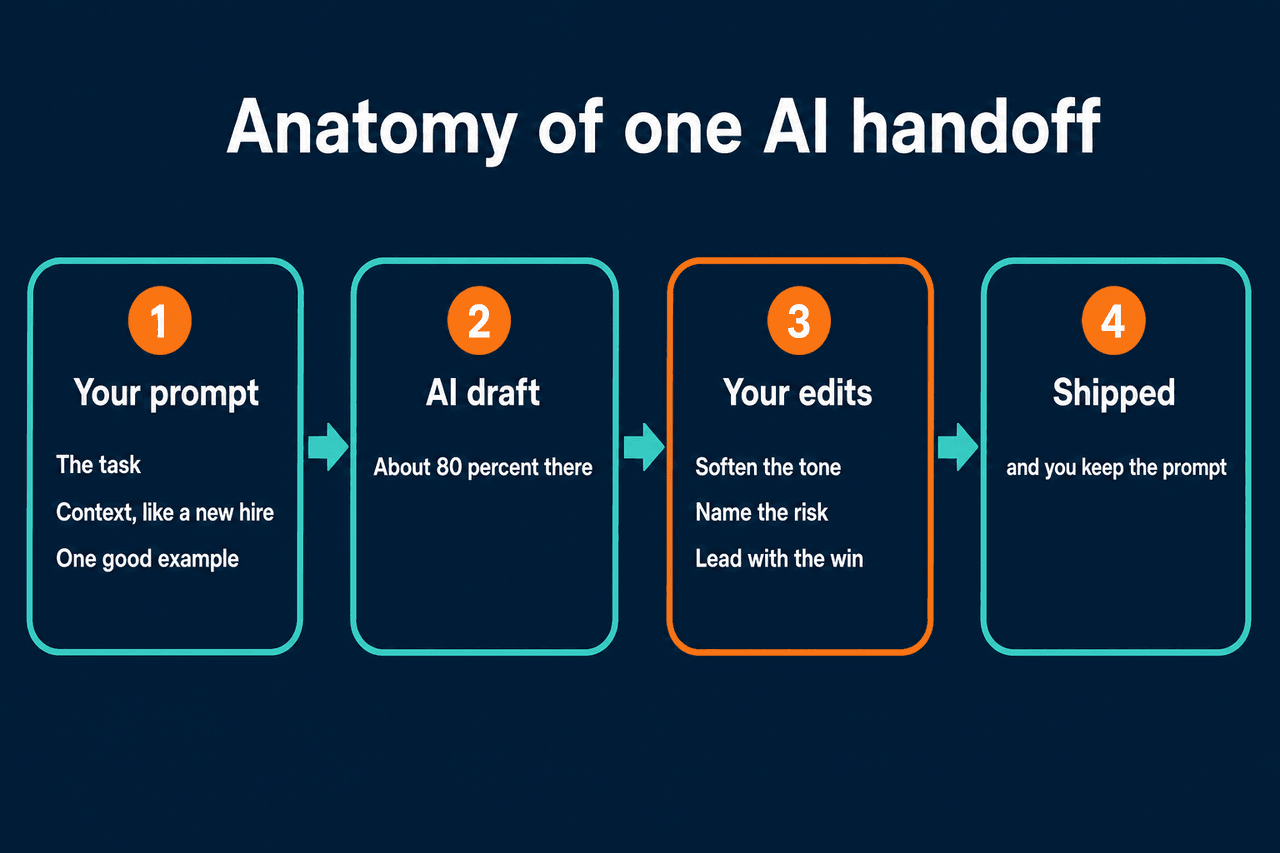
WHAT TO SKIP
## Where AI quietly wastes operator time Not every use is worth your hour. A few categories burn time and trust without paying off, and skipping them early is part of the skill. - **Work you cannot judge.** If you could not tell a good answer from a confident wrong one, you are gambling, not editing. Build judgment on familiar work first. - **One-off novelty tasks.** A clever prompt you run once is a story, not a system. The returns come from work you repeat. - **Any number you cannot source.** Models state figures with total confidence and no basis. Treat every unsourced number as a draft to verify. - **Fully automated output with nobody on it.** The pilots that fail share this trait: a tool switched on and left unsupervised. Real-work AI keeps a human editor between the draft and the decision. The pattern is the inverse of the value cases. Unfamiliar, rare, unverifiable, and unowned work is where AI quietly costs more than it saves.THE PATTERN
## The pattern that separates value-capturers from dabblers The owners who compound gains are not using better tools than the ones who quit. They run a different loop. We call it the agent-does-the-work model: the AI produces the outcome, and you stay the editor who makes it true. | The work | What the AI handles | What you own | | --- | --- | --- | | Drafting | The full first version: structure, tone, the connective tissue | Whether it is true, fits your voice, and is worth sending | | Synthesis | Condensing messy inputs into a clean summary | What actually matters, and what the model quietly left out | | Decisions | Laying out options, risks, and the other side of the argument | The call itself, given your customers and your standards | | Documentation | A first-pass procedure from how the work really happens | Correcting it to match reality before anyone relies on it | That inverts the usual advice. You do not need to become a prompt engineer or learn to build. You need to get good at two things: choosing work worth automating, and judging output you are qualified to judge. Both are operator skills, not technical ones. It also explains the failure rate. A chatbot bolted onto a website is a tool nobody owns, aimed at no recurring task, with no human editing the result. The work that succeeds is narrow, repeated, and owned: this email sequence, this weekly report, this kind of proposal, every time, with you on the output.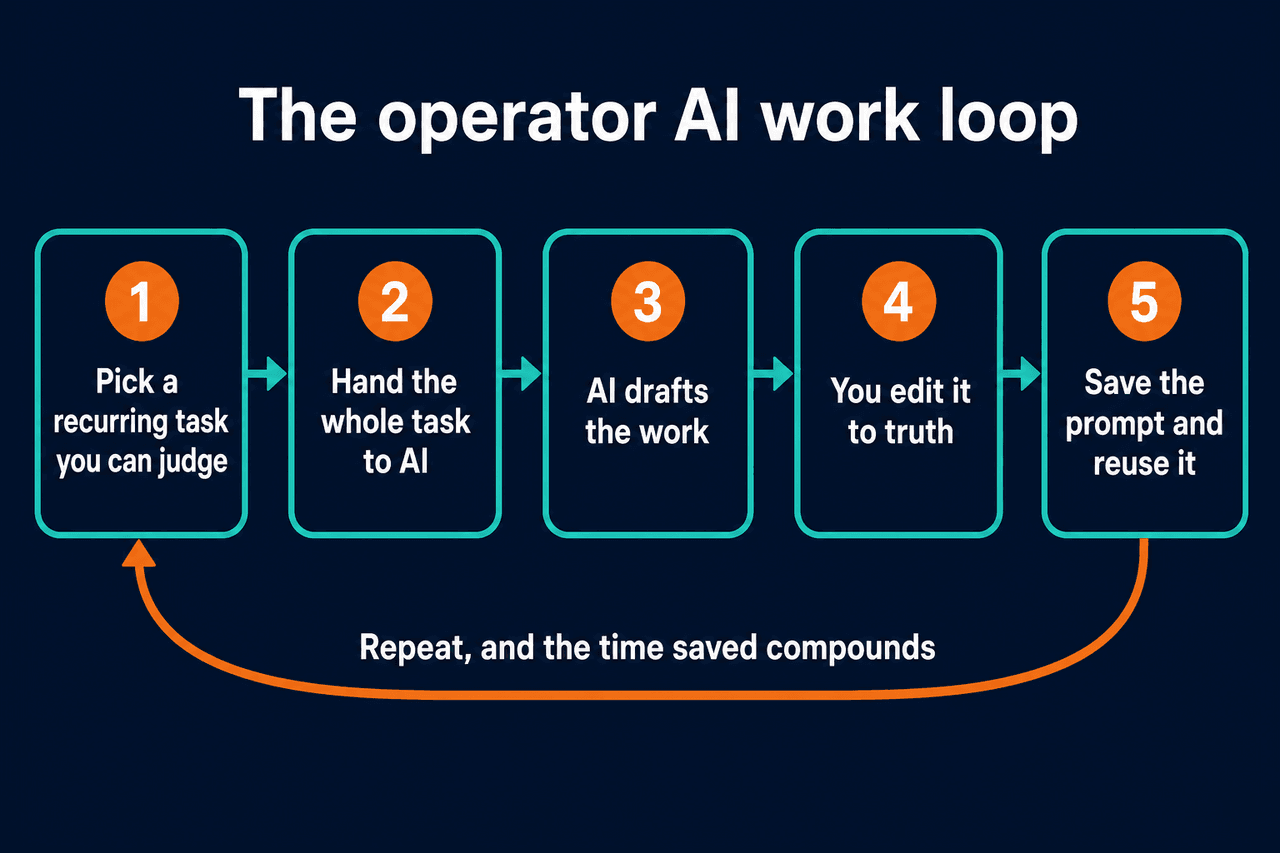
THE TWO SKILLS
## The two skills that actually matter If the tool is not the constraint, what should you actually get good at? Two things, and neither is technical. The first is task selection: knowing which work is worth handing over. The test is simple. Is it recurring, can you judge the output, and is it slow or blank-page hard today? Work that clears all three is where the time goes. The second is judgment: looking at a confident draft and knowing what is wrong with it. This is the scarce skill in an age of fluent machines. The model will always sound sure; your job is to know when sure is wrong. You build it the only way anyone builds judgment, by doing real work and getting feedback, ideally with a guide who can shorten the loop.THE SHIFT
## AI does not replace the operator, it changes the job The fear underneath all of this is that AI makes the owner redundant. In practice it does the opposite, though it does change the job. Less of your week goes to producing first drafts, and **more of it goes to judgment**: deciding what is true, what fits the business, and what is worth shipping. That is a better use of an operator than typing the fifth draft of a proposal. It is also work a model cannot do for you, because it requires knowing your customers and your standards. The operators who thrive lean into being the editor and let the machine handle the keyboard. Seen that way, capable AI is less a threat and more the first time a small team can produce like a large one.START THIS WEEK
## How to start this week You do not need a strategy deck. You need one task and one honest hour. 1. **Pick one recurring task you already understand.** Something you do most weeks and could grade in your sleep. 2. **Hand AI the whole task, not a fragment.** Give it the goal, the audience, and an example of a good past result. Ask for the full draft. 3. **Edit the output to truth.** Fix what is wrong, cut what is generic, add what only you know. This step is the job, not a failure of the tool. 4. **Save the prompt and the example.** The reusable asset is the repeatable setup, not the one answer. 5. **Run it again next week.** The second pass is faster, and the compounding starts. What you need to begin: a capable AI assistant, one real task, and the willingness to be the editor. That is the whole kit.CLOSING THE GAP
## Why most owners stall, and what closes the gap If the loop is that simple, why do half of owners stall? They are not short on tools. They are short on reps and a guide. Only about 23% of small businesses using AI have had any [formal training](https://capsulecrm.com/blog/small-business-ai-adoption-statistics/) on it, and roughly half of owners are still "explorers," dabbling without committing.This is the gap our whole approach is built around. People learn this by doing their own real work with a guide who can shorten the loop, not by watching another course they will not finish. Inside the Vista AI Collective, members work from a project folder pointed at their actual business and apply each piece to real work. The free Vista AI Lab is the no-cost way to see that style before committing.