
AI for operators
How Operators Actually Use AI to Get Real Work Done

The short version: The operators who get real work out of AI treat it as a drafting partner, not a magic button. They hand it a task they already understand, let it produce the first pass, then edit the result until it is true and ship it. The hard part is almost never the tool. It is knowing which work to point AI at and being able to judge what comes back.
The work they hand over is ordinary: a first draft of a proposal, a synthesis of three messy documents, a batch of customer replies, a pricing scenario to pressure-test.
Key takeaways
- Using AI for real work means handing it a task you already understand, then staying the editor who makes the result true.
- Adoption is no longer the differentiator; capturing value is, and most businesses do not.
- MIT found 95% of enterprise AI pilots delivered no measurable return, for organizational rather than technological reasons.
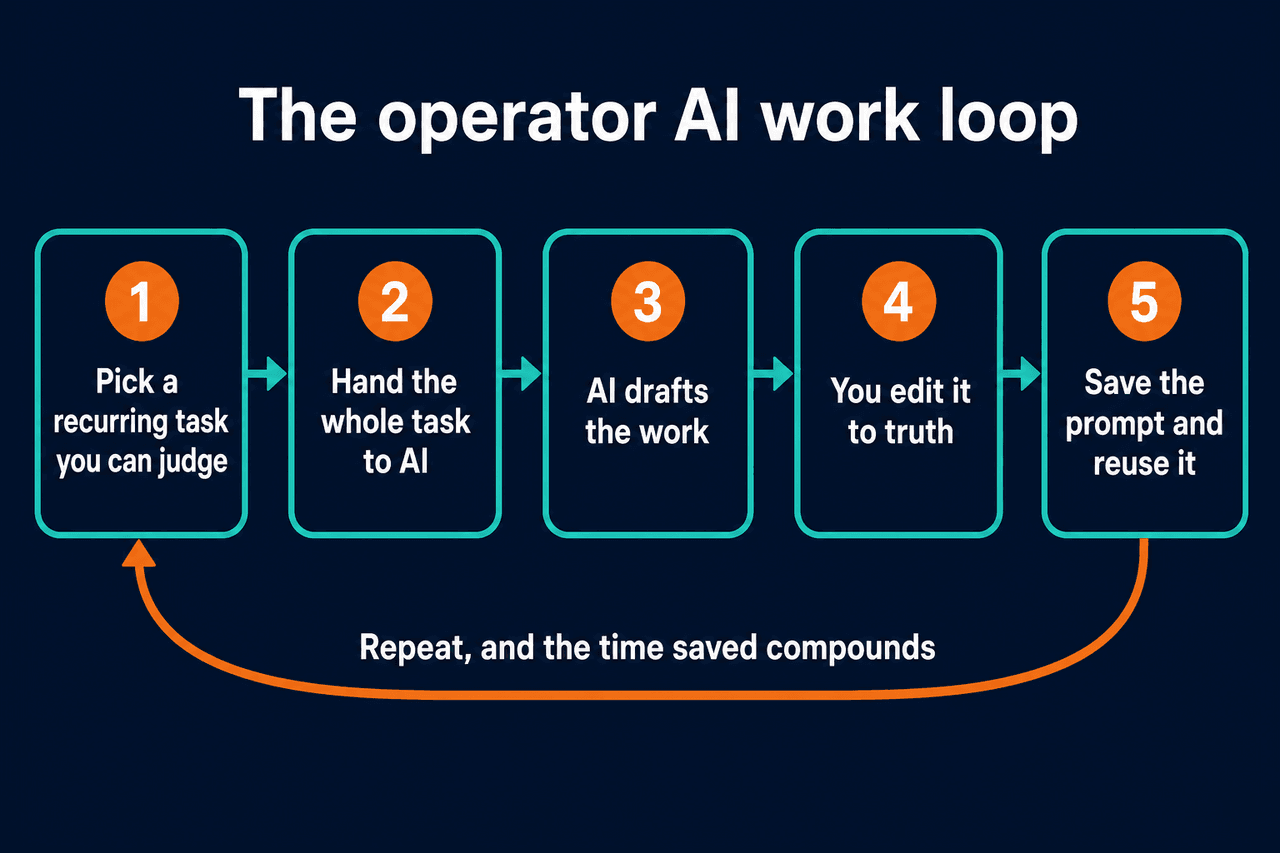
- The winning loop is narrow, repeated, and owned: pick recurring work you can judge, let AI draft it, edit to truth, save the prompt, repeat.
- The two skills that matter are choosing the right work and judging the output, both built through reps with a guide.
THE FOUNDATION
What "using AI for real work" actually means
Using AI as a business owner means handing a capable model the slow, repetitive, or blank-page parts of your real workload, then staying the editor who makes the result correct. It is not about novelty prompts or watching demos. It is output you would have produced anyway, produced faster and to a higher floor.
A few plain definitions help, because the jargon scares people off more than the work does. A model is the AI assistant you type to. A prompt is the instruction you give it. Context is the background you paste in so it can do the job well, the way you would brief a new hire.
None of it requires code. If you can write a clear email to a colleague, you already have the core skill.
Real-work AI use has a recognizable shape:
- It starts from a task you already understand, so you can tell when the output is wrong.
- It targets recurring work, not one-off tricks, so the payoff compounds.
- The AI does the heavy first pass; you supply the judgment about what is true and what ships.
- It produces an artifact: a sent email, a working draft, a defensible decision, not a chat transcript.
- It gets faster over time, because you save the prompt that worked and reuse it.
If that sounds less exciting than "AI will run your business," good. The owners getting real value are deliberately unexciting about it.
THE LANDSCAPE
Everyone is using AI, but few capture the value
Adoption is no longer the story. Using AI is now normal; turning it into results is not.
Here is where small businesses stand today:
| Measure | Now | A year earlier |
|---|---|---|
| Use AI regularly | ~68% | 48% (mid-2024) |
| Use generative AI | ~58% | 40% |
| Average time saved | ~5.6 hrs/week | not measured |
Source: small-business AI adoption data, 2026.
And yet most of that activity is not turning into results.
of enterprise generative AI pilots delivered no measurable financial return, per MIT's 2025 State of AI in Business report (150 executive interviews, 350+ employee surveys, 300 deployments).
The productivity numbers tell the same story. Self-reported gains run around 40%, while independently measured gains come in closer to 5.4%.
Read those facts together and the real-constraint lens snaps into focus. The bottleneck is not access to the model, because almost everyone has access. It is everything around it:
- which task you choose
- whether you can judge the output
- whether you do the work often enough for the time saved to matter
In the engagements we run, the constraint is almost never the tool. It is pointing AI at work the owner cannot yet judge, or at a task too rare to compound.
MIT found the same misallocation in the budgets. More than half of generative AI spending goes to sales and marketing, while the largest returns showed up in unglamorous back-office automation. Operators reach for the visible work and underinvest in the repetitive work where AI quietly pays for itself.
WHAT WORKS
The jobs operators actually hand to AI
Strip away the hype and the high-value uses are consistent across businesses. Six show up again and again.
- First drafts of anything written. Proposals, scopes, follow-up emails, job descriptions, landing-page copy. One owner described drafting a client response with AI, editing for voice, and sending in ten minutes, against the forty it used to take.
- Synthesizing messy inputs. Paste in three transcripts, a spreadsheet export, and a long thread, then ask for the decision-relevant summary. Drop in a month of support tickets and ask for the three complaints that keep recurring.
- Customer communication. Drafting replies, turning a terse note into a clear one, handling the second and third follow-up without losing tone.
- Thinking through a decision. Not as a calculator, but as a pressure-test: walk through pricing scenarios, name the risks in a plan, argue the other side of a hire.
- Internal documentation. AI writes the first version of a standard operating procedure from a description of how the work happens, and you edit it to match reality.
- Turning an idea into something you can see. A rough prototype or a mock landing page, fast enough to react to before spending real money. This is the core of what members practice inside the Vista AI Collective.
Where the time actually goes, measured by share of small businesses using AI:
| Use | Share |
|---|---|
| Content creation | 68% |
| Customer communication | 52% |
| Administrative tasks | 47% |
| Financial management and bookkeeping | 31% |
Source: small-business AI adoption data, 2026.
The throughline across all six is the same. The AI does the boring first pass, you do the judgment, and the combination beats both working alone and the model working unsupervised.
IN PRACTICE
What good looks like: one task, start to finish
Take a task most operators quietly dread: the weekly update to a client or a team.
You start with what you already know. You have sent dozens of these, so you can tell a good one from a generic one in seconds. That is the qualifying condition: you are the judge.
Then you hand the AI the whole job, not a fragment. Give it the raw material and the context a new hire would need:
- the notes from the week
- the metrics that matter
- the open items
- one past update you were happy with, as the model to match
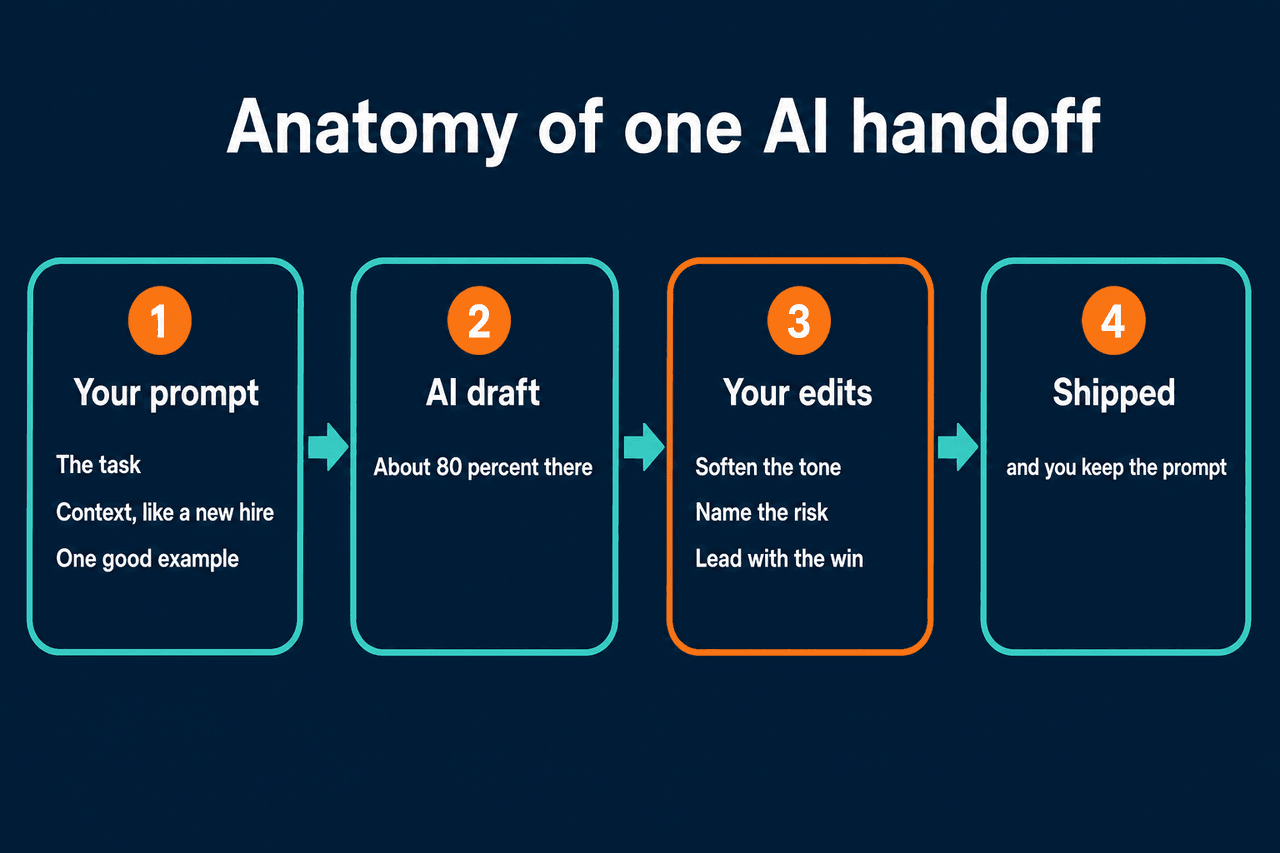
What comes back is eighty percent there and twenty percent wrong, which is exactly right. It has the structure and the connective tissue handled. What it does not have is your judgment: the thing you would soften, the risk you would name, the win you would lead with. So you edit it to truth.
Save the setup, not just the answer.
The reusable asset is not the one reply. It is the prompt, the context, and the example you keep. Next week the same task takes ten minutes instead of forty, because you are not starting from blank. That is the compounding most owners never reach, because they treat every run as a one-off.
WHAT TO SKIP
Where AI quietly wastes operator time
Not every use is worth your hour. A few categories burn time and trust without paying off, and skipping them early is part of the skill.
- Work you cannot judge. If you could not tell a good answer from a confident wrong one, you are gambling, not editing. Build judgment on familiar work first.
- One-off novelty tasks. A clever prompt you run once is a story, not a system. The returns come from work you repeat.
- Any number you cannot source. Models state figures with total confidence and no basis. Treat every unsourced number as a draft to verify.
- Fully automated output with nobody on it. The pilots that fail share this trait: a tool switched on and left unsupervised. Real-work AI keeps a human editor between the draft and the decision.
The pattern is the inverse of the value cases. Unfamiliar, rare, unverifiable, and unowned work is where AI quietly costs more than it saves.
THE PATTERN
The pattern that separates value-capturers from dabblers
The owners who compound gains are not using better tools than the ones who quit. They run a different loop. We call it the agent-does-the-work model: the AI produces the outcome, and you stay the editor who makes it true.
| The work | What the AI handles | What you own |
|---|---|---|
| Drafting | The full first version: structure, tone, the connective tissue | Whether it is true, fits your voice, and is worth sending |
| Synthesis | Condensing messy inputs into a clean summary | What actually matters, and what the model quietly left out |
| Decisions | Laying out options, risks, and the other side of the argument | The call itself, given your customers and your standards |
| Documentation | A first-pass procedure from how the work really happens | Correcting it to match reality before anyone relies on it |
That inverts the usual advice. You do not need to become a prompt engineer or learn to build. You need to get good at two things: choosing work worth automating, and judging output you are qualified to judge. Both are operator skills, not technical ones.
It also explains the failure rate. A chatbot bolted onto a website is a tool nobody owns, aimed at no recurring task, with no human editing the result. The work that succeeds is narrow, repeated, and owned: this email sequence, this weekly report, this kind of proposal, every time, with you on the output.
THE TWO SKILLS
The two skills that actually matter
If the tool is not the constraint, what should you actually get good at? Two things, and neither is technical.
The first is task selection: knowing which work is worth handing over. The test is simple. Is it recurring, can you judge the output, and is it slow or blank-page hard today? Work that clears all three is where the time goes.
The second is judgment: looking at a confident draft and knowing what is wrong with it. This is the scarce skill in an age of fluent machines. The model will always sound sure; your job is to know when sure is wrong. You build it the only way anyone builds judgment, by doing real work and getting feedback, ideally with a guide who can shorten the loop.
THE SHIFT
AI does not replace the operator, it changes the job
The fear underneath all of this is that AI makes the owner redundant. In practice it does the opposite, though it does change the job. Less of your week goes to producing first drafts, and more of it goes to judgment: deciding what is true, what fits the business, and what is worth shipping.
That is a better use of an operator than typing the fifth draft of a proposal. It is also work a model cannot do for you, because it requires knowing your customers and your standards. The operators who thrive lean into being the editor and let the machine handle the keyboard. Seen that way, capable AI is less a threat and more the first time a small team can produce like a large one.
START THIS WEEK
How to start this week
You do not need a strategy deck. You need one task and one honest hour.
- Pick one recurring task you already understand. Something you do most weeks and could grade in your sleep.
- Hand AI the whole task, not a fragment. Give it the goal, the audience, and an example of a good past result. Ask for the full draft.
- Edit the output to truth. Fix what is wrong, cut what is generic, add what only you know. This step is the job, not a failure of the tool.
- Save the prompt and the example. The reusable asset is the repeatable setup, not the one answer.
- Run it again next week. The second pass is faster, and the compounding starts.
What you need to begin: a capable AI assistant, one real task, and the willingness to be the editor. That is the whole kit.
CLOSING THE GAP
Why most owners stall, and what closes the gap
If the loop is that simple, why do half of owners stall? They are not short on tools. They are short on reps and a guide.
Only about 23% of small businesses using AI have had any formal training on it, and roughly half of owners are still "explorers," dabbling without committing.
This is the gap our whole approach is built around. People learn this by doing their own real work with a guide who can shorten the loop, not by watching another course they will not finish. Inside the Vista AI Collective, members work from a project folder pointed at their actual business and apply each piece to real work. The free Vista AI Lab is the no-cost way to see that style before committing.
It connects to why we exist. The matchmaking thesis behind Vista is that the right guide matched to your specific constraint beats one more subscription. If your bottleneck is judgment, a better model will not fix it; the reps will. When you are ready to pinpoint your real constraint, that is what a short intro call is for.
Frequently asked questions
- What is the best way for a non-technical business owner to start using AI?
- Pick one task you already do every week and understand well, then hand the entire task to a capable AI assistant and edit the result. Starting from work you can judge means you can catch mistakes, and starting from recurring work means the time you save compounds.
- Do I need to learn to code or write advanced prompts to use AI for real work?
- No. The two skills that matter are choosing work worth automating and judging the output, and both are operator skills, not technical ones. Clear context and a good example beat clever prompting. You stay the editor and the AI does the drafting.
- Why do so many businesses fail to get value from AI?
- MIT's 2025 research found 95% of enterprise AI pilots delivered no measurable financial return, and the causes were organizational, not technological. Tools were aimed at no specific recurring task, with nobody owning the output. Value shows up when AI is pointed at narrow, repeated, owned work with a human editing the result.
- How much time can AI realistically save a small business?
- Measured gains are more modest than the headlines. Independent studies find 15% to 50% reductions in completion time on writing and analysis tasks, and the average AI-using small business reports saving around 5.6 hours a week. Judge by your own before-and-after on a specific task.
- What AI tools does a business owner actually need to get started?
- Less than the noise suggests. One capable general-purpose AI assistant covers the large majority of real operator work: drafting, synthesis, communication, and thinking through decisions. Start there, get fluent on your own recurring tasks, and add specialized tools only when a specific job clearly demands one.
- Is AI going to replace the owner's judgment?
- No, and the owners getting real value design around the opposite. The model produces the first pass and the owner supplies the judgment about what is true and what ships. That division of labor is why the human-plus-AI result beats AI working unsupervised.
Vista Insights
Get new posts in your inbox
Practical AI and advisory insights for operators, sent as they publish. No spam, unsubscribe anytime.

Founder, Vista Advising Group. Writes about using AI for real operating work.
Keep reading
- Finding the real constraint
Design Intake a Non-Expert Can Run
Break owner-dependence at intake by making routine decisions inferable, defaulted, and easy to override.
- Advisory
When Personalization Reads as Surveillance
Cold outreach earns more trust when it matches a public segment want than when it displays a prospect dossier, especially in conservative industries.
- AI for operators
AI Ideation Is Real. Your Job Is Filtering.
AI can widen the creative field. Operators create the value by filtering what fits the brand, moment, and audience.