
What's Stuck
Why Does Owner Dependency Discount Your Sale Price?

Why Does Owner Dependency Discount Your Sale Price?
Owner dependency discounts your sale price because a buyer must replace the judgment, relationships, and approvals you still supply. Reduce that risk by documenting recurring decisions, assigning authority, and testing handoffs. AI can draft instructions from your explanations. The test is a business that keeps moving without your constant involvement.
Key takeaways
- A buyer needs evidence that decisions and customer relationships can transfer.
- Inventory the recurring decisions that still come to you for approval.
- Use AI to draft instructions, then check them against actual work.
- Hand off low-risk decisions first and test the limits before expanding authority.
You can improve revenue and margins while leaving the business difficult to hand over if staff need you to interpret every unfamiliar request. Pre-exit work should reveal that dependence and replace your everyday involvement with operating rules your team has practiced using.
THE TRANSFER TEST
Why does your involvement become a buyer's problem?
Revenue cannot answer the handoff question. A buyer needs to understand how the business will handle approvals after you leave, including who handles unusual cases.
In the sale preparations we support, the split repeats. You polish revenue and margins.
The buyer keeps circling one question: "What happens when you leave?" Strong numbers help. They do not answer that question.
The dependency often hides in plain sight: your business runs smoothly, yet pricing exceptions, key customer calls, and hiring decisions still reach your desk. That is the discount. The dependence hides inside ordinary work. You may experience it as being available to help; a buyer sees decisions that still need a person they cannot simply replace.
Vista's Real-Constraint Lens. Identify what limits the result before adding more effort elsewhere. In sale preparation, the binding constraint is often you, not the numbers.
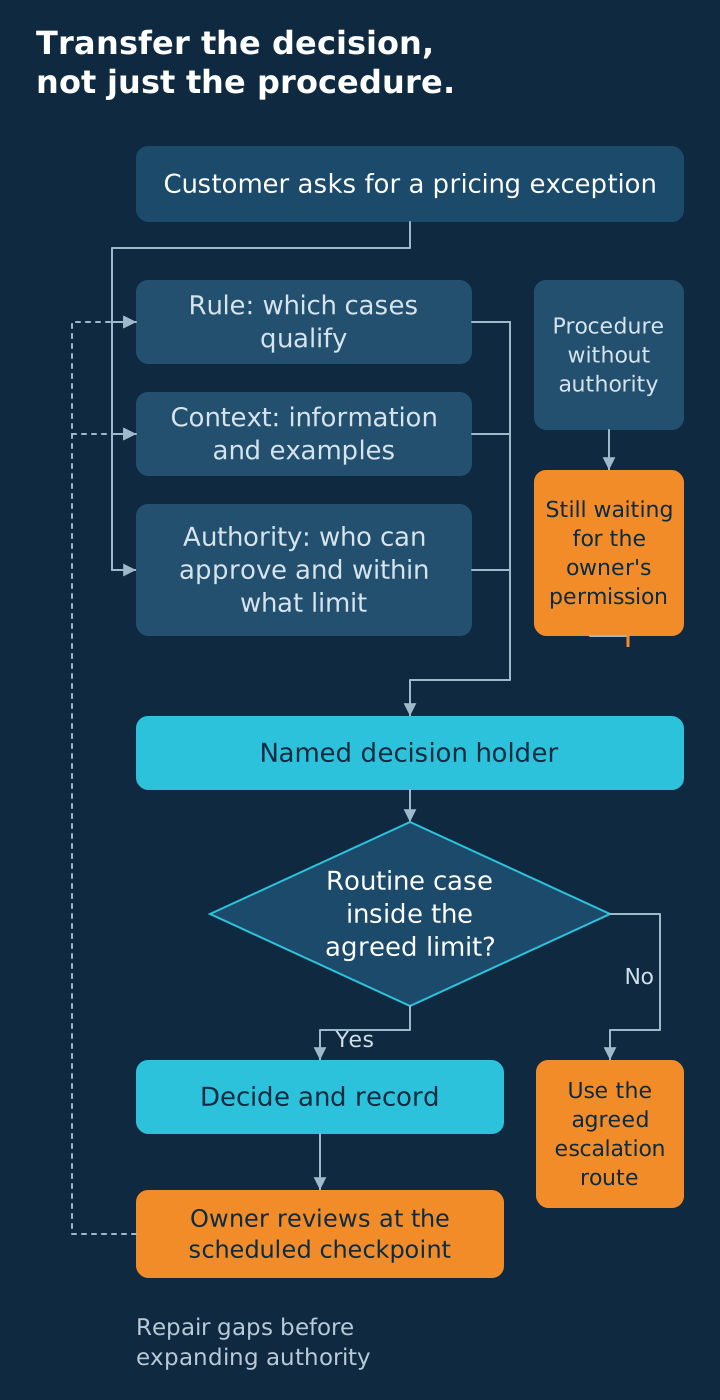
A supervisor is ready to send a revised quote, but the customer asks for an exception you usually approve by phone. The draft sits open while the supervisor waits for your reply, because the price is already calculated but permission is the missing piece. Documenting the calculation alone would leave that queue exactly where it was.
Look for dependence in these parts of your operation:
- Judgment: staff need you to interpret an exception or choose between competing priorities.
- Relationships: a customer trusts your personal promise but has no working connection with your team.
- Authority: someone knows what to do but lacks permission to act within a defined limit.
Transfer the rule, the context, and the permission together. A folder of procedures transfers only the first. If you recognize the same pattern outside sale preparation, the signs you have outgrown running everything yourself show where to start examining your role.
DECISION INVENTORY
Which recurring decisions still come to you?
List the decisions before writing procedures. Start with the questions staff ask you during routine work, including approvals you have stopped noticing.
Use your messages, calendar, and conversations to collect examples from a normal stretch of work. Record specific calls, since "sales" hides too much and "approve a discount outside the standard offer" gives you something to inspect. Include the information you check and what would make you change your answer.
Here is what a filled-in inventory looks like. Swap in your own decisions.
| Decision | How often | Can it be a rule? | Who could own it | How to document it |
|---|---|---|---|---|
| Approve a pricing exception | Whenever a quote falls outside the standard offer | Yes, with limits and an escalation point | Sales lead | Approved cases, required checks, and approval boundary |
| Resolve a customer complaint | When a customer challenges the agreed work | Partly, with judgment for unusual claims | Service lead | Response steps, available remedies, and when to stop |
| Change the crew schedule | When availability or scope changes | Yes, for standard changes within capacity | Scheduler | Capacity checks, priority rule, and customer notification |
| Approve a purchase | When work needs an item outside normal ordering | Yes, within purchasing permissions | Operations lead | Buying rule, supplier details, and approval route |
| Choose a hiring candidate | During recruiting | Partly, with shared evaluation and final approval | Team lead | Role criteria, interview notes, and decision responsibilities |
Separate a repeatable rule from a judgment call before handing either over. A rule has known conditions and a defined next action, while judgment needs context, examples, and an escalation route. Some calls should remain with you for now, but recording why they stay makes the next handoff easier to prepare.
Give each inventory entry a starting status:
- Ready for a rule: staff can act once conditions and permissions are documented.
- Needs examples: the basic process is known, but unusual cases depend on your interpretation.
- Stays with you: the consequence or missing context makes delegation premature.
Choose an approval you can test in normal work, since an uncommon case can consume your documentation effort while everyday approvals keep interrupting you. Ask the proposed lead to explain what they already know before you start drafting the instructions they will use. The gap between their explanation and yours tells you what the document must contain to support a call without your help.
CAPTURING JUDGMENT
How can AI turn your explanations into instructions?
Explain the decision before drafting the procedure. Give AI the sequence you already follow, then check the draft against the work your team actually performs.
Describe a routine case aloud or write a rough explanation for the person taking it over. Include what triggers the question, what information you need, and what makes you pause. Remove unnecessary customer details and other sensitive material, and use your explanation to capture the judgment behind the steps as well as their order.
Use a bounded drafting request like this:
Drafting request. Turn this explanation into operating instructions with a trigger, required information, decision rule, authority limit, escalation route, and record to keep. Separate routine cases from exceptions. Mark missing information as a question for me. Do not fill gaps with assumptions.
Treat the output as a draft your team must inspect. If it adds a remedy you never authorize or skips a check you always perform, correct it before anyone acts. Keep the first document short enough to use while handling the task, attaching supporting examples without turning the operating instructions into a long manual.
Check the draft in this order:
- Inputs: does it identify the information needed before a decision can be made?
- Rule: does the routine action match how you want the business to operate?
- Limit: can staff tell when their permission to act ends and whom to contact?
- Record: will the next person know what was decided and why?
The guide to writing SOPs faster with AI covers drafting; sale preparation also requires a person with permission to follow that procedure. A document describing your approval is progress, but the handoff becomes real when someone else can use it correctly.
In our work, the shift from operator to owner happens when you deliberately document and hand off the process. Stepping back and hoping is not a handoff. It leaves staff reconstructing your judgment under pressure. Keep a brief update note after each test so your team can distinguish the current instructions from something you approved in the past.
ORDER OF OPERATIONS
What should you hand off first?
Start with reversible, low-risk decisions. Move decisions with greater consequences only after your team has practiced the process and its escalation limits.
Begin with everyday work that uses information already available to staff. A standard schedule adjustment or ordinary reorder may fit your operating rules, while a major customer commitment may need more preparation. Rank each call by what could go wrong, how quickly you would notice, and how easily the team could correct it.
Use a deliberate handoff sequence:
- Explain the rule and why it exists, using a past case with identifying details removed.
- Ask the new decision holder to describe how they would handle a routine case and an exception.
- Let them act inside the agreed boundary, with your review scheduled afterward.
- Review the result, repair missing instructions, and expand the approval limit only when the process holds.
Once you hand off a decision, stop blessing it. An informal "run it by me" keeps the dependency alive. Make the boundary specific enough that staff can act without guessing about your approval or waiting for a reply. The escalation route should cover exceptions, not quietly pull every standard approval back into your queue.
Define the operating log before the trial:
- What the team decided and which information supported the choice.
- Which rule applied and how the action was recorded for the next person.
- Why a request needed escalation and what instruction changed afterward.
Review that log at an agreed time instead of monitoring every action as it happens. You want to see the pattern of calls, not become a second queue for the same work. If results drift, check the rule, access to information, and permission to act before assuming the person cannot handle the responsibility.
Hand off customer relationships alongside operating approvals by introducing the person taking over, letting them handle routine contact, and backing their role when questions arise. A procedure cannot transfer trust by itself, so customers need experience working with the team that will serve them after your role changes.
EVIDENCE OF PROGRESS
How do you know you have handed off enough?
Test independence in ordinary work. Look for calls that move through the business with a record, a person accountable, and exceptions that follow the agreed route.
Step out of reach on purpose for a planned stretch, and see what still finds you. Stay available for the exceptions the rules assign to you, while letting normal work finish inside the agreed limits. Review the log afterward with the people holding the work and check that their explanations make sense without a private conversation supplying the missing context.
Watch for these signs of progress:
- Everyday approvals finish without staff seeking your informal permission.
- Customer requests reach the person authorized to handle them.
- Staff can find the current rule and explain when it applies.
- Unusual requests follow the escalation route instead of becoming a general request for your help.
- The operating log lets someone else understand what happened.
These records are what you show a buyer who asks what happens when you leave. A tested handoff answers with evidence. A promise answers with hope.
If your absence just builds a backlog, you are not done. You also have a gap when staff can follow standard steps but cannot spot an unusual case. Repair the instruction or authority limit and test again, because you need repeatable operating evidence before presenting the handoff as settled.
Bring in help when you cannot turn your judgment into a teachable rule, or when your team needs support taking responsibility. An advisor should help build the capability and plan their own departure. Read how an advisor plans their own exit to assess that approach. You can also book a Vista conversation to work through the decisions keeping you involved.
Before moving on, check the handoff itself:
- I have listed the recurring decisions that still come to me.
- Each entry has required information, a rule or examples, and an authority limit.
- A named person has practiced the call and accepted the responsibility.
- Staff can find the current instructions and the escalation route.
- Customers know whom to contact as my involvement changes.
- Normal work has continued through a planned test of reduced involvement.
- The record shows what still depends on me and what I will address next.
COMMON QUESTIONS
Frequently asked questions
Prove the handoff through working decisions.
What does owner dependency mean when preparing to sell?
Owner dependency means everyday calls, customer relationships, or approvals still rely on your personal involvement to keep the business moving. A buyer must understand how those responsibilities will transfer. You reduce that dependence by documenting judgment, assigning authority, and testing how the team handles normal work and exceptions.
Why might revenue growth leave owner dependency unresolved?
Revenue growth can leave the same approval and judgment bottlenecks in place, even when your financial results improve. If pricing exceptions, customer promises, and staff decisions still come to you, the operating dependence remains. Sale preparation needs evidence that those decisions can transfer to people who will continue the work.
Which decisions should I put in a decision inventory?
List recurring decisions that staff still bring to you, including pricing exceptions, customer remedies, scheduling changes, purchases, and hiring choices. Record the information you use, possible rules, and who could take responsibility. Separate calls ready for delegation from those needing examples or authority that your team does not yet have.
Can AI write the SOPs needed for a handoff?
AI can draft operating instructions from your explanation of a decision, including the trigger, information needed, standard rule, and escalation route. Check the draft against actual work before staff use it. Documentation supports the handoff when someone has the authority, context, and practice to make the decision correctly.
How should I test reduced involvement before a sale?
Plan a period when staff make routine calls within documented limits and record what they do, with your review scheduled afterward. Remain available for the exceptions assigned to you by the rules. Review the calls and unanswered questions to find instructions, authority, or relationships that still need a stronger handoff.
What is Vista's Real-Constraint Lens in sale preparation?
Vista's Real-Constraint Lens identifies what limits the result before you add effort elsewhere, including your role in daily business decisions. In sale preparation, strong financial results may coexist with operating dependence on you. Use a decision inventory and tested handoffs to address that constraint where it appears in ordinary work.
Frequently asked questions
- What does owner dependency mean when preparing to sell?
- Owner dependency means everyday calls, customer relationships, or approvals still rely on your personal involvement to keep the business moving. A buyer must understand how those responsibilities will transfer. You reduce that dependence by documenting judgment, assigning authority, and testing how the team handles normal work and exceptions.
- Why might revenue growth leave owner dependency unresolved?
- Revenue growth can leave the same approval and judgment bottlenecks in place, even when your financial results improve. If pricing exceptions, customer promises, and staff decisions still come to you, the operating dependence remains. Sale preparation needs evidence that those decisions can transfer to people who will continue the work.
- Which decisions should I put in a decision inventory?
- List recurring decisions that staff still bring to you, including pricing exceptions, customer remedies, scheduling changes, purchases, and hiring choices. Record the information you use, possible rules, and who could take responsibility. Separate calls ready for delegation from those needing examples or authority that your team does not yet have.
- Can AI write the SOPs needed for a handoff?
- AI can draft operating instructions from your explanation of a decision, including the trigger, information needed, standard rule, and escalation route. Check the draft against actual work before staff use it. Documentation supports the handoff when someone has the authority, context, and practice to make the decision correctly.
- How should I test reduced involvement before a sale?
- Plan a period when staff make routine calls within documented limits and record what they do, with your review scheduled afterward. Remain available for the exceptions assigned to you by the rules. Review the calls and unanswered questions to find instructions, authority, or relationships that still need a stronger handoff.
- What is Vista's Real-Constraint Lens in sale preparation?
- Vista's Real-Constraint Lens identifies what limits the result before you add effort elsewhere, including your role in daily business decisions. In sale preparation, strong financial results may coexist with operating dependence on you. Use a decision inventory and tested handoffs to address that constraint where it appears in ordinary work.
Vista Insights
Get new posts in your inbox
Practical AI and advisory insights for operators, sent as they publish. No spam, unsubscribe anytime.

Founder, Vista Advising Group. Writes about using AI for real operating work.
Keep reading
- Using AI
Before You Sell the App You Built With AI
Use ten checks to test your AI-built app's customer experience, security, data handling, recovery, support, and route to paying buyers.
- What's Stuck
Two-Minute Screen Recordings Beat the Manual
Show your team where the buttons are with short task recordings, checked AI-written companion lists, and a simple way to keep both current.
- Reading the AI Landscape
How to Vet an AI Consultant: Shippers vs. Explainers
Vet an AI consultant with questions about shipped work, repairs, data handling, pricing, and the handoff your team will need.