
What's Stuck
Set the Kill Date Before You Launch the Growth Experiment

Set the Kill Date Before You Launch the Growth Experiment
Set a review date and a pass/fail test before you launch a growth experiment. Tie the date to your sales cycle, cap the spend, and define what would justify stopping, extending, or scaling. Pipeline can buy you time. It cannot stand in for revenue.
Key takeaways
- Name the business decision before choosing the growth channel.
- Track an early buyer action and a separate revenue signal.
- Set review dates from your sales cycle and cap the full cost.
- Agree on kill, extend, and scale rules before spending.
THE PATTERN
What decision should your experiment settle?
Buy an answer you can act on. Your trial needs to settle a business decision, such as keeping a channel or funding a larger rollout.
It is review day. The campaign report is open, and a colleague scrolls through promising inquiries. Someone asks which inquiries became paid work. The room goes quiet, then the conversation turns to giving the campaign more time because nobody agreed on the stopping rule.
In our advisory work, an AI-assisted bidding pilot built a large pipeline while contract awards lagged by months. Neither side could judge if the service earned its price because nobody had agreed what success meant or when to make the call.
A paid-social test in another engagement took a different approach. It began with small local segments, held back part of the budget, and set a hard checkpoint. After an earlier campaign ran for months without settling the question, the improved trial gave the team an answer they could act on.
Once spending starts, we often see it become its own argument for more spending. You have already paid for setup, so another month feels easier than stopping. Sunk setup cost is not evidence. Write the stop rule before the first invoice.
A growth experiment should buy an answer you can act on.
- Name the decision the experiment informs.
Why it matters: you need to know what you will change when the evidence arrives.
Write the decision as a sentence: "We will decide if this channel earns an ongoing place in our growth budget." Then name the next action: another bounded trial, a recurring agreement, or a larger operating commitment, each requiring different evidence. That sentence opens your experiment card, a single page you fill in step by step. The full card appears in the last section.
Real-Constraint Lens. Vista uses this framework to find the bottleneck that limits progress. Here, the constraint is an undecided test: you cannot judge the channel because you never defined the answer you needed.
What you need before you start the card:
- The offer, audience, and channel you are testing.
- Your recent path from inquiry to payment, including delays.
- A person who can approve spending and stop the test.
- A trail connecting inquiries, proposals, awards, and collected money.
Before launch, check that you can explain the offer and serve new customers reliably, because a new channel will inherit those problems. Read when paid advertising is premature to separate an acquisition experiment from the work your business needs first.
THE EVIDENCE
What counts as progress before revenue arrives?
Measure buyer movement. Your early signal should show a customer taking a meaningful next step toward the purchase you need.
- Write the pass/fail test with an early signal and a revenue signal.
Why it matters: you need timely evidence without mistaking interest for a finished sale.
Choose an action that fits your buying process, such as a qualified inquiry with a stated need and a scheduled conversation. For bidding, it could be a requested proposal that fits your capabilities and reaches the buyer's approval process. Define the action tightly enough that you can recognize a failure.
A contact who never answers is different from a prospect who asks for a scoped proposal. A proposal you submitted is different from an award you can fulfill profitably. Keep those stages separate so a busy report cannot disguise weak demand as progress or leave you funding activity that never earns its cost.
Connect the trial to your business outcome by choosing signed work, collected payment, or contribution after delivery costs as the revenue measure. Put the measure on the card and use the same definition at each review. A signed contract is not cash. Pick the signal closest to money in the bank.
- Early signal: the buyer takes the next action you specified.
- Revenue signal: the work reaches the commercial result you specified.
- Operating check: you can serve that work within your cost and capacity limits.
Set the pass condition from your economics. Work backward from the value of a sale, delivery costs, staff time, and the cost of keeping the channel running. If qualified demand passes but the later result remains weak, investigate the gap before approving any expansion.
If targeting is the problem, use going narrow without dropping below the floor to focus demand without accepting work that cannot support the business. Put that floor on your card so an attractive inquiry cannot qualify merely by existing.
THE CLOCK
When should you judge a channel with a long sales cycle?
Use your actual buying timeline. A fair test leaves room for customers to decide and gives you scheduled chances to stop funding weak evidence.
- Set the review dates from inquiry to decision and payment.
Why it matters: a short deadline can reject a viable channel, while an open-ended deadline can protect a failing one.
Look at recent work similar to the offer being tested and trace the path from inquiry through acceptance, delivery, and payment. Ask where customers pause and which delays your team controls, then use that history to choose the earliest checkpoint that answers a real question.
For a long cycle, write an early buyer-action checkpoint and a later revenue review on the card. The early checkpoint judges buyer action and opportunity quality; the later checkpoint judges collected results. Keep watching open proposals after the early review. You do not have to keep buying new ones while you wait.
Your timing notes should cover:
- When you expect qualified buyer actions to appear.
- When those buyers can reasonably accept or reject the offer.
- When the resulting work should reach your collection target.
- Which date controls the next spending commitment.
In the bidding pilot, awards lagged behind the pipeline, and nobody had agreed what to judge while waiting or how long to wait. Settle both on your card before launch. A delayed award can justify patience only if the opportunity is still progressing through the process you expected.
Assign the review and put its dates in a shared calendar; document any material delay before revising the deadline. Keep the spending ceiling intact unless you deliberately approve a replacement limit; a calendar change should never quietly become a budget increase.
A new date is not a new budget.
Two clocks separate new acquisition spending from work on existing prospects.
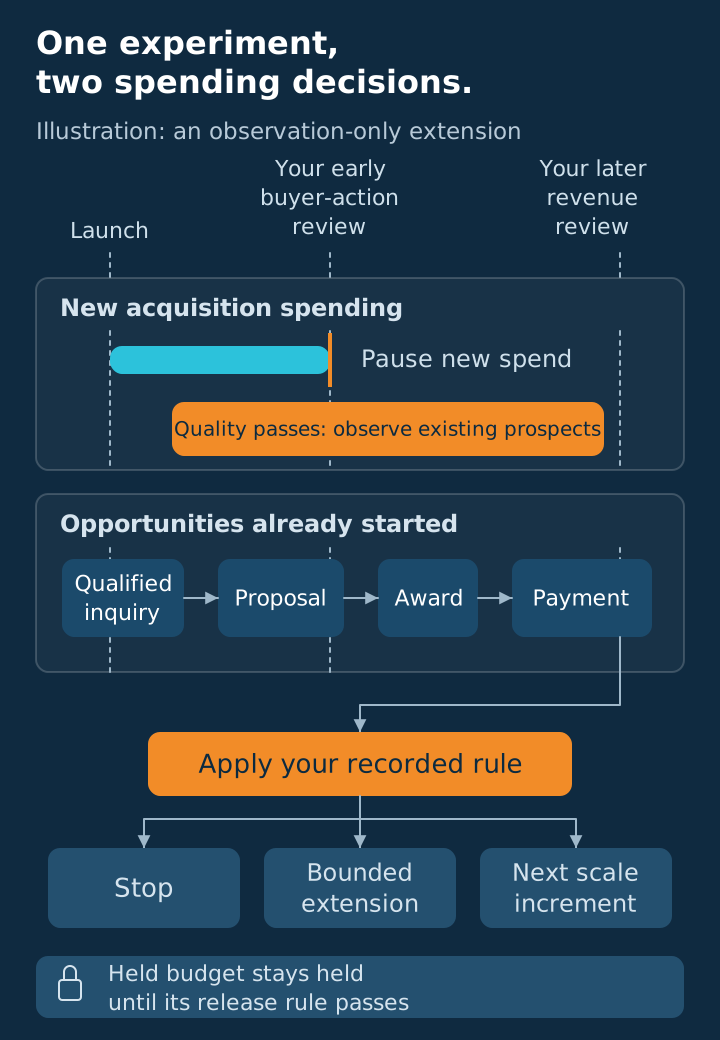
In this example, the early quality test passes. New acquisition spending pauses while existing proposals are monitored until the recorded revenue review. A person then applies the stop, extend, or scale rule.
THE GUARDRAILS
How do you stop the test from consuming the whole budget?
Cap the full cost. Protect enough cash and operating room to act on what the experiment teaches you.
- Limit the spend and hold a portion back.
Why it matters: spending everything up front removes your ability to improve the test after you learn something.
Include setup fees, channel spending, service fees, and staff time for managing inquiries, then add costs for estimating or preparing proposals after leads arrive. Judge the cost of winning work you can deliver, because cheap inquiries can still become expensive jobs to win.
Put a release rule beside the ceiling so the held-back budget becomes available only after the checkpoint passes its stated test. Until then, it stays outside the experiment, making the review a spending decision with consequences instead of leaving every payment running in the background.
Make the control practical before launch:
- Name who can approve additional spending.
- Identify any recurring charge that needs a stop instruction.
- Set a limit on staff time as well as cash.
- Specify what happens to open customer conversations after a stop.
A cap also stops you from mistaking more inquiries for more business when estimates stall or delivery slips. Check fulfillment as the constraint before paying for more demand that your operation cannot handle.
Keep the first trial small enough to understand the result, because changing the audience, offer, message, and sales process together loses the answer. A narrower test helps you spot which assumption failed so you can change it in the next bounded trial.
THE DECISION
What should happen on the review date?
Run the review on time. Apply the rule you wrote before the spending began, even when the result makes the next conversation uncomfortable.
- Define kill, extend, and scale before launch.
Why it matters: each outcome needs a different action, and disappointment is a poor time to invent those actions.
Kill means ending new spending and recurring commitments under your agreement while following through on legitimate customer conversations already underway. Document what failed so stopping the trial leaves you with knowledge you can use and prevents funding the same assumption again under a new name.
Extend means giving named open proposals more time to reach an award, with the missing evidence and new date written together. If you cannot name the unanswered question, you have no basis for an extension. Watch those proposals without new acquisition spending, and use their progress to answer the uncertainty by the deadline.
An extension needs an unanswered question, a deadline, and a spending ceiling.
Scale means releasing a defined next increment after the evidence and your operating checks pass. Check delivery capacity, customer fit, and the cost of winning the work before releasing it. Scale on collected results. Never scale on an encouraging report.
Use this one-page experiment card before you approve the first commitment, following the strong examples to write each entry. Fill in the actual dates, limits, and tests from your business records, then have everyone who controls spending agree to the same card.
| Field | What you write | Example of a weak vs strong entry |
|---|---|---|
| Decision | The commitment this trial will settle | Weak: "Try growth." Strong: "Decide if [channel] earns [ongoing commitment]." |
| Scope | Offer, audience, and channel | Weak: "Find customers." Strong: "Test [service] with [local segment] within [service area]." |
| Early test | Buyer action and pass condition | Weak: "Build interest." Strong: "By [early review date], [your target] qualified inquiries name a need we serve and book a call." |
| Revenue test | Commercial outcome and pass condition | Weak: "Large pipeline." Strong: "By [revenue review date], collected payments from this channel clear [your contribution target] after acquisition and delivery costs." |
| Review dates | Early checkpoint and revenue review | Weak: "Check later." Strong: "Early review [date]. Revenue review [date]. Both set from our last similar jobs." |
| Spend controls | Full ceiling, reserve, and release rule | Weak: "Stay reasonable." Strong: "Cash limit [amount]. Staff-time limit [time]. Reserve [amount], released only after a pass." |
| Kill rule | Failure and stop action | Weak: "See how it goes." Strong: "If the early test fails on [date], cancel the campaign and the service retainer that week." |
| Extend rule | Named open proposals and new date | Weak: "Give it time." Strong: "Extend to [date] only to see if [named open proposals] award. No new spend." |
| Scale rule | Evidence and next commitment | Weak: "More momentum." Strong: "If both tests pass and [named lead] confirms capacity, release the held-back [amount]." |
| Decision authority | Person who applies the rule | Weak: "The team." Strong: "[Approver] applies the rule; [operator] carries it out." |
- Hold the review and document the outcome.
Why it matters: the card changes nothing unless you use it when the deadline arrives.
Bring the agreed evidence and compare each result with its pass condition, separating missing data from weak performance. If your tracking failed, stop expansion and fix it before funding another trial. If the experiment failed, act on the stop instruction; if it passed, release only the next commitment already described.
Keep learning after a stop by marking later awards or payments against their original experiment so you understand delayed value. Keep those results separate from permission to restart spending. If your team needs help agreeing on the constraint and the next move, book an advisory conversation with Vista.
THE DETAILS
Frequently asked questions
Set the rule before spending.
What is a kill date for a growth experiment?
A kill date is the scheduled point when you decide if a growth experiment can keep spending. Set it before launch, together with the evidence you need and the stop action. For a long sales cycle, use an early buyer-action checkpoint and a later revenue review with separate spending decisions.
How do I choose a review date without cutting the test short?
Choose the date from your recent inquiry-to-payment history for similar work, and give buyers time to reach the stage you plan to judge. Use an earlier checkpoint for qualified demand and a later checkpoint for revenue. Record which review can authorize additional spending and which only monitors prospects already in progress.
Can pipeline justify extending a growth experiment?
Pipeline can justify an extension when qualified proposals are advancing through the expected buying process. Name the open proposals, missing evidence, and new review date, with no new acquisition spend. A large pipeline alone cannot settle the commercial question, so track eventual awards and payments against the trial that produced them.
What costs belong in the experiment budget?
Include setup, channel spending, service fees, and the staff time required to manage inquiries and prepare proposals. Use your delivery economics when judging the work won, and hold back budget that can be released after a checkpoint passes. Assign someone to control recurring charges and approve any change to the ceiling.
What is the difference between extending and scaling a test?
Extending gives named open proposals time to reach a decision by a new date, with no new acquisition spending. Scaling releases a larger commitment after both evidence checks and delivery capacity pass. Define both actions before launch, and stop the trial if you cannot name the uncertainty the extension resolves.
What should I do with open prospects after killing a channel?
Stop new acquisition spending according to your experiment card while continuing legitimate customer conversations. Track later awards and payments against the original trial so you can assess delayed value. Those outcomes may inform a future test, but they do not automatically authorize restarting the channel or changing the earlier spending decision.
Frequently asked questions
- What is a kill date for a growth experiment?
- A kill date is the scheduled point when you decide if a growth experiment can keep spending. Set it before launch, together with the evidence you need and the stop action. For a long sales cycle, use an early buyer-action checkpoint and a later revenue review with separate spending decisions.
- How do I choose a review date without cutting the test short?
- Choose the date from your recent inquiry-to-payment history for similar work, and give buyers time to reach the stage you plan to judge. Use an earlier checkpoint for qualified demand and a later checkpoint for revenue. Record which review can authorize additional spending and which only monitors prospects already in progress.
- Can pipeline justify extending a growth experiment?
- Pipeline can justify an extension when qualified proposals are advancing through the expected buying process. Name the open proposals, missing evidence, and new review date, with no new acquisition spend. A large pipeline alone cannot settle the commercial question, so track eventual awards and payments against the trial that produced them.
- What costs belong in the experiment budget?
- Include setup, channel spending, service fees, and the staff time required to manage inquiries and prepare proposals. Use your delivery economics when judging the work won, and hold back budget that can be released after a checkpoint passes. Assign someone to control recurring charges and approve any change to the ceiling.
- What is the difference between extending and scaling a test?
- Extending gives named open proposals time to reach a decision by a new date, with no new acquisition spending. Scaling releases a larger commitment after both evidence checks and delivery capacity pass. Define both actions before launch, and stop the trial if you cannot name the uncertainty the extension resolves.
- What should I do with open prospects after killing a channel?
- Stop new acquisition spending according to your experiment card while continuing legitimate customer conversations. Track later awards and payments against the original trial so you can assess delayed value. Those outcomes may inform a future test, but they do not automatically authorize restarting the channel or changing the earlier spending decision.
Vista Insights
Get new posts in your inbox
Practical AI and advisory insights for operators, sent as they publish. No spam, unsubscribe anytime.

Founder, Vista Advising Group. Writes about using AI for real operating work.
Keep reading
- Using AI
Is a Dedicated Computer for an Always-On AI Agent Worth It?
A dedicated computer earns its place through uptime for established agent jobs; start with narrow, read-only access on your everyday machine.
- Choosing an Advisor
A Referral Partner Is Only Worth It If They Reach Customers You Don't
Test customer overlap and referral timing before committing to a partner, then share approved assets and track the new reach they create.
- Reading the AI Landscape
Rent the Core, Own the Glue
Keep the specialized platform that works, buy on available access, and own a narrow bridge with clear rules, maintenance, and a fallback.