
Built by Logan / Case study / Business intelligence
Acquisition OS
Buying a business runs on a CIM, a spreadsheet, and a gut feeling. This workbench replaces that with a governed deal record: define what the buyer wants, ingest the packet, approve every fact against its source page, score fit, model value, and produce a decision artifact that can be reproduced later.
- DBusiness intelligence
- CSoftware you own
- BHard-to-get data, made usable
- $450,000+
- what a dedicated development team would charge to build it
- $35,000
- what Logan would charge to build it for you
- About$190
- in software and AI usage to build it internally (your team's time excluded)
- 4weeks
- from first commit to an end-to-end deal workflow, built alongside other projects
Team figure reconciles independent replacement-cost estimates, not a quote. Internal figure is reconstructed from usage records. 721 commits across 14 active build days.
What problem does it solve
Deals are decided on facts nobody can trace.
A confidential information memorandum is a sales document. The numbers that matter get copied into a model by hand, the buyer's criteria drift from deal to deal, and six months later nobody can say which figure came from which page or why the multiple was what it was.
What impact does it have
49 facts. Every one approved against its page.
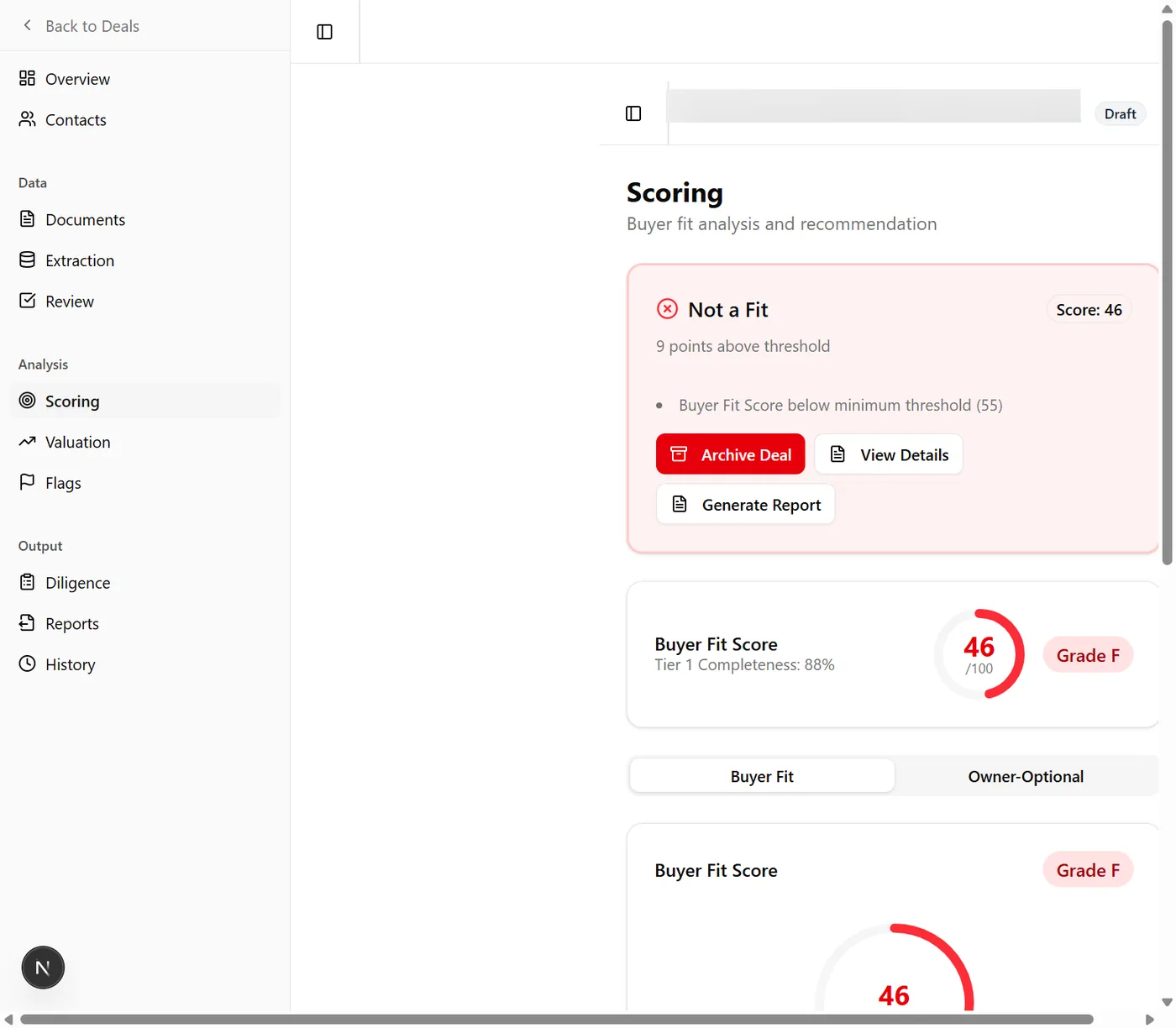
Documents are extracted into typed proposals, never authority. A reviewer accepts or corrects each fact beside the cited source before it can touch a score, a valuation, or a report. Fit scoring reads an immutable buyer mandate covering 64 states and provinces, applies hard gates, and returns proceed, request data, or pass with the risks visible instead of buried in a composite.
What value does it have
A decision record, not a memo.
Mandates are versioned and immutable. Facts carry lineage. Scenarios freeze their inputs and policy version so a stale result is withheld rather than trusted. Reports fail closed when authority is unresolved. The result is an acquisition process a firm can run repeatedly, audit later, and hand to a new analyst without losing the reasoning.
What it does today
A working internal workbench. Everything below runs end to end on real packets.
Mandate and workspace
- Guided buyer mandate: industries, exclusions, geography, equity, revenue, EBITDA, price, multiples, concentration, hard gates
- Immutable published mandate versions with clone authoring and lineage
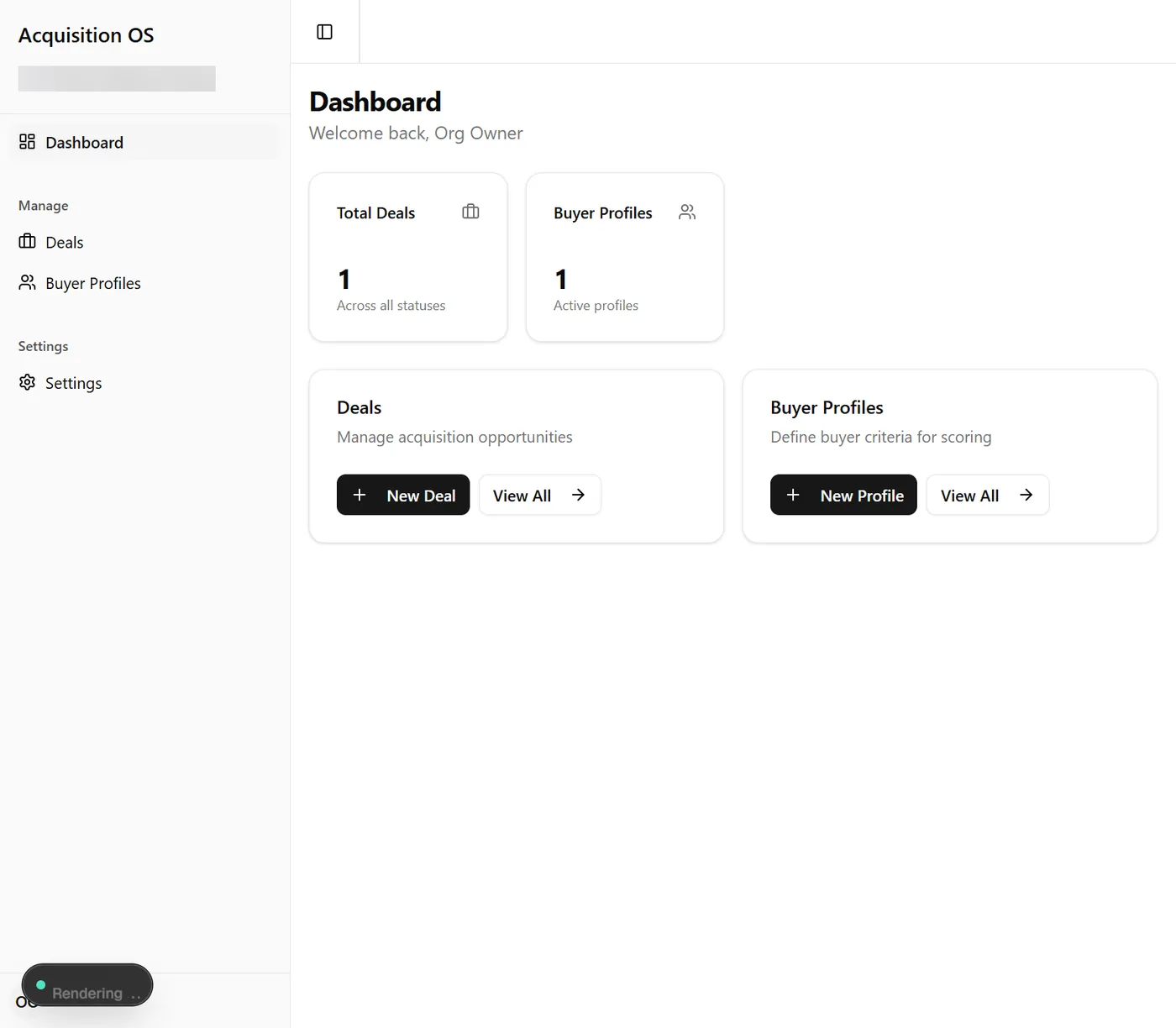
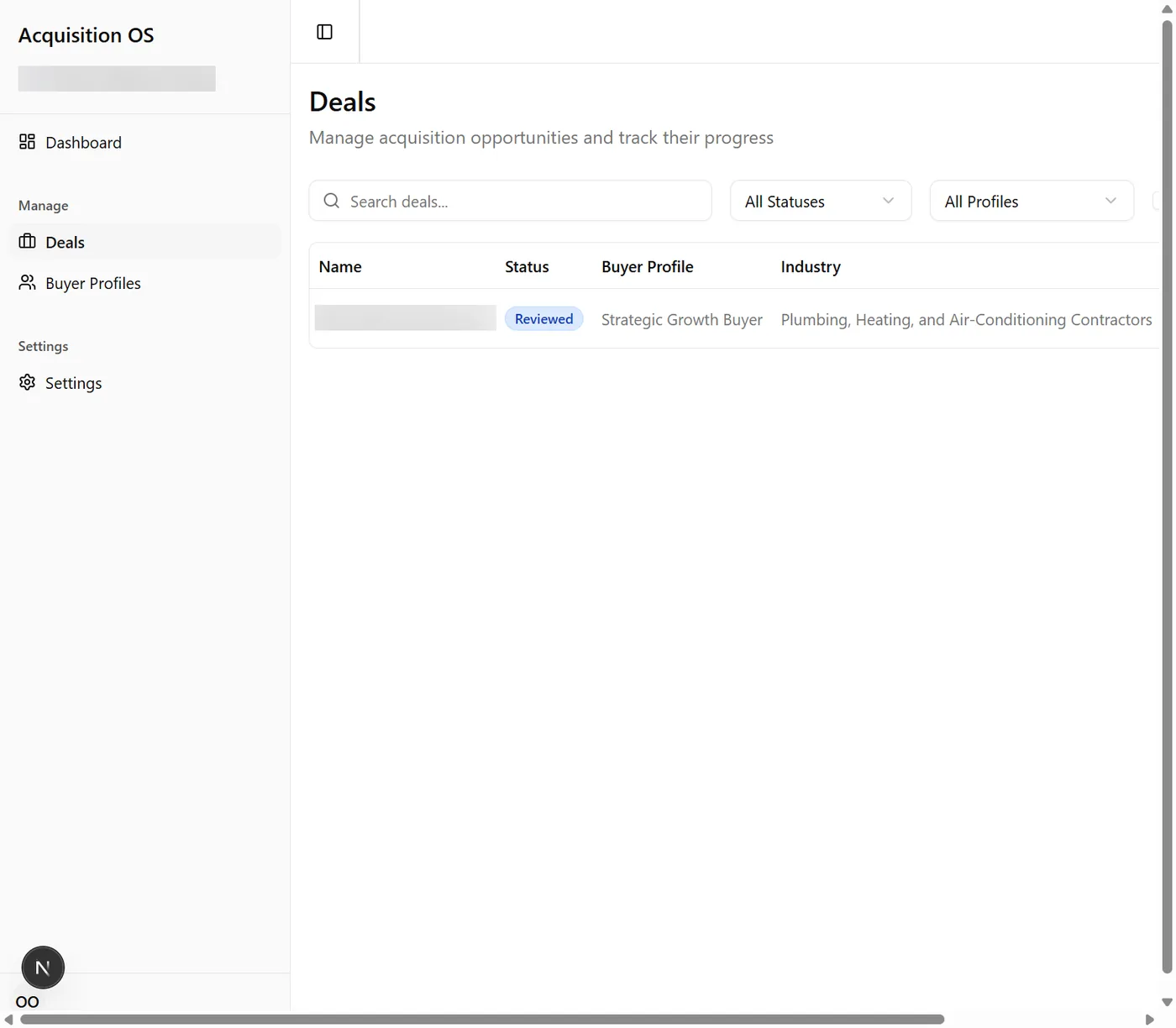
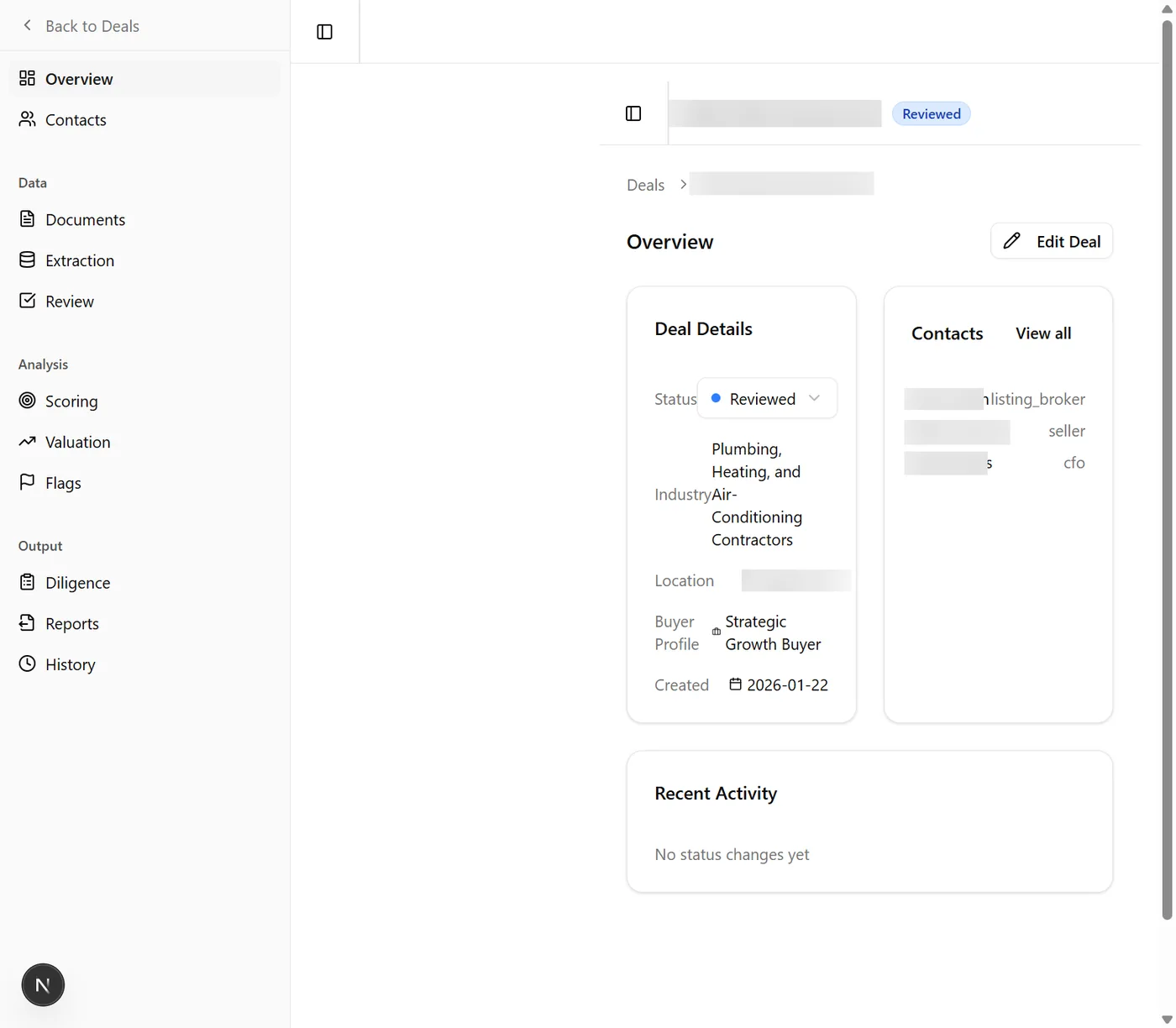
- Deal workspace: Overview, Contacts, Documents, Ingestion Review, Deal Facts, Scoring, Valuation, Flags, Diligence, Reports, History
- Authenticated organization boundaries, append-only decisions, fail-closed prerequisites between stages
Evidence and facts
- PDF and workbook ingestion with standard and enhanced extraction
- 49 application fields: core deal, operational, and detailed diligence
- Split-view review: accept or correct each fact against the cited page; unknowns withheld by default
- Golden-dataset harness that scores value and citation accuracy across six validation packets
Scoring and valuation
- Deterministic fit scoring across financial, operational, and market dimensions with hard gates
- Categorized risk flags with severity and history
- Valuation from accepted facts, cited comparables, and benchmark sets, with sensitivity and headroom
- Saved upside scenarios that freeze lever positions and policy identity
Diligence and reports
- Categorized diligence requests tied to specific evidence gaps, with a controlled email draft that never sends on its own
- Executive snapshot, full assessment, diligence packet, and enhanced addendum as reviewable PDFs
- Governed findings: model-proposed, human-approved, and unable to alter standard scoring
On the roadmap
- In-app deal sourcing board
- Provider-backed extraction to a 90 percent floor across all packets
- External-user release
Why owning it matters
Your criteria, enforced.
A rented deal platform scores against its idea of a good business. This one scores against the buyer's published mandate, and the mandate is a versioned document the firm controls.
Fail-closed by design.
Reports refuse to render on stale or unapproved facts. That is not a setting a vendor might change; it is how the system is built.
The harness stays with the firm.
The golden-dataset harness that measures extraction quality is part of the asset. Every new packet makes the next one more reliable, and that learning does not belong to a provider.
Why the operator built it
Why an operator who evaluates deals built the deal software.
Governance was the requirement, not a feature.
Someone who has been burned by a number copied wrong from a CIM does not want faster extraction; they want extraction that cannot become truth without a human. That design choice runs through all 49 fields, and it came from experience, not from a product manager's roadmap.
721 commits in fourteen days.
The build moved at the speed of describing the next control to AI and watching it run: mandate immutability one morning, fact lineage that afternoon, fail-closed reports the next day. An outside team would still have been writing the specification.
Honest about where it stands.
The workbench ships with its own quality harness and a positioning document that says what is proven and what is not. That candor is only possible when the builder is the user and has nothing to sell but the result.
That is what the Vista AI Cohort teaches: operators building their own software, with a community for the parts that need a second set of eyes.
See it
Real screens from the workbench. Deal names and figures blurred.
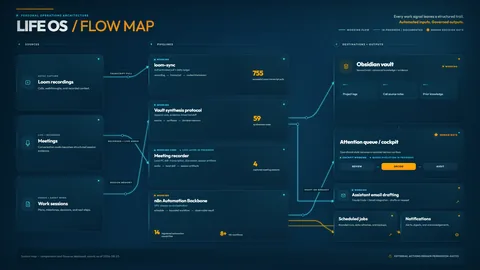 Next project · In productionLife OSThe operator's own operating system: transcripts, a second brain, automations, and assistant-drafted email, all talking to each other.
Build your own advantage.
Get a personal AI trainer and a community for the parts that need a second set of eyes.