
Built by Logan / Case study / Business operating system
Life OS
Every call, recording, session, and scheduled job an operator runs leaves a trail. This is the system that catches it: transcripts pulled automatically, a second brain that remembers across sessions, a command console for what needs attention, and an always-on automation backbone that works while the desktop sleeps.
- EBusiness operating system
- CSoftware you own
- BHard-to-get data, made usable
- Too labor-intensive until AI
- what a dedicated development team would charge to build it: nobody would have scoped it
- $15,000
- what Logan would charge to build it for you
- About$590
- in software and AI usage to build it internally (your team's time excluded)
- 4months
- from the first transcript pipeline to a deployed control plane, built alongside other projects
No team figure: a system this personal was not worth commissioning before AI made the work cheap. Internal figure is reconstructed from usage records. 88 commits across 13 active build days on the control plane alone.
What problem does it solve
Context dies between sessions.
A recorded call is useless until someone transcribes and files it. A decision made in one working session is forgotten by the next. Jobs that should run nightly only run when a laptop is open. The operator becomes the integration layer, and the integration layer gets tired.
What impact does it have
755 transcripts. 14 always-on capabilities. Zero copy-paste.
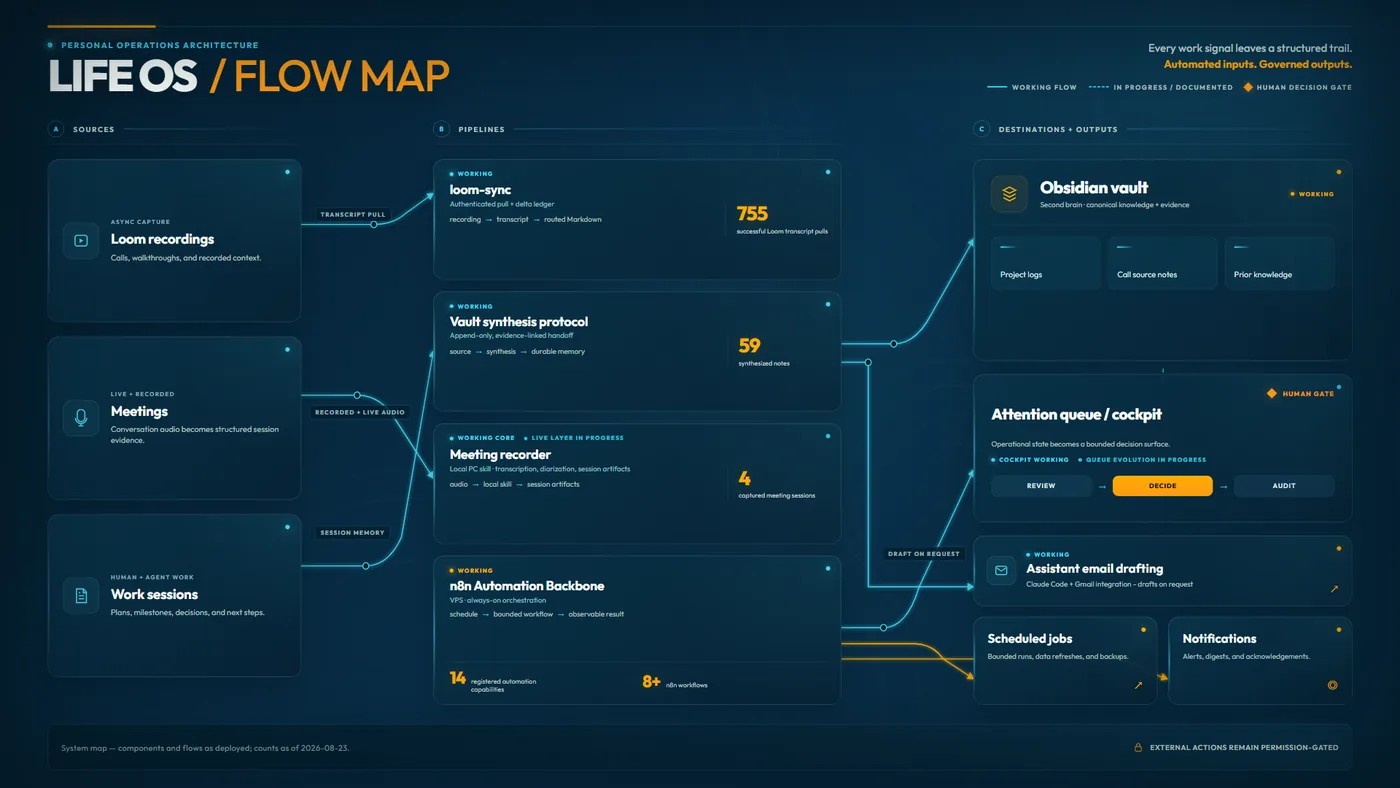
An unofficial Loom pipeline has pulled 755 recording transcripts and routed them by project without a single manual copy, feeding 59 synthesized knowledge notes. A vault protocol turns every meaningful session into an append-only note the next session picks up. A VPS backbone runs fourteen registered capabilities, eight of them live n8n workflows, on schedules that do not care whether the desktop is awake.
What value does it have
Memory and execution, owned.
The knowledge layer, the task truth, the capture bot, and the schedulers are all code and data the operator controls. Nothing depends on a note-taking SaaS deciding to change its export, and every new project inherits the same memory, the same automation host, and the same assistant that can draft an email or route a transcript without being asked twice.
What it does today
A working personal operating layer. Everything below runs on schedule or on demand.
Knowledge memory
- Cross-session vault protocol: plan completions and milestones become timestamped, append-only notes with next steps
- Loom transcript pipeline: authenticated pulls through an undocumented backend, five daily windows, per-project routing, duplicate-safe ledgers
- Transcript-to-note synthesis into a single high-signal vault source note per recording
- Assistant-drafted email through the connected mailbox, from inside the same working sessions
Command and attention
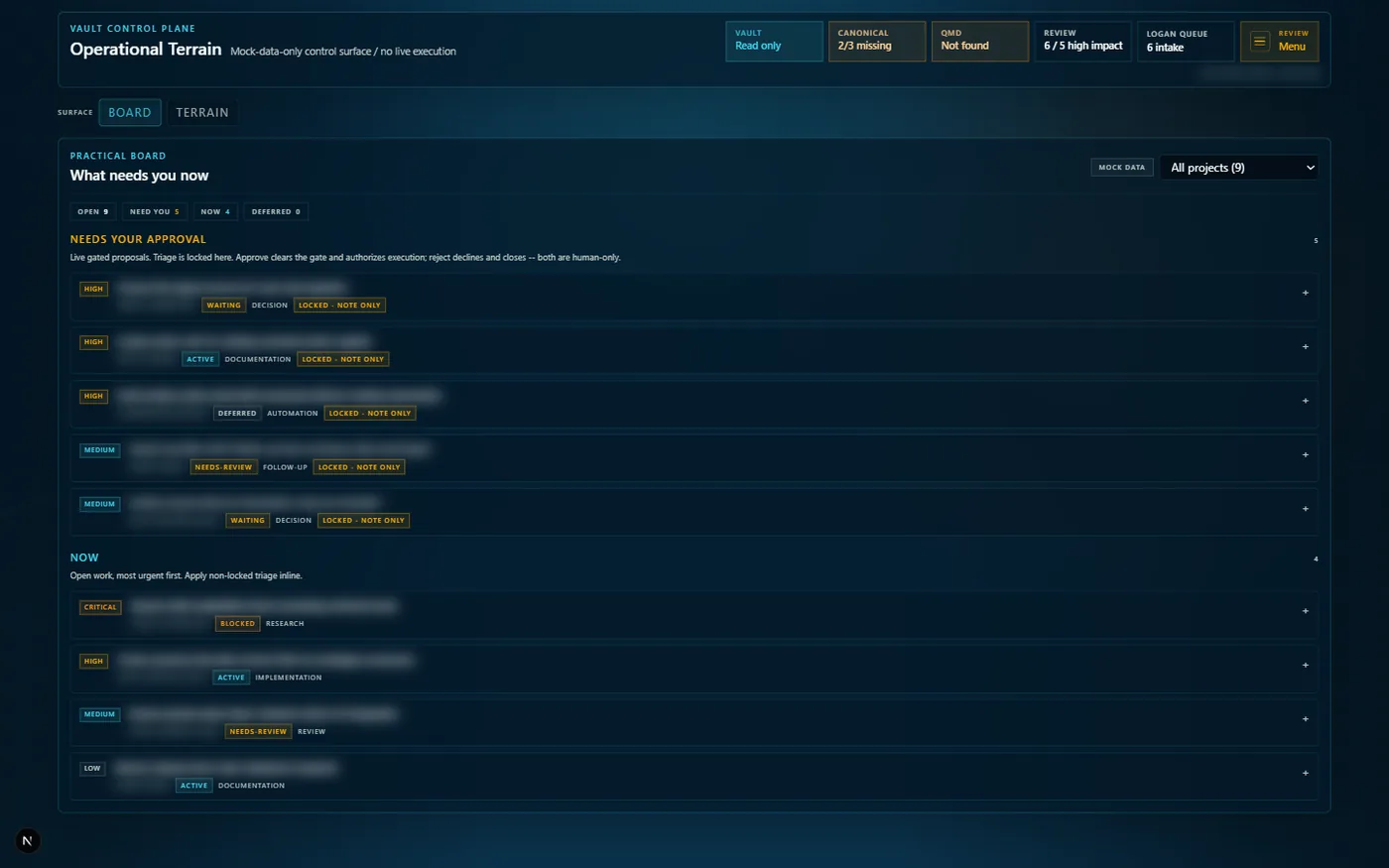
- Vault Control Plane: a deployed cockpit with a prioritized practical board, gated approvals, and project drill-downs
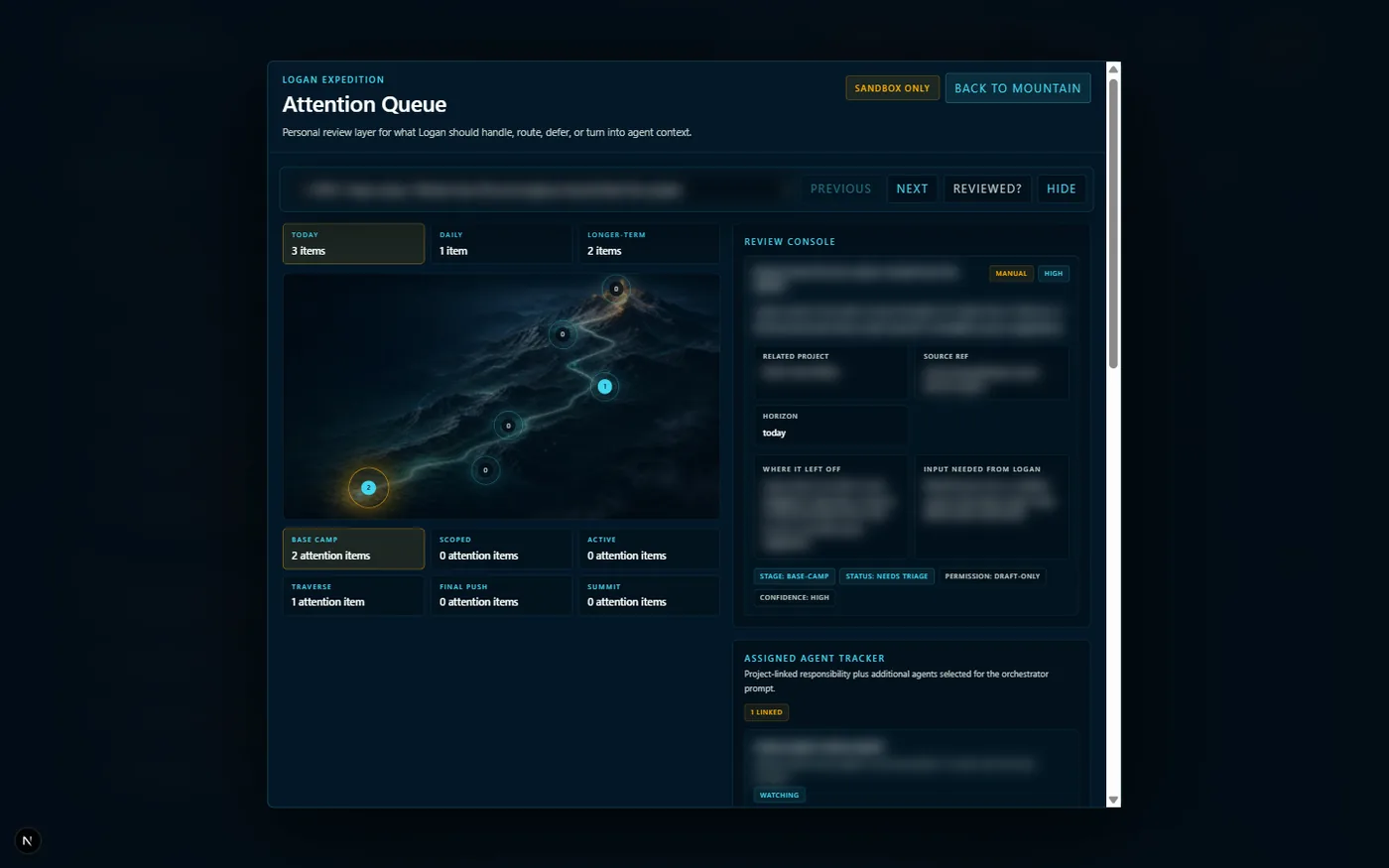
- Attention queue: quick capture, review, horizon and stage changes, audit trail that survives refresh
- Propose-first agent engine: captures from eight project channels, classifies, enriches, prepares review packets; humans authorize
- 151 passing tests behind the console
Always-on automation
- n8n backbone on a hardened VPS behind TLS: schedules, inbox triggers, webhooks
- Fourteen registered capabilities: reply monitor, inventory backups, per-person notifications, opportunity sweeps, feedback webhooks, signal collectors, newsletters, a bid-review bridge
- One capability registry recording owner, trigger, behavior, status, and runbook for every job
- Documented exceptions where cron, a warm browser, or a desktop task beats a workflow
Meetings
- Local GPU post-processing: audio extraction, transcription, diarization, speaker matching, structured meeting folders
- Live always-on-top caption overlay that saves the session when the call ends
- Evaluation-first voice ID that abstains rather than guess
On the roadmap
- Scheduled agent cadence and a locked-action executor
- Meeting context cards during live calls
- Calibrated attention elevation rules
Why owning it matters
No vendor holds the memory.
Transcripts, notes, and task truth live in files and databases the operator controls. Exports never break because there is nothing to export.
The backbone is shared.
Every project on the portfolio gets scheduling, monitoring, and notifications from the same host. A new business does not start from zero on operations.
Agents stay on a leash.
The control plane is the only writer of task state, and agents propose rather than act. Governance is architecture, not a policy document.
Why the operator built it
Why nobody but the operator could have built this.
It had to fit one person's actual day.
Where a transcript should land, what deserves attention today, which job must run at 02:30: these are personal operating decisions. Working them out with AI, session by session, produced a system shaped exactly like the work, which is the one thing a productivity product can never be.
No official API? Build around it.
Loom does not offer transcripts through a public API. Describing the browser session and the backend calls to AI produced a working extractor in a day. A contractor would have quoted the integration as impossible or expensive; the operator just kept describing what the browser did.
Four months, in the gaps.
The transcript pipeline, the vault protocol, the deployed control plane, and the automation host were built in the gaps between client projects. No agency scopes a personal operating system, which is exactly why one had to be built.
That is what the Vista AI Cohort teaches: operators building their own software, with a community for the parts that need a second set of eyes.
See it
The system map and, where safe to show, the console. Task titles, projects, and dates blurred.
 Next project · In productionVista Site and Insights EngineThe site you are reading, its content engine, commerce, and admin console, built and run by one operator.
Build your own advantage.
Get a personal AI trainer and a community for the parts that need a second set of eyes.