
Built by Logan / Case study / Hard-to-get data, made usable
Bank Signal Signal
Every US bank and credit union leaves a public trail when a CEO, CFO, COO, or President seat opens up. The engine reads that trail every morning across eighteen sources, joins it to 8,586 institutions, and hands the operator a ranked list of doors that are open right now.
- BHard-to-get data, made usable
- DBusiness intelligence
- CSoftware you own
- AMaking things people see
- $100k $150kto
- what a dedicated development team would charge to build it
- $25,000
- what Logan would charge to build it for you
- About$110
- in software and AI usage to build it internally (your team's time excluded)
- 7weeks
- from the first research note to a daily production run, built alongside other projects
Team figure is the founder's estimate of what a dedicated team would charge, not a quote. Internal figure is reconstructed from usage records. 7 active build days on the engine itself, 69 commits.
What problem does it solve
The signal is public. Nobody reads all of it.
Regulator actions, corporate filings, structure changes, job boards, search firms, and banking news each carry a piece of a leadership transition. They name the same institution five different ways and none of them talk to each other. By the time a story is obvious, the seat is filled and the window for an interim executive, a placement, or an acquisition conversation has closed.
What impact does it have
One morning queue. 5,702 institutions scored.
Eighteen collectors run daily and resolve every capture to a single institution identity. Evidence clusters into transition windows, gets pressure-scored, and lands on a two-axis outreach board. In the latest snapshot the engine held 403 active windows, had scanned 796 enforcement orders for management-change language, and shortlisted 46 distress targets with 229 ranked potential acquirers.
What value does it have
Earlier than anyone else, at $0 per source.
Every feed is free and public, so the steady-state data cost is nothing. The same evidence core serves three businesses: interim-executive placement, prospect timing for a professional community, and acquisition lead-listing. It is owned software on a plain SQLite ledger, and it explains every score it produces.
What it does today
A working intelligence pipeline, not a slide. Everything below runs on schedule.
Collection and identity
- Eighteen registered collectors across regulators, filings, structure data, job boards, search firms, and banking news
- National roster of 8,586 banks and credit unions as the join key
- Daily run with quarterly financial and weekly leadership-census cadences
- Deduplicated event ledger with provenance on every record
- Offline fixtures for every collector, so nothing depends on a live site to test
Windows and scoring
- Evidence clustered into watching, open, closing, and closed transition windows
- Reproducible pressure and outreach-priority scores, with signal strength kept separate from placement fit
- Daily score history, movement alerts, and a two-axis outreach board
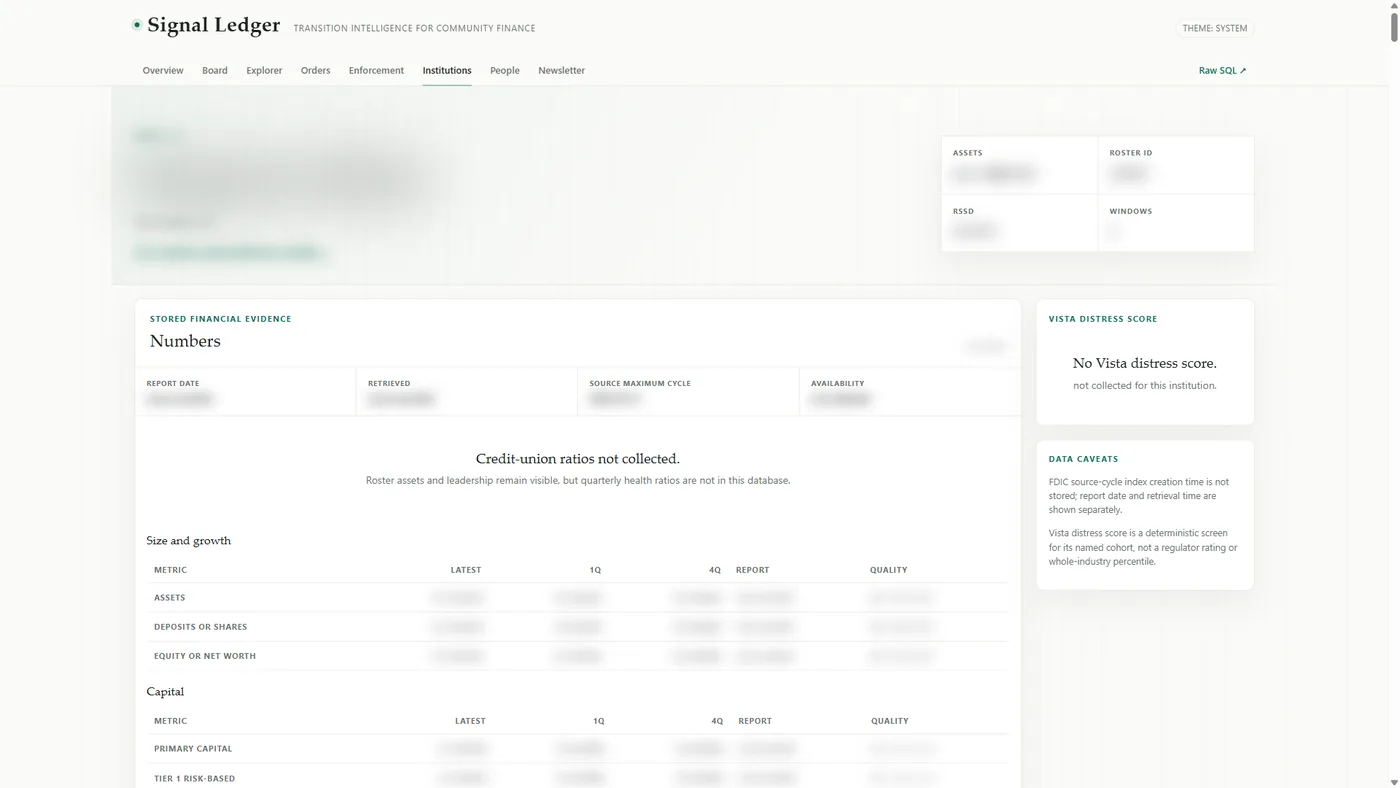
- Institution condition profiles across size, growth, capital, earnings, asset quality, liquidity, and funding
- Acquirer shortlist: up to five ranked candidates per distress target
Documents and people
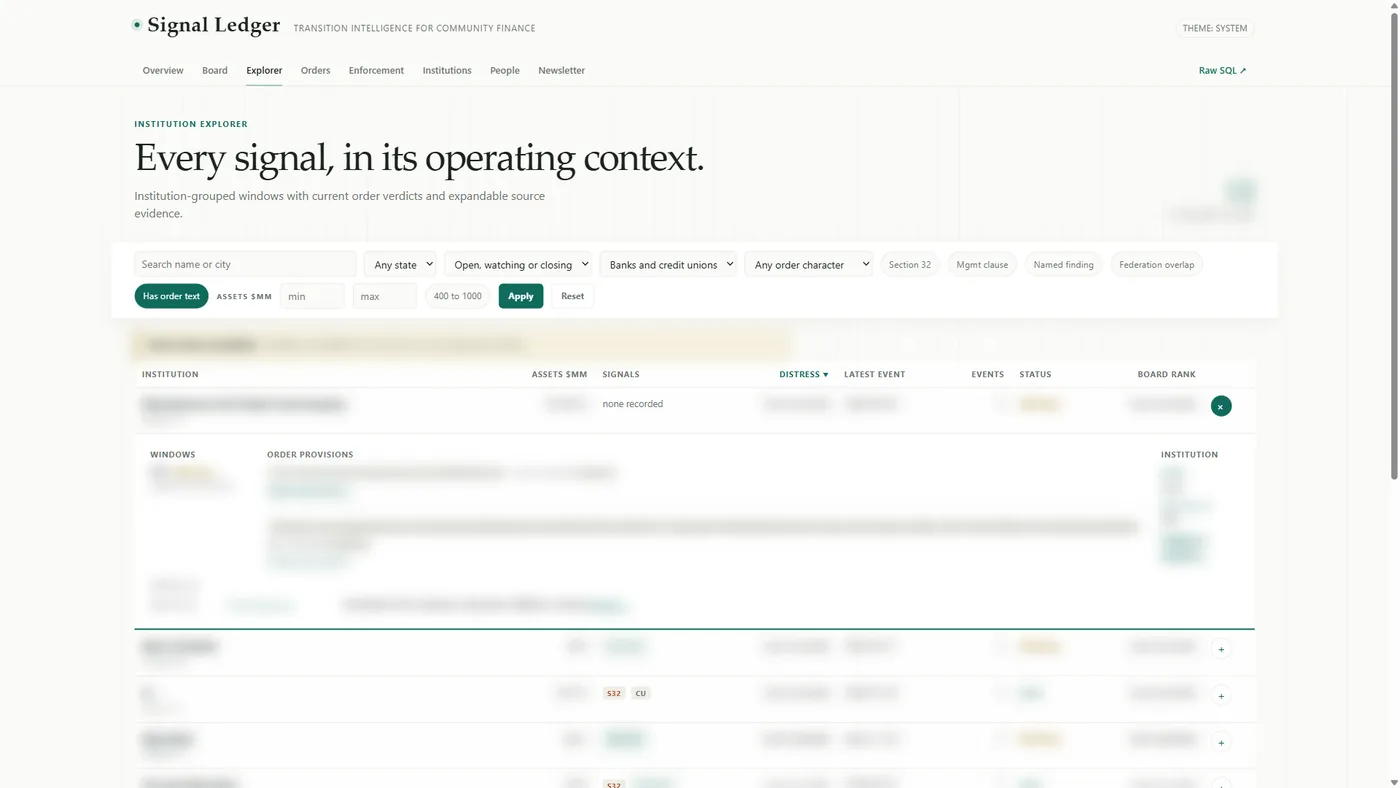
- Enforcement-order scanner that finds Section 32 and management clauses inside the order text
- Named-executive extraction from orders, filings, news, and leadership snapshots
- Person and person-event records with provenance, for interim benches and champion sourcing
- Contact and officer layer keyed to the roster: 9,378 canonical contacts, 81% matched, do-not-contact suppressed by default
Review and delivery
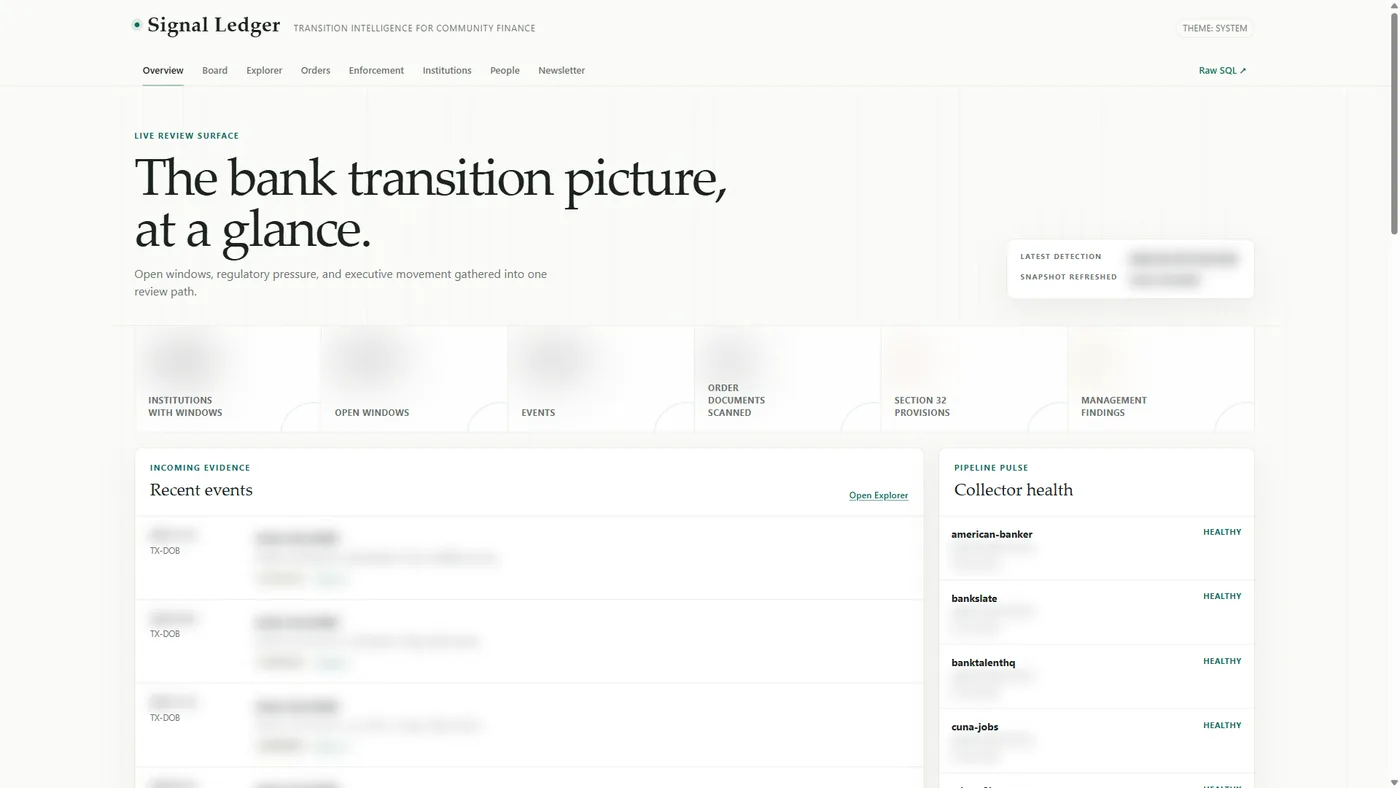
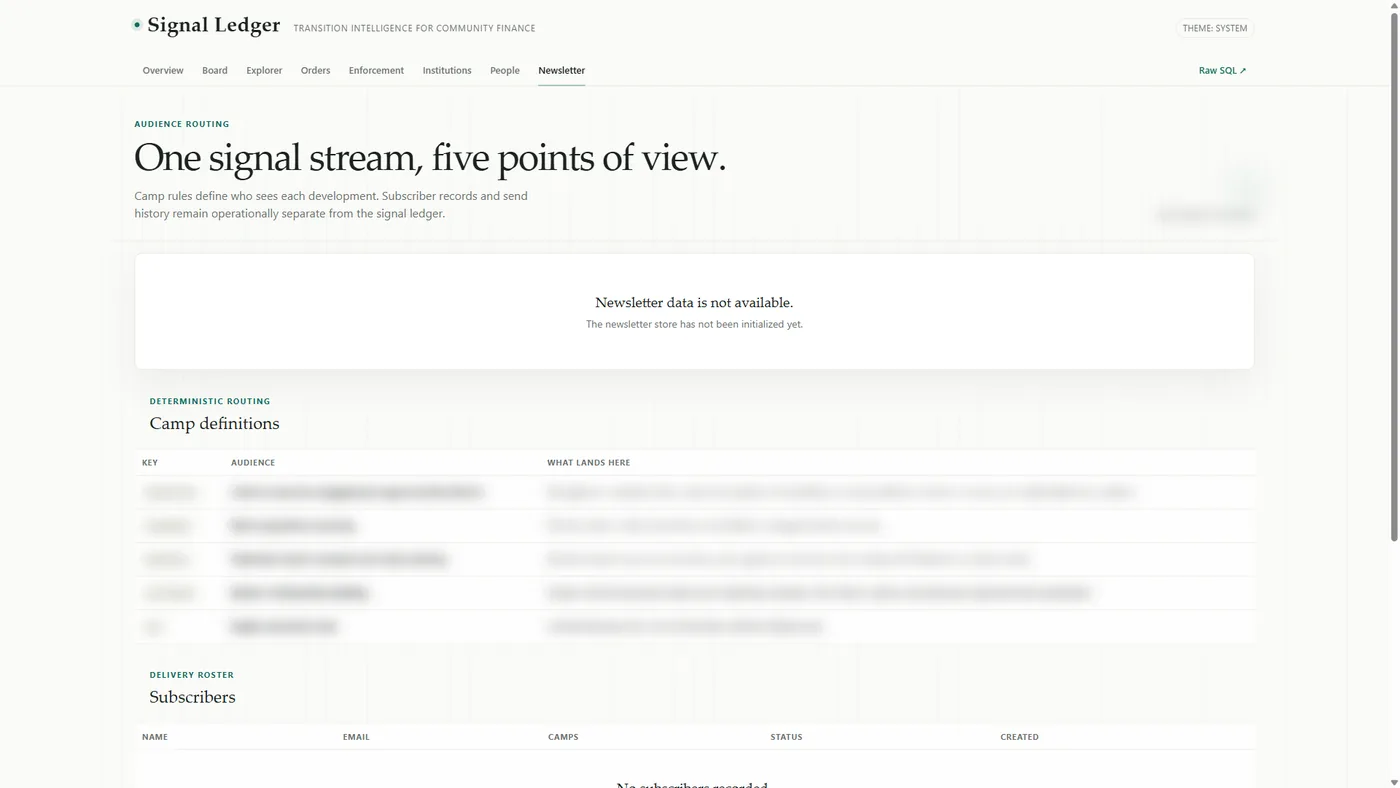
- Browser review app: Overview, Board, Explorer, Orders, Enforcement, Institutions, Dossier, People, Newsletter
- Five audience-specific newsletters from one ledger, plus a daily digest
- Read-only saved queries, CSV export, and a self-contained snapshot for sharing
- Deployed to a server the operator controls
On the roadmap
- Recruiter-partner views on the people asset
- Scoring backtests against filled seats
- State-regulator coverage beyond the first four
Why owning it matters
No vendor between you and the signal.
The data is public and the code is yours. No seat licenses, no per-record pricing, no feed that disappears when a vendor changes plans.
Three businesses, one engine.
Placement, community, and acquisition lanes all read the same ledger. Adding a fourth is a config change, not a new subscription.
It gets smarter every morning.
Every daily run adds evidence, tightens identities, and extends the score history. A rented tool starts from zero for everyone; this one only starts from zero once.
Why the operator built it
Why this had to be built by someone who would use it.
Knowing which signal is a real opening.
An enforcement order with a Section 32 clause, an 8-K departure, a search-firm listing: an operator who places executives reads those as three different kinds of urgency. A data vendor reads them as three rows. The scoring is built on years of knowing which doors actually open, and that knowledge was never going to survive a requirements document.
Eighteen sources, none of them cooperative.
Every regulator and publisher names institutions differently and changes its format without notice. A hired team would have quoted each connector as a work package and each break as a ticket. Here, a collector that broke on Tuesday was fixed by talking through the new page on Tuesday.
Seven weeks from question to morning queue.
The first research note asked whether public records could reveal an open seat before the search closed. Seven weeks later, alongside other projects, the engine was scoring 5,702 institutions every morning. The build days on the engine itself numbered seven.
That is what the Vista AI Cohort teaches: operators building their own software, with a community for the parts that need a second set of eyes.
See it
Real screens from the review app, captured against a live ledger. Institutions, people, and scores blurred.
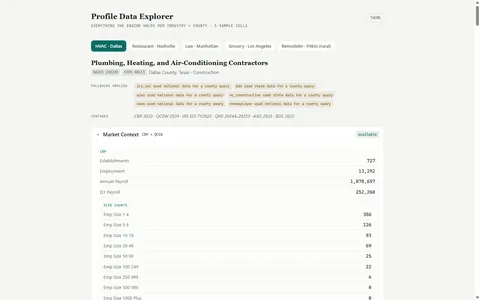 Next project · BuiltIndustry Benchmarking Engine288,092 industry-by-county profiles built from 13.7 million federal records, so any business can see what normal looks like next door.
Build your own advantage.
Get a personal AI trainer and a community for the parts that need a second set of eyes.